
Most nonprofit leaders know the moment.
A funder asks, “How are things going?”
And you pause. Not because you do not know. You know exactly how things are going. Cash flow is tight. Staff are stretched. The program is holding together with duct tape and loyalty. The board wants growth, but fundraising is unpredictable. Another grant report is due, and your team is already working nights.
Still, you give the safe answer. The polished answer. The half-true answer.
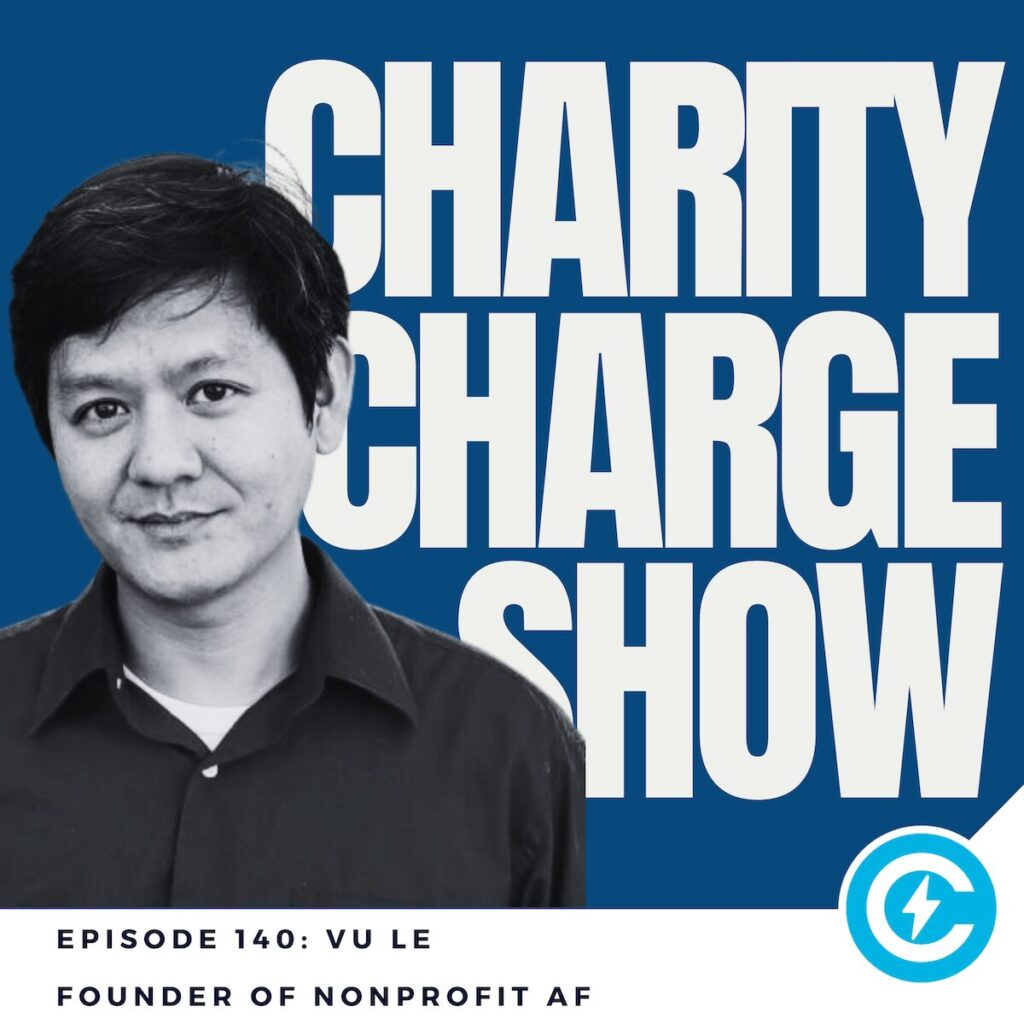
In this episode of the Charity Charge Show, Stephen Garten sits down with Vu Le, founder of Nonprofit AF, to talk about the uncomfortable reality behind that pause. Vu says what many leaders think but rarely say out loud: nonprofits lie to funders a lot, or at least we get trained to speak in half-truths because we are afraid funding will disappear if we are fully honest.
This conversation goes past venting. Vu lays out why this dynamic persists, how funder behavior shapes nonprofit operations, and what has a real chance of changing the system: clearer communication, collective action, multi-year funding, and general operating support.
Overview
Meet Vu Le, and how Nonprofit AF started
Vu’s path into the sector started with a pivot. He was pre-med at Washington University in St. Louis, then realized he wanted community-focused work and earned a degree in social work. He joined AmeriCorps, worked at an organization supporting refugees and immigrants, and eventually became an executive director.
Nonprofit AF began in a way that will feel familiar to many nonprofit leaders. A funder asked Vu to write a blog post. Because of the power dynamics in philanthropy, it is hard to say no to someone funding your work. Vu agreed, and asked if he could make it funny. The result was a blunt, humorous post about nonprofit scarcity thinking, including the habit of hoarding donated stuff because “you never know when you will need it.”
That voice resonated. Vu committed to publishing consistently, one post every Monday. Over time, the audience grew because the writing was steady and because it refused to be boring.
Nonprofit AF has now been around far longer than most people realize. The brand name changed along the way, but the through-line stayed consistent: honest commentary about how the sector actually functions, not how it is supposed to function.
What has not changed in 16 years
Vu offers a clear view: nonprofits remain vital, but the sector still struggles with the same structural funding problems.
He compares nonprofits to air. Food is visible, easy to appreciate, easy to talk about. Air is essential, but invisible, and people only notice it when it is gone. Nonprofits are like that. Communities rely on them, but funding systems often treat them as optional and disposable.
Meanwhile, the familiar problems keep repeating:
- Chronic funding instability
- A competitive “Hunger Games” dynamic for resources
- Funder restrictions that treat overhead as suspect
- Grantmaking processes that consume massive time for minimal dollars
Vu uses a simple example. Funders want to pay for “direct work” but not the “infrastructure” that makes direct work possible. He compares it to funding the water to fight a fire, but refusing to fund the hose.
If that sounds ridiculous, it is. But it is also common.
The half-truth problem, and why it keeps happening
Vu names the core issue plainly: nonprofits often do not tell funders the full truth about how hard things are.
That is not because nonprofit leaders are dishonest by nature. It is because many have been trained to believe honesty is risky.
When funders are risk-averse, transparency feels dangerous. A nonprofit that admits struggle can be labeled “unstable.” A nonprofit that shares uncertainty can be judged “not ready.” A nonprofit that shows real operational strain can lose future support.
So leaders learn to report success, frame setbacks as controlled, and talk about “challenges” in a way that feels tidy and resolved.
The cost is real. Over time, this performance becomes normal. Funders hear the same curated story from everyone, then assume everything is fine. Or they assume problems are minor. Or they assume a small grant should produce massive change.
Which leads to a broken cycle: funders underfund, nonprofits mask reality, and communities pay the price.
What nonprofits can do, without pretending it is easy
Vu does not pretend there is a simple fix. He lays out a few approaches that actually matter.
1) Give funders direct feedback
If a funder asks how things are going, answer honestly. Not with drama, and not with shame. With reality.
If the grant requirements are consuming too much time, say it. If restricted dollars are forcing layoffs, say it. If you need operating support to keep the lights on, say it.
Some funders will react badly. That is true. But continuing to protect fragile funder expectations guarantees the system will not change.
2) Organize, because individual nonprofits have limited leverage
This is one of the most practical points from the episode: individual nonprofits are easy to ignore. Groups are harder to ignore.
Vu references an example where 180 executive directors wrote an open letter pushing funders toward:
- More money
- Multi-year commitments
- General operating support
- A public pledge funders could sign
That matters because it changes the power dynamic. It becomes less about one nonprofit “complaining” and more about sector-wide reality.
3) Use “naming and shaming” when funders waste nonprofit capacity
Vu also talks about a more confrontational tactic: calling out funders when their processes waste nonprofit time.
He shares a story about a funder proud of receiving thousands of applications, then awarding only a handful of tiny grants. Even if each application takes only a few hours, the cumulative time wasted across the sector is enormous.
Nonprofits do not have spare capacity. Time is money. A grant that costs 20 hours to chase and yields $500 is not support, it is extraction.
Vu’s point is blunt: if philanthropy wants to claim it supports communities, it has to stop burning the very capacity nonprofits need to do the work.
The practical reforms that matter most
A lot of nonprofit funding talk stays vague. Vu is not vague. He points to two changes that make the biggest difference.
Multi-year funding
One-year grants force constant scrambling. They encourage short-term thinking and endless re-application cycles. Multi-year commitments allow planning, staffing stability, and program continuity.
General operating support
Restricted dollars are one of the biggest drivers of dysfunction. When a funder dictates what “counts” as impact, nonprofits end up shaping work around what is fundable, not what is needed.
General operating support treats nonprofits like real organizations, not project vendors. It funds the leadership, the systems, the payroll, the compliance, the technology, and yes, the “overhead” that actually makes impact possible.
If you want results, you fund operations.
A hard truth about “other people’s money”
Vu challenges a mindset that runs deep in fundraising culture: the idea that nonprofits should feel grateful because it is “someone else’s money.”
He argues that much wealth, at least in the United States, has often been accumulated through inequitable systems. When donors and institutions benefit from tax avoidance or extractive practices, it is fair to question the moral framing of philanthropy.
You do not have to agree with every edge of this argument to understand the practical point.
If nonprofit leaders operate as if funders are saviors and nonprofits are beggars, the power imbalance becomes permanent.
Vu pushes for a different posture: partnership, not worship. Gratitude can be human, but it should not be a strategy that trains funders to expect praise instead of accountability.
Why “individual donors are the majority” can be misleading
Stephen raises a common statistic: a large share of charitable giving comes from individuals.
Vu adds nuance that leaders should not ignore. For many organizations led by marginalized communities, individual donor wealth may not be as available. Wealth disparities affect who can give, which causes get funded, and which leaders get access to donor networks.
So when someone says, “Just focus on individual donors,” it can become an unfair criticism of organizations that are already operating in an uneven landscape.
This does not mean individual giving is irrelevant. It means leaders and funders should be honest about how wealth and demographics shape donor behavior, and stop pretending the playing field is level.
Boards, and why so many of them hold organizations back
One of the most valuable parts of the episode is the board conversation.
Vu offers a simple “rule of thirds”:
- One-third of boards are effective
- One-third are useless
- One-third are actively destructive
That lines up with what many executive directors quietly experience.
He points to structural problems:
- Boards often prioritize wealth and fundraising access, which skews membership toward richer, often whiter networks
- The people with the least day-to-day understanding of the work can hold the most power
- Boards usually control hiring and firing of executive leadership, even though staff experience the consequences daily
Vu challenges a few “sacred cows,” including the idea that board members should never be paid. Corporations pay board members routinely. Nonprofits act like it is immoral. Vu cites an arts organization example that paid board members so working artists could participate without sacrificing income.
The broader point is not “pay every board.” The point is: if your governance model prevents lived-experience leaders from participating, you should rethink it.
The nonprofit Hunger Games, and what collaboration can look like
The episode returns to a theme that nonprofit leaders feel every day: competition.
Vu describes how funder structures encourage nonprofits to compete instead of collaborate. Competitive grants, scarcity framing, and performance expectations create a survival mindset.
But he also shares examples of nonprofits behaving differently, including organizations declining funding so it could go to peers in greater need, or using a major giving day to point donors toward partner organizations.
These are small examples, but they matter. They show what it looks like to act like a sector, not a set of isolated vendors.
What to do next, if you are a nonprofit leader
Here is the straightforward takeaway. If you want to change funding dynamics, you have to stop treating them as unchangeable.
Start with what you can control:
- Tell one funder the truth this quarter. Not a rant. A clear, respectful reality check.
- Ask for multi-year, general operating support. Ask plainly. Stop assuming it is “too much.”
- Join or form a coalition. Letters, shared standards, shared asks, shared accountability.
- Audit your board expectations. Are you selecting for mission alignment and competency, or for wealth and social comfort?
- Stop chasing “crappy” grants. If the time cost exceeds the benefit, walk away, and tell the funder why.
What funders should take from this episode
If you are a funder reading this, here is the truth: nonprofits are managing around your incentives.
If you punish honesty, you will never hear honest information. If you underfund operations, you will get fragile programs. If you demand polished narratives, you will receive polished narratives, not reality.
Want to help? Then fund the things that make impact possible:
- multi-year commitments
- general operating support
- simpler applications and reporting
- faster decision timelines
- trust-based relationships
And if you want accountability, ask for outcomes that actually match the size of the grant.
Podcast Q&A TRanscript
How did you get started in the nonprofit sector?
I started out pre-med at Washington University in St. Louis. I realized fairly quickly that I did not want to be a doctor and wanted to do something more community-focused. I earned a degree in social work, joined AmeriCorps, and worked at an organization supporting refugees and immigrants. A few years in, I became the executive director, which really set my path in the nonprofit sector.
What led you to start Nonprofit AF?
A funder asked me to write a blog post for their website. Because of power dynamics, it is hard to say no to a funder. I agreed and asked if I could make it light and funny. I wrote about nonprofit scarcity mindset, including how we hoard donated items because we never know when we will need them. People connected with the honesty and humor, and I committed to writing consistently. That consistency is what made it grow.
What has changed, and what has not changed, over the years?
What has not changed is how essential nonprofits are to communities. The sector is still vital, but largely invisible. What also has not changed are funding challenges. We still deal with unstable funding, restrictive grants, obsession with overhead, and competitive processes that waste time. The structures have barely evolved, even though the need has grown.
Why do nonprofits feel pressure to tell funders half-truths?
Because funders are often risk-averse. When a funder asks how things are going, nonprofits are terrified to say things are bad. We are afraid honesty will lead to funding being pulled. Over time, we get trained to sound fine even when things are not fine. That becomes normal behavior, even though it hurts the sector.
How does funder risk aversion affect nonprofit operations?
It pushes nonprofits to perform stability instead of addressing reality. Leaders spend time managing perceptions instead of solving problems. It also leads funders to expect outsized impact from very small grants because they never hear how fragile the system actually is.
What role does collective action play in changing funder behavior?
Collective action is critical. Individual nonprofits have very little leverage. When groups organize, funders have to listen. For example, 180 executive directors came together to write an open letter asking for more money, multi-year funding, general operating support, and a pledge funders could sign. That kind of organizing is far more effective than going it alone.
What are “crappy funding practices” and why call them out?
Crappy funding practices are processes that waste nonprofit time and capacity. An example is a funder bragging about thousands of applicants while awarding a handful of tiny grants. Even if each application takes only a few hours, the collective time lost is enormous. Naming these practices publicly helps shift norms and accountability.
Why is multi-year funding so important?
One-year grants force nonprofits into constant survival mode. Leaders are always reapplying instead of planning. Multi-year funding allows organizations to hire responsibly, plan programs, and focus on outcomes instead of short-term fundraising cycles.
Why does general operating support matter more than restricted funding?
Restricted funding forces nonprofits to shape their work around what is fundable instead of what is needed. General operating support funds the reality of running an organization, including staff, systems, compliance, and leadership. Without that, impact is fragile and often unsustainable.
Why do you challenge the idea that nonprofits should feel grateful for “other people’s money”?
Because much wealth has been accumulated through inequitable systems. When nonprofits internalize the idea that they should feel lucky for any funding, they become deferential and hesitant. That reinforces power imbalances. Funders and nonprofits should be partners, not saviors and supplicants.
How should nonprofits think differently about asking for money?
Nonprofits should ask for what the work actually costs. Funders expect large impact from small grants, which is unrealistic. I often compare this to venture capitalists funding a Wi-Fi connected juicing machine with over $100 million, yet nonprofits are expected to change communities with $5,000. Add a zero or two to your ask. The work is more important than many things that get funded easily.
What is your perspective on nonprofit boards?
Boards are extremely influential, and many are ineffective. Roughly one-third are helpful, one-third are useless, and one-third are actively harmful. The structure often gives the most power to people with the least lived experience of the work. That creates tension, burnout, and leadership turnover.
Why do boards often create problems instead of solving them?
Many boards prioritize wealth, fundraising access, and social status over mission alignment and lived experience. This leads to poor decision-making and weak accountability. Boards also often control hiring executive leadership without meaningful staff input, even though staff are most affected by that decision.
Should nonprofits rethink traditional board models?
Yes. There are many sacred cows that need examination, including the idea that board members should never be paid. Corporations pay board members routinely. Some nonprofits have paid board members to enable participation from people who otherwise could not afford the time. Governance models should serve the mission, not tradition.
Why do nonprofits struggle to collaborate instead of compete?
Funding structures encourage competition. Grants are framed as scarce and competitive, which pushes nonprofits into survival mode. This creates a Hunger Games dynamic where organizations protect turf instead of working together.
Have you seen examples of nonprofits doing collaboration well?
Yes. Some nonprofits have declined funding so it could go to organizations in greater need. Others have used major giving days to direct donors to partner organizations. These actions are rare, but they show what sector-level thinking can look like when scarcity thinking is challenged.
What should nonprofit leaders do differently right now?
Be more honest with funders. Ask for multi-year, general operating support. Organize with peers instead of acting alone. Stop chasing grants that cost more in time than they provide in value. And rethink governance structures that hold organizations back.
What is the biggest mindset shift the sector needs?
We need to restore imagination. Too many nonprofits believe the best we can do is make the world slightly less bad. We should be unapologetic about building a just society and demand the resources required to do it. Without that shift, we will keep managing symptoms instead of solving problems.