The legal distinction between 501(c)(3) and 501(c)(4) status gets explained constantly. The financial implications almost never do.
Most guides stop at “501(c)(3) donations are deductible; 501(c)(4) donations are not.” That’s true, but it’s only the beginning. The two designations create cascading differences in grant eligibility, expense tracking obligations, Form 990 reporting, accounting system setup, and how your finance team handles a combined structure if you operate both entities.
Quick Summary
- Donations to 501(c)(3) organizations are tax-deductible for donors. Donations to 501(c)(4) organizations are not.
- 501(c)(3) organizations are eligible for foundation grants and most government grants. 501(c)(4) organizations are largely excluded from foundation grant programs.
- Both designations require Form 990 filing, but the schedules differ and disclosure obligations diverge significantly.
- 501(c)(4) organizations that engage in political activity face potential excise taxes under IRC Section 527(f) and must track and allocate those expenses separately.
- If you operate both a 501(c)(3) and a 501(c)(4), the IRS requires two separate sets of books and two distinct legal entities.
The Core Financial Difference: Donor Tax Deductibility
Contributions to a 501(c)(3) organization are deductible from federal taxable income under IRC Section 170. A donor who gives $10,000 to your organization can reduce their taxable income by $10,000, subject to adjusted gross income limits.
Contributions to a 501(c)(4) organization are not deductible. The donor gives the same $10,000, receives no federal income tax benefit, and your organization gets a check with no deductibility to offer in return.
This matters financially for several reasons beyond the obvious optics.
Fundraising economics. Many donors, particularly high-net-worth individuals and family foundations, make tax-deductibility a precondition for giving. If your organization is a 501(c)(4), you’re competing for a smaller pool of motivated donors.
Planned giving. Charitable bequests, donor-advised fund (DAF) grants, and charitable remainder trusts all require 501(c)(3) status on the receiving end. A 501(c)(4) cannot accept DAF distributions. Given that DAF grantmaking has grown significantly in recent years, this is a material constraint.
Corporate giving programs. Most corporate matching gift programs and corporate foundation grantmaking is restricted to 501(c)(3) organizations. If your organization is a 501(c)(4), your staff and board members’ employers likely cannot match their donations.
Grant Eligibility: A Structural Divide
501(c)(3) organizations are eligible for private foundation grants, government grants at the federal, state, and local level, corporate foundation grants, and United Way affiliates and community foundation grantmaking programs.
501(c)(4) organizations face a much narrower grant landscape. The IRS requires private foundations to exercise “expenditure responsibility” when granting to 501(c)(4) organizations, which creates significant administrative burden and legal exposure for the foundation. In practice, most foundation program officers decline to make those grants rather than take on the compliance overhead.
Government grant eligibility for 501(c)(4) organizations varies by program. Federal grants administered under OMB’s Uniform Guidance (2 CFR Part 200) don’t automatically exclude 501(c)(4) organizations, but agency-specific eligibility rules frequently do. Many SAMHSA, HUD, and HHS grant programs limit eligibility to 501(c)(3) public charities.
The practical effect: if grant revenue is a significant part of your funding model, 501(c)(4) status substantially shrinks your addressable funding base.
How the Two Structures Compare
| Category | 501(c)(3) | 501(c)(4) |
|---|---|---|
| Donor tax deductibility | Yes (IRC Section 170) | No |
| DAF grant eligibility | Yes | No |
| Private foundation grants | Yes | Requires expenditure responsibility; rarely funded in practice |
| Federal/state government grants | Yes (most programs) | Limited; agency-specific rules apply |
| Corporate matching programs | Yes | No (most programs) |
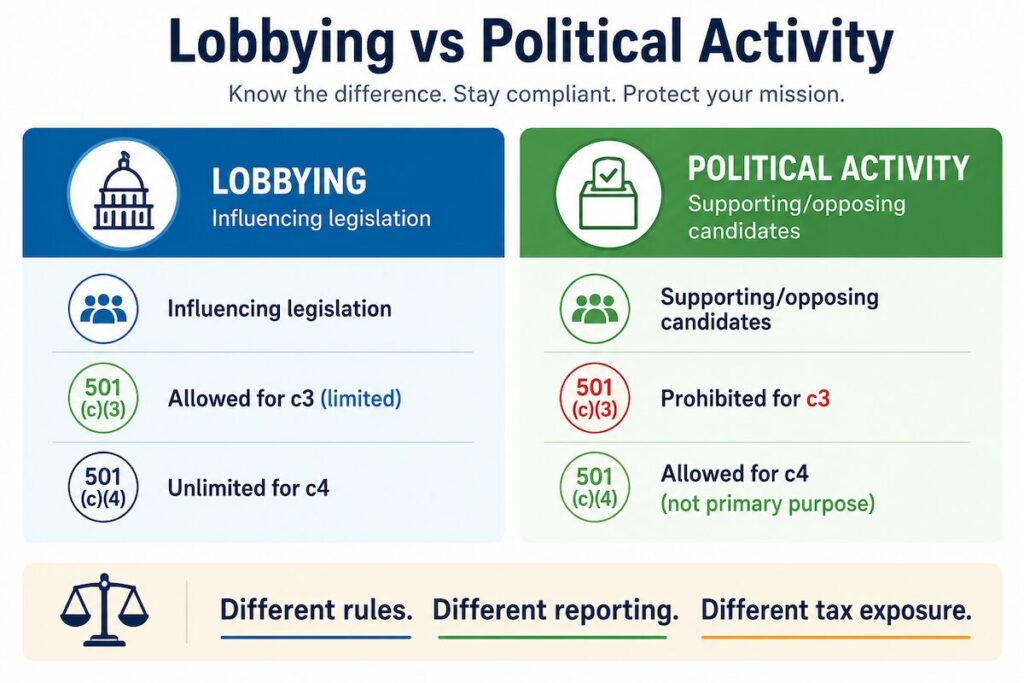
| Lobbying activity | Limited (501(h) election or substantial part test) | Unlimited (in furtherance of social welfare mission) |
| Political campaign activity | Prohibited | Permitted; cannot be primary purpose; excise tax may apply |
| Form 990 filing | Yes | Yes |
| Schedule B public disclosure | Yes (donor names redacted) | Not required publicly |
| FASB ASC 958 applies | Yes | Yes (restricted contributions less common) |
Expense Classification: Where the Accounting Gets Complicated
This is the area most guides skip, and it’s where finance teams run into real problems.
For 501(c)(3) organizations, expense classification follows the standard FASB ASC 958 framework: expenses are classified by function (program, management and general, fundraising) and by nature (salaries, occupancy, printing, etc.). The Statement of Functional Expenses reports this two-dimensional matrix. The IRS expects it on Form 990 Part IX.
For 501(c)(4) organizations, you follow the same functional classification structure, with one additional complexity: political activity expenses.
501(c)(4) organizations can engage in political campaign activity, but that activity can’t be their primary function. Expenses directly attributable to political campaign intervention are subject to excise tax under IRC Section 527(f). Your accounting system needs to track political activity expenses separately from social welfare program expenses.
The IRS has never issued clear regulations on how to measure “primary” activity or how to allocate shared costs between political and non-political purposes. Until clearer guidance is issued, best practice for 501(c)(4) organizations is to:
- Maintain a separate general ledger account or cost center for political campaign activity expenses
- Document the methodology used to allocate shared staff time and overhead between political and non-political purposes
- Consult with legal counsel before any significant political expenditure cycle
Lobbying expenses are handled differently. For 501(c)(3) organizations, lobbying is subject to dollar limits under either the substantial part test or the 501(h) expenditure test. Lobbying expenses must be tracked and reported on Form 990 Schedule C. For 501(c)(4) organizations, lobbying in furtherance of the social welfare mission is unlimited. Schedule C still applies and must be completed accurately.
Form 990 Filing: What’s Different
Both 501(c)(3) and 501(c)(4) organizations file Form 990 (or 990-EZ or 990-N depending on revenue size). The core financial schedules are the same. The differences are in the supplemental schedules.
Schedule B (Schedule of Contributors): Both types must file Schedule B if contributions exceed thresholds. However, 501(c)(3) public charities must make Schedule B available for public inspection with donor names redacted. 501(c)(4) organizations are not required to disclose Schedule B to the public, though the IRS retains the information. This confidentiality is why some donors prefer giving to 501(c)(4) organizations.
Schedule C (Political Campaign and Lobbying Activities): This schedule is most relevant for 501(c)(4) organizations that engage in lobbying or political activity. Finance teams must accurately report direct lobbying expenditures, grassroots lobbying expenditures, and any IRC Section 527(f) excise tax liability. Getting Schedule C wrong creates audit exposure.
Accounting System Setup: What Changes Based on Tax Status
If you’re setting up accounting for a 501(c)(3), the fundamental architecture is: a chart of accounts organized by natural expense class, classes or departments representing programs and cost centers, restricted fund tracking per FASB ASC 958, and grant-specific reporting tied to award numbers and periods of performance.
If you’re setting up accounting for a 501(c)(4), the core structure is similar, with two additional requirements.
Political activity segregation. Your chart of accounts needs a clear separation between social welfare program costs and political campaign activity costs. This isn’t optional if you engage in any political campaign activity.
Simplified net asset structure. FASB ASC 958 applies to 501(c)(4) organizations, but since 501(c)(4)s rarely receive restricted contributions, the restricted net asset tracking infrastructure is less central. Your accounting software setup will reflect this simpler structure.
QuickBooks can handle either structure. For 501(c)(3)s, you use Classes to simulate fund accounting and track restricted grants. For 501(c)(4)s, the setup is simpler, but you should still create a dedicated class or account for political activity expenses. Neither version of QuickBooks has a native 501(c)(4) template.
Sage Intacct handles both structures natively through its dimensional accounting framework. For a 501(c)(4) with multiple programs or advocacy campaigns, Sage Intacct’s fund and grant dimensions provide cleaner segregation than QuickBooks workarounds.
Operating Both a 501(c)(3) and a 501(c)(4): The Dual Structure
Many advocacy organizations maintain both a 501(c)(3) public charity and a 501(c)(4) social welfare organization. This is a recognized and legal structure, commonly called an affiliated dual structure.
The IRS requires the following:
- Two separate legal entities. You can’t operate as a single organization. Each entity needs its own EIN, articles of incorporation, and bylaws.
- Two separate boards of directors. The same individuals can serve on both boards, but meetings must be distinct and board decisions must be made separately for each entity.
- Two separate sets of books. Commingling accounting records is a compliance failure. Each entity files its own Form 990, maintains its own financial statements, and has its own bank accounts.
- Documented cost-sharing agreements. If staff or overhead is shared between the two entities, a written cost-sharing agreement must be in place and must be reflected in the books of both. Without it, the IRS can treat the shared costs as improper transfers between organizations.
Finance directors who manage both entities spend a significant portion of their time on cost allocation, interorganizational billing, and separate-entity reconciliation. This isn’t a structure to enter casually.
Manage nonprofit card spend with audit-ready expense coding
Charity Charge helps nonprofit finance teams track spend by program, cost center, and grant. Built exclusively for 501(c)(3) organizations. See how Charity Charge works
Frequently Asked Questions
Yes. 501(c)(4) organizations can accept contributions, but those contributions are not tax-deductible for the donor. Donors can still give; they just receive no federal income tax benefit. This limits the size and source of contributions compared to 501(c)(3) organizations.
Private foundations can make grants to 501(c)(4) organizations, but doing so requires “expenditure responsibility” under IRC Section 4945: a compliance process that includes written agreements, regular reporting, and documentation that funds were used for appropriate purposes. Most foundation program officers and legal counsel advise against this additional burden, so 501(c)(4) organizations are effectively excluded from most foundation grantmaking.
501(c)(4) organizations are exempt from federal income tax on income related to their social welfare mission. Income from unrelated business activities is subject to Unrelated Business Income Tax (UBIT) at standard corporate rates, just as it is for 501(c)(3) organizations. Political campaign expenditures may also trigger excise tax under IRC Section 527(f).
Lobbying is attempting to influence legislation. Political campaign activity is participating in campaigns for or against specific candidates for public office. For 501(c)(4) organizations, lobbying in furtherance of the social welfare mission is unlimited. Political campaign activity is permitted but can’t be the organization’s primary purpose, and expenses directly tied to political campaign activity are subject to excise tax under IRC Section 527(f).
Only if your advocacy or political activities would exceed what a 501(c)(3) is permitted to do. For most charitable organizations, 501(c)(3) status is sufficient. If your mission requires significant lobbying beyond the 501(h) election limits, or if you want to engage in partisan political activity, a separate 501(c)(4) affiliate may be necessary. Talk with nonprofit legal counsel before making that decision; the compliance overhead is real.