Last updated September 3, 2026
A booster club treasurer’s job is to keep club money under club control, maintain records the board can review, and leave the next treasurer with working access. That starts with a bank account in the club’s legal name, an organization-controlled card account for routine spending, written financial policies, and a documented transition.
If your club depends on one parent’s wallet, inbox, phone number, or memory, its financial system expires when that parent leaves.
In This Article
What a booster club treasurer is actually responsible for
A treasurer is responsible for more than paying bills. The job is to make sure the club can explain where its money came from, where it went, who approved each expense, and what the next treasurer needs to continue the work.
That includes deposits, approved payments, documented reimbursements, monthly reconciliation, board reporting, annual filings, and the handoff. Each duty addresses a failure mode such as missing cash, hidden errors, late filings, or lost access.
A booster club generally needs its own EIN to open accounts and file federal returns or notices in the organization’s name. An EIN identifies the organization; it does not establish tax-exempt status. The IRS advises forming the organization legally before applying. Our EIN guide for nonprofits explains how to obtain, find, and use the number.
Step 1: Get the club its own EIN and bank account
The bank account should be titled in the club’s legal name and use the club’s EIN. Do not run club money through a president’s personal checking account, a coach’s payment app, or an account that still belongs to a former officer.
Banks set their own requirements, so call before the appointment. For an unincorporated association using its own EIN, Chase says it may request the IRS EIN confirmation, articles of association or a charter, and meeting minutes listing current officers, according to its business account guidance. An incorporated club should ask for the bank’s corporation checklist rather than assuming the same documents apply.
Bring a clean packet:
- IRS EIN confirmation.
- Articles of incorporation, articles of association, or other formation document.
- Current bylaws.
- Board minutes or a resolution naming the authorized signers.
- Government-issued identification for each signer.
- Any assumed-name or state-status documentation the bank requests.
Name at least two current officers who can administer or recover the account, subject to the bank’s rules. This is an access-continuity measure, not a requirement that every payment carry two signatures. Independent review is separate: someone who did not make or approve a transaction should review the statement and monthly reconciliation. Use club-controlled mailing and recovery details whenever the bank allows it.
Step 2: Move routine club spending off personal cards
Personal cards feel convenient until a coach fronts a tournament fee, a parent buys concession supplies, and the treasurer receives a receipt photo weeks later. The volunteer carries the expense, while the club’s books depend on a reimbursement trail and someone else’s account history. Occasional reimbursement may still be necessary, but it should require advance approval and complete documentation.
An organization-issued card changes the structure. The club can give access to the people who actually spend, set limits based on their roles, and keep the activity under an account the board controls. A coach might receive a tournament-only limit. A team manager might handle travel purchases. The concessions lead might have a separate card for inventory. Access can change without asking a volunteer to keep financing the club.
The Charity Charge Business Credit Card is a true line of credit paid in full each cycle, underwritten to the organization’s EIN, with individual cards, per-card limits, and real-time controls.
The card only works if the policy works. Before choosing any program, compare repayment terms, fees, guarantees, account controls, records, and support. The 2026 nonprofit credit-card comparison explains those differences without pretending every organization needs the same card.
Step 3: Write the financial policies before you need them
A useful policy answers ordinary questions before they become arguments. Who can spend? What needs advance approval? Which purchases are prohibited? What proof is required? Who reviews the statement? What happens when someone leaves?
Keep the first version short enough that volunteers will read it. The club’s nonprofit credit-card policy guide and template is a practical starting point.
Here is an example to adapt, not a universal set of limits:
- Budgeted purchases up to $250 may be approved by the committee lead.
- Purchases from $251 to $1,000 require approval from the treasurer or president before the order is placed.
- Purchases over $1,000 require a recorded board vote.
- Any unbudgeted purchase over $250 requires approval from two officers.
- The person who made or approved a purchase may not be its only reviewer.
The exact numbers should match the club’s budget, bylaws, and board authority. What matters is advance approval, prompt documentation, and review by someone independent of the transaction.
Reconcile monthly, even during the quiet season. If the club needs help building reliable books, nonprofit bookkeeping and accounting support can reduce the amount of financial history trapped in volunteer spreadsheets. The nonprofit chart of accounts guide also shows how to separate programs, fundraising, and administrative activity in the books.
Step 4: Hand off the treasury without losing access
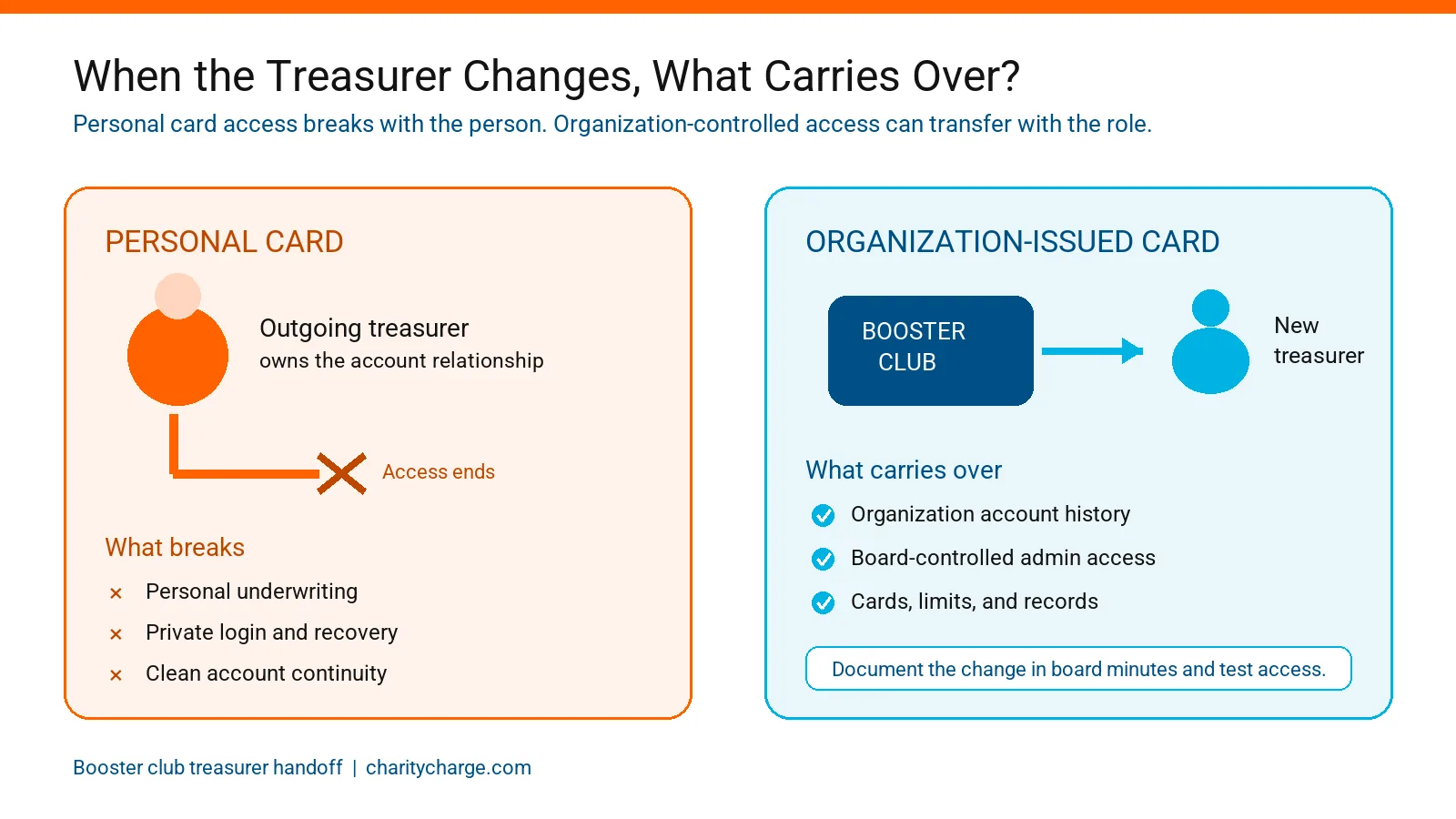
The handoff is where weak systems become obvious. Imagine the outgoing treasurer’s child graduates in May. The board elects a replacement in August. Fall registration opens in three weeks, the tournament deposit is due, and the bank still sends security codes to the former treasurer’s phone.
Do not wait until August.
Schedule a transition meeting before the outgoing officer’s term ends. Use the following checklist and record completion in the board minutes.
- Approve the officer change. Record the outgoing and incoming treasurer, effective date, and authorized signers in the minutes.
- Update the bank. Remove former signers, add the new officers, replace personal recovery details, and confirm where statements and alerts are sent.
- Review every card. List the cardholder, purpose, limit, recurring charges, and current status. Close or reassign access that no longer fits the new season.
- Transfer account administration. Move the primary administrator role through the provider’s formal process. Never hand over a shared password in a spreadsheet.
- Move club records. Transfer bank statements, receipts, budgets, tax filings, board reports, contracts, insurance records, and vendor details into storage controlled by the club.
- Finish the last reconciliation. The outgoing treasurer should reconcile through the transition date and explain every open item.
- List pending obligations. Include unpaid invoices, deposits, reimbursements, subscriptions, and recurring card charges.
- Confirm filing dates. Record the club’s fiscal year, Form 990-series due date, state renewal dates, and the person responsible for each filing.
- Test access. The incoming treasurer should sign in, view statements, export activity, receive an alert, and contact support before the outgoing officer leaves.
- Report to the board. Give the board a closing balance, open-items list, access confirmation, and signed transition checklist.
A card tied to one volunteer’s personal credit creates a break at exactly this moment. An organization-issued account should allow administrators and cardholders to change while the organization’s account history continues.
Schedule a 30-day review. Fix any missing contacts, stale subscriptions, and approval gaps while the outgoing officer can still answer questions.
Youth sports leagues have the same rules and more moving parts
A youth sports league may have several teams, coaches, tournaments, and travel schedules moving at once. Keep them inside one board-controlled structure with defined budgets, role-based access, consistent receipt deadlines, and centralized exception review. The nonprofit expense-management guide explains how those controls work together as the organization grows.
Common booster club money mistakes and what they cost
Commingling club and personal funds makes records harder to defend, complicates handoffs, and can leave the club dependent on a volunteer’s cooperation.
Letting one person control the money and the reporting removes a basic check on error or misuse. In August 2026, the Tennessee Comptroller announced that a former band-booster treasurer had been indicted following an investigation. The agency alleged at least $48,650.42 in misappropriated funds and reported more than $74,000 in disbursements without adequate receipts or invoices. An indictment is an accusation, not a conviction, and the defendant is presumed innocent unless proven guilty. The operational lesson does not depend on the case outcome: boards need records they can access and a reviewer who did not make or approve the transactions.
Counting concession cash without a count sheet leaves no reliable comparison between sales, deposits, and inventory. Use two counters, record the total, and have both sign the sheet.
Skipping the monthly reconciliation lets duplicate charges, missing deposits, and unauthorized activity sit unnoticed. A reconciliation is useful only if someone who did not create the transactions can review it.
Missing a required annual filing can become more than an administrative nuisance. If the club is recognized as tax-exempt and required to file a Form 990-series return or notice, many organizations with gross receipts normally at or below $50,000 may file Form 990-N, although exceptions apply. The IRS says the filing is due on the 15th day of the fifth month after the tax year ends, and missing three consecutive required returns or notices causes automatic revocation of federal tax-exempt status. State and local filing requirements may also apply. Use the nonprofit compliance checklist and financial-reporting guide to map the club’s actual obligations.
Treating the handoff as a password exchange leaves former officers attached to accounts and new officers guessing. A handoff is a board-controlled transfer of authority, records, and access.
Build the system for the next treasurer
A strong treasurer leaves the club with cleaner records, clearer controls, and less dependence on any individual than they inherited.
Start with the bank account. Move routine and recurring expenses off personal cards. Adopt a short policy. Then put the handoff checklist on the board calendar now, before anyone announces they are leaving.
When the club is ready to separate organizational spending from volunteer credit, review the Charity Charge Business Credit Card and confirm the current terms against the club’s needs.
This article provides general educational information, not legal, tax, accounting, or financial advice. Requirements vary by state, bank, tax status, and product. Confirm the rules and terms that apply to your club with the relevant institution and qualified legal, tax, or accounting professionals.
A booster club generally needs its own EIN to identify the organization to the IRS and open an account in its own name. An EIN does not establish 501(c)(3) status or prove that the club is tax-exempt. Form the organization legally before applying, then keep the IRS confirmation with the club’s permanent records.
Yes. The Charity Charge Business Credit Card is underwritten to the organization’s EIN, so the account belongs to the club rather than living on a volunteer’s personal card. Terms vary by provider, so review the signed agreement that governs your club.
The board should authorize at least two current officers so one volunteer is not the sole point of access. Limit transaction authority to people who need it and remove former officers promptly. Separately, a board member or officer who did not make or approve the transactions should review the monthly statement, reconciliation, and unresolved items.
Reconcile every month, including months with little activity. A second officer or board member who did not enter the transactions should review the bank statement, reconciliation, and unresolved items.
The board should remove the outgoing treasurer’s administrative access, update recovery details, review every active cardholder and recurring charge, and transfer account administration through the provider’s process. Cards tied to the organization can support an officer change without moving the club’s spending history into a new volunteer’s personal account.