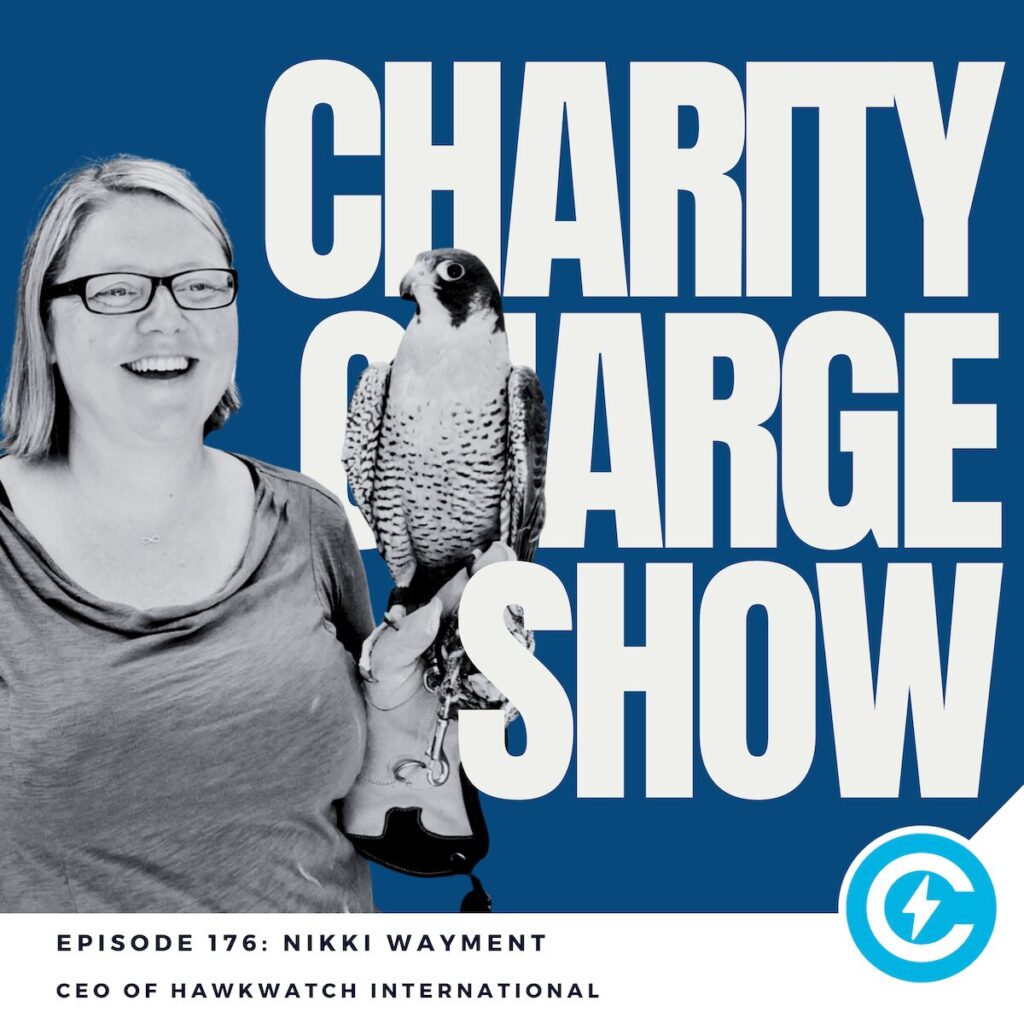
Most nonprofits that fold don’t fail because the mission stopped mattering. They fail because 80% of the budget sat on top of one grant, one donor, or one contract, and that one thing disappeared. HawkWatch International has avoided that trap for 40 years, and CEO Nikki Wayment says the fix is not complicated: stop putting all your eggs in one basket, and start treating every donor relationship like it’s worth building for a decade, not a campaign.
HawkWatch is a Utah-based raptor conservation nonprofit built on migration research. It has weathered four decades of funding cycles, a pandemic, and the kind of donor fatigue that hits every cause-based organization eventually. On a recent episode of the Charity Charge Show, Wayment walked through exactly how the organization has stayed financially sound long enough to reach its 40th anniversary, and the lessons apply well beyond conservation work.
Quick Summary
- HawkWatch International has operated for 40 years by continually adding new, uncorrelated revenue sources instead of depending on one.
- Personal donor stewardship (handwritten notes, thank you calls with no ask attached) converted a $50 a year donor into a $250,000 estate gift.
- Only about 5% of most people’s net worth sits in cash, which means nonprofits that only ask for checks are missing the other 95% of what donors could give.
- A 16 acre property gift and a corporate card built for nonprofit cash flow both show up in the episode as the kind of unplanned, unconventional support that keeps a mission-driven organization solvent.
Why nonprofits that depend on one revenue source are one bad year from a crisis
A nonprofit with a single dominant funding source is exposed every time that source has a bad year. Wayment has seen this firsthand. “We had a million dollar budget and very few revenue sources,” she said of her early years at HawkWatch. “If any one of those revenue sources at any time disappeared, it could be catastrophic for the organization.”
The fix she points to is deliberate diversification: major donor cultivation, industry partnerships, planned gifts, and event revenue running in parallel instead of one channel carrying the whole budget. HawkWatch now works with wind energy companies, government agencies, and other nonprofits on projects like its Eagle Vehicle Strike Program, relationships that generate both revenue and a policy seat at the table that a grants-only organization would not get.
For a nonprofit finance leader building next year’s budget, the practical version of this lesson is a simple stress test: if your single largest revenue source disappeared tomorrow, would the organization survive the year? If the honest answer is no, that is the gap to close first.
Why a $50 a year donor turned into a $250,000 gift
Wayment’s clearest example of stewardship paying off involves a donor who gave HawkWatch $50 a year for roughly a decade. “Every year she made a gift, every year I called her and thanked her,” Wayment said. When the donor passed away, her estate left HawkWatch $250,000, a gift she had never mentioned was coming.
The lesson is not that every small donor is secretly wealthy. It is that Wayment treats a $25 gift and a $25,000 gift with the same level of personal attention, because she has no way of knowing which relationship becomes the estate gift a decade later. Her team hand-addresses every envelope for the year-end major donor mailing rather than printing labels, and every Thanksgiving her board and staff call donors with no ask attached, purely to say thank you.
That kind of stewardship is inexpensive and scales down to any budget size. A phone call costs nothing. What it buys is the relationship that survives long enough to become a legacy gift.
Why the 95% of donor wealth that isn’t cash matters
Most nonprofit fundraising asks for one thing: a check or a card swipe. Wayment pointed to a statistic worth sitting with: only about 5% of a typical person’s net worth sits in cash or cash equivalents. The other 95% is in real estate, retirement accounts, and other assets that a standard donation form never asks about.
She described a case where a supporter offered a nonprofit a house they no longer needed, and the organization said it didn’t accept homes, so the donor gave it to a different nonprofit instead, one equipped to liquidate the property through a donor-advised or planned giving service. That second organization walked away with roughly a million dollars. HawkWatch itself was recently given a 16 acre property in Tucson that wasn’t on any strategic plan, and Wayment is now building a use case around it rather than turning it down.
The takeaway for finance and development teams: a gift acceptance policy that only knows how to process cash and credit cards is leaving money on the table before a donor even asks.
How cash flow tools change what a small nonprofit team can risk
Diversified revenue only helps if the organization can actually manage the cash flow that comes with it, uneven grant timing, seasonal field costs, and reimbursements from field crews working months at remote sites. Wayment credited partners like Charity Charge with helping HawkWatch “defer some of our expenses until it makes a little bit more sense from a cash flow perspective,” which is a practical description of what a nonprofit-built corporate card is for.
Virtual cards, in particular, solve a specific version of this problem for organizations like HawkWatch that run field crews in remote locations for months at a time: a crew member on a mountaintop or a staff member working internationally can be issued spending capacity without waiting on a physical card to arrive or a reimbursement cycle to close. For a Member managing a distributed team, that is a cash flow and control feature, not a workaround.
Three Takeaways
- Diversify before you’re forced to. A revenue mix that survives the loss of any single source is the difference between a bad year and a closed organization.
- Stewardship is the cheapest fundraising tool you have, and it compounds. A thank you call costs nothing today and can become a six figure gift a decade from now.
- Ask for more than cash. Real estate, appreciated assets, and planned gifts represent the vast majority of donor wealth, and a gift acceptance policy that can’t process them is turning away support.
Podcast Episode Q&A
Stephen Garten: Well, I’d rushed to hit record because I didn’t want to lose any of the excitement of first getting into the recording room with you. I was so touched by how this came about. I know you all have been a Member of Charity Charge for a number of years, but I was up in Park City with a friend of mine a couple of months ago to do some hiking and check out the outdoors. As soon as I was checking into the hotel, I met Chris and all these wonderful raptors, owls, and everything. We started talking and realized you all were already Members of Charity Charge. I’m really glad Chris put us in touch.
Nikki Wayment: Me too. I’ve been at HawkWatch for a long time, and I’d say the education piece of our program has connected more people with the organization than I can even express. There’s something powerful about having the opportunity to stand that close to an owl or a falcon or an eagle and look in their eyes and think, holy cow, what is happening right now. I have to care about this.
Stephen Garten: Could you give us a little bit of the backstory of HawkWatch International? Congratulations, I know you’re coming up on your 40th anniversary celebration, which is really incredible.
Nikki Wayment: Like a lot of conservation nonprofits in the US, we started as a really grassroots organization. Our founder, Steve Hoffman, moved out west to go to grad school at Utah State, which is in northern Utah. He had grown up in Pennsylvania and had been to Hawk Mountain and seen hawks migrating every fall. When he moved out west he really missed that, and everyone kept telling him that in the West, raptors don’t migrate, they’re all resident birds. He just couldn’t believe that was true, so he set out to prove them wrong, and he did. He discovered a huge western flyway throughout the western US.
He graduated from Utah State, started working for the Fish and Wildlife Service on the Endangered Species program in the West, and would save up all his vacation to travel around the West looking for more places to add to that flyway. He quit his job in 1986 and started this fledgling nonprofit, and really did it out of the back of his pickup truck for many years. Migration is still the backbone of what we do at HawkWatch. It informs a lot of our other conservation work, and we’ve continued to evolve into this truly global nonprofit I’m incredibly proud of.
Stephen Garten: For an organization to be around for 40 years, there must be a lot of interest in this work. Can you talk about why people are continuing to support what you’re doing, and what the big challenges are that you’re solving?
Nikki Wayment: I think first and foremost, people are captivated by raptors. They’re cool and different. People who are interested in the outdoors and in conservation are generally mystified by predators, whether that’s bears, wolves, bobcats, or mountain lions. Raptors fit in that same group, but the difference is they’re more approachable. We see them more often. You can ask anyone if they’ve seen a hawk, an owl, a falcon, or an eagle, and they’ll have a story. I think that’s the hook, that’s how we get people in the door.
We keep them involved because we’re an organization founded on data, and we stand behind that data. Every decision we make, every statement we make, is backed by data, and I think that gives us a lot of credibility. We collaborate with people that maybe other conservation organizations wouldn’t, including industry partners, agencies, and hunters. People assume we have some stance against hunting, and we actually don’t. We think hunting is really important in keeping an ecosystem balanced. Because of that, we’ve built a reputation for being responsible and ethical in how we do the work and collect the data. The challenges facing raptors are some of the same challenges facing humans: climate change, population growth, development, and the loss of wild spaces.
Stephen Garten: Going back to the data, what are some of the big picture things that have changed over 40 years that people listening might not know about?
Nikki Wayment: We have the largest migration monitoring network in the US, and probably in the world, though we’ve never been able to fully verify that. We use it as an early warning system, looking at populations over time. A lot of environmental data is pretty doom and gloom, like polar bears and melting ice caps, where it feels like there’s nothing we can do. But with migration, we see real success stories, like the peregrine falcon and the bald eagle, both of which were on the endangered species list and are now off it. We also see declines, especially in grassland species like short-eared owls and northern harriers, tied to the loss of open farmland spaces. We’re always looking for the good news too, and data gives us that.
Stephen Garten: In what ways are you actually able to track and measure this data?
Nikki Wayment: We have migration sites all along the western US, fall sites and spring sites, so we’re following the birds on their natural life cycle. As they fly over, we count them, and it’s standardized, you’re measuring the same thing at the same time every year. Migration starts for us at the very beginning of August in Texas, counting kites, and goes through mid-November, weather permitting. We have crews that live on top of mountains or on the coast of Texas for three to four months, counting every raptor that flies over. We also measure weather, because one year you might have a great count and the next it’s totally different due to a drought or a heavy fire year, when smoke changes migration patterns. That’s why long-term data matters. With a 40 year data set, we can compare arrival timing and counts for a species like the sharp-shinned hawk decade over decade, rather than reacting to any single year.
Stephen Garten: Are there ways you’ve leveraged new technology as the decades have gone on?
Nikki Wayment: Migration is hard, probably the hardest of our programs, because a lot of our sites are remote. Crews are sleeping in tents on top of a national forest nine thousand feet up for three months, going into town once every week or two for supplies. The biggest technology shift came from companies building solar-powered charging stations, which gave us charging capability on remote mountaintops and let us start using tablets. Until about ten years ago, almost all of our data was collected on paper, we probably have 12 filing cabinets full of migration data written in pencil. We’ve been slowly integrating that into digital form, and that’s been the biggest game changer, because it lets us see the data in real time from our office and share it with people who are curious about the flight counts at a given site.
From a broader conservation perspective, satellite transmitters have been a major shift. They’re small solar-powered GPS units, about the size of a backpack, that we put on birds, and we can track them in real time. We’ve been banding birds for 40 years, but the only way to get data back from a band is to recapture that bird, which happens for maybe 4 to 5 percent of the birds we’ve trapped. Satellite transmitters give us real information about where birds winter and whether they return to the same nesting areas. The challenge, like with a lot of technology, is that they’re expensive, so we don’t have too many of them.
Stephen Garten: What are some of the outcomes of that data, and how is it valuable to your organization and to industry partners?
Nikki Wayment: Having data immediately available in a digital format makes it much easier to sort and dig into, and easier to share with partners, agencies, and other organizations. Historically, migration would end in November, and we had a team member whose job for 15 to 20 years was to enter every data sheet into our database, a process that ran from November through February or March. By the time that was done, we were already planning for next year’s migration cycle. Having it digital from the start lets us get that data collected and shared sooner.
Stephen Garten: What’s the outcome of all that data over 40 years? What does it ultimately help you do?
Nikki Wayment: It’s informed the species we should be concerned about and where we should focus our effort. Golden eagles are the best example. We could see over many years that golden eagle populations were declining significantly, but we didn’t know exactly why. That data told us where to focus, and now we have almost an entire team devoted to golden eagles, and another devoted to nesting species like American kestrels, the smallest falcons in the world. You go from a high level view of 17 different species over 40 years to keying in on two or five species and really trying to move the needle for them.
Stephen Garten: In the example of the golden eagle, what has your organization done, in partnership with others, to help the species?
Nikki Wayment: In Utah especially, golden eagles have traditionally been successful in the West Desert, which spans parts of Idaho, Utah, and Nevada. We’re finding there have been a lot more fires than there were a hundred years ago, and an invasive grass called cheatgrass has moved in and crippled the native plant structure, which has crashed jackrabbit populations, the primary food source for golden eagles. We saw that more than half of the eagles we tagged with transmitters weren’t surviving a year. Since golden eagles take five years to reach breeding age, a population where half the young don’t survive a year can decline quickly. We’re also seeing more parasites in nests as temperatures increase.
The other major impact is vehicle strikes. In the winter, golden eagles scavenge roadkill because there isn’t much live food available. These are birds that weigh ten-plus pounds with a six to eight foot wingspan, so getting off the ground takes time, and if a car startles them while they’re feeding on a carcass at the roadside, they can be hit. We run a program called the Eagle Vehicle Strike Program that looks at the safe distance to move carcasses off the road to keep eagles safe. We put camera traps on every carcass we move, and we’ve found it also provides a food source for other scavengers, mountain lions, bobcats, raccoons, red-tailed hawks, bald eagles, and ravens. We’re hoping the Fish and Wildlife Service will work with us on using this as a mitigation technique for golden eagle take at wind farms.
Stephen Garten: With the organization around for 40 years, how have you been able to maintain financial stability, both before you arrived and during your time leading the organization?
Nikki Wayment: The most important thing nonprofits have to do, whether just starting or well established, is diversify their funding sources. When I first started at HawkWatch 17 years ago, we had about a million dollar budget and very few revenue sources, so if any one of them disappeared, it could be catastrophic. That’s been the biggest lesson for me, not putting all your eggs in one basket, and finding ways to leverage cash flow with good partners like Charity Charge that help defer expenses until it makes more sense from a cash flow perspective.
When I became executive director six years ago, one of our biggest priorities was investing in our donors. I’d much rather build a relationship with a person or a small family foundation I can call and say I’m $5,000 short on a project, than write three grants that 75 other nonprofits are also applying for. We’ve also worked outside the realm of a lot of other nonprofits, with wind farms and task forces on issues like rodenticide use, and those relationships have brought in revenue but also given us a seat at tables we might not have been invited to otherwise. A good organizational credit card can be a huge game changer too, especially for small nonprofits where cash flow can be unpredictable.
Stephen Garten: I really appreciate what you said about building relationships with donors and figuring out basic ways to say thank you, whether that’s a phone call, a handwritten card, or getting coffee with someone who’s supported your organization.
Nikki Wayment: I agree completely.
Stephen Garten: I was surprised to learn recently that only about 5 percent of people’s net worth is typically in cash or cash equivalents, and that’s generally how nonprofits ask for support. But there’s this other 95 percent that might be in a house or other assets that people could leave in a will or give in other ways, and we’re often only asking for that small percentage.
Nikki Wayment: Yeah, planned giving is such an interesting thing.
Stephen Garten: The example I was thinking of is a supporter who reached out to an organization and said they were downsizing and wanted to give their extra home, and the nonprofit said they don’t take homes, so the donor went to a different nonprofit that could take the property, list it, sell it, and transfer the proceeds. That organization walked away with a million dollars, while the first one had asked for a $5,000 credit card donation and missed out entirely because they didn’t have a way to meet the donor where they were.
Nikki Wayment: Those kinds of things happen all the time. We were just given a 16 acre property in Tucson that wasn’t anywhere on our radar. When you think about the potential in that, for an organization like ours that’s been fairly small and hasn’t had an outward-facing place for people to come and engage with us, that’s huge. It’s terrifying and daunting, but it’s also the most exciting thing, and it feels like the perfect setup for what our next 40 years might look like. I think nonprofits have been trained to be risk-averse, and you have to take some risks. Sometimes they fail, and you learn hard lessons, but sometimes it becomes the next biggest thing for your organization.
I’ll give you a perfect example of planned giving. When I first started at HawkWatch, we had a donor who gave us $50 a year, a lovely woman who lived in Seattle. Every year she made a gift, and every year I called her and thanked her. Ten years later she passed away, and once her estate was settled, we ended up with $250,000. She had never mentioned anything about it. Some donors are very direct about their plans, and others hold that closely. I tell my team I’m just as happy to call someone who makes a $25 donation as someone who makes a $25,000 donation, because any donation is meaningful for that person and deserves the same appreciation.
I write a lot of handwritten notes. For our end-of-year giving campaign, we have a group of major donors who get a more personalized note, and I insist every one of those envelopes is hand addressed, sometimes 300 of them, and I’ll sit in front of the TV for three days addressing envelopes because I want them to know I appreciate them. Every Thanksgiving, my board and staff volunteer to make calls where we don’t ask for money, we just say thank you for being part of this community. It makes a big difference, and people love it.
Stephen Garten: For people listening who want to learn more or get involved, how can they find out more about HawkWatch?
Nikki Wayment: The easiest way is to visit our website, HawkWatch.org, it has all of that information. We’re also on Instagram, Facebook, YouTube, and TikTok.
Stephen Garten: Nikki, thank you so much for being a guest and for being part of the Charity Charge community.
Nikki Wayment: Thank you, and thank you for creating a platform for nonprofits to do the work we do with the support of credit behind us. That’s a really big challenge for nonprofits to navigate, so having that is a game changer. I tell nonprofit friends and leaders to get a Charity Charge card all the time. They’re easy to work with, their customer service is phenomenal, and we have an employee who lives in South Africa who has never had trouble using her card, which hasn’t been the case otherwise. So we’re really grateful for you as well.
Stephen Garten: That means the world to me. To everyone listening, continue to charge it forward in everything you do. Take care until the next episode.
FAQ’s from this episode
A nonprofit diversifies revenue by combining major donor relationships, planned gifts, industry or corporate partnerships, and event income instead of relying on one grant or funding stream. HawkWatch International grew from a nearly single-source budget into this kind of mix over time. The goal is that losing any one source doesn’t threaten the organization’s survival.
Planned giving is a donation arranged in advance, often through a will, estate, or non-cash asset like real estate, rather than a cash gift given immediately. A HawkWatch donor who gave $50 a year for a decade left the organization $250,000 through her estate without ever mentioning the plan. Planned gifts often come from long-term, well-stewarded relationships, not just wealthy donors.
Donors give more over time when they feel personally appreciated, not just solicited. Consistent, no-ask stewardship, like thank you calls and handwritten notes, builds the kind of trust that leads to larger and eventually estate-level gifts. HawkWatch treats every donor size with equal personal attention for this reason.
A corporate card built for nonprofits helps by letting an organization defer expenses to match uneven grant and donation timing, rather than paying costs out of pocket and waiting on reimbursement. Virtual cards let remote or field-based staff spend within budget without a physical card, which matters for organizations running distributed teams.