Most nonprofits hit a fundraising ceiling at some point. They exhaust their immediate network, run the same annual appeals, and wonder why growth has stalled. Rick Peck has seen this pattern at organizations of every size, and his diagnosis is consistent: nonprofits aren’t asking the right people for the right things in the right ways.
In this episode of the Charity Charge Show, Rick breaks down what separates organizations that grow past the early plateau from those that don’t, covering non-cash gift acceptance, board accountability, executive director dynamics, and long-term financial planning.
Quick Summary
- 97% of nonprofits operate under $2M in revenue, and most hit a fundraising wall once they exhaust their personal networks.
- A strong “case for support” document is foundational — most nonprofits don’t have one.
- 95% of most donors’ assets are non-cash. Nonprofits that only ask for cash are missing the majority of available giving capacity.
- Third-party vendors like Realty Gift Fund and Charitable Solutions can process non-cash gifts (real estate, stock, crypto) on behalf of nonprofits, removing the logistical barrier.
- Board effectiveness depends on clear job descriptions, term limits, and active recruitment beyond friends and family.
- Financial sustainability means planning for the future, not just balancing the current year’s budget.
Why Nonprofits Get Stuck at the Same Fundraising Ceiling
Nonprofits stall when they rely exclusively on the founding network and never build systems to find new donors. Rick is direct about this: once an organization’s inner circle is tapped, growth requires a different approach entirely.
The first fix is building a proper case for support: a document that articulates the organization’s mission, current state, future goals, and specific funding needs. Rick says most nonprofits don’t have one, and without it, fundraising conversations lack structure and persuasive power.
“If you don’t have a good case for support, it’s hard for people to understand what you want and how they can help you.”
Beyond the case for support, he points to three channels for finding new donors: broad-based prospect research tools (iWave and DonorSearch are two he names), deep-dive contract research on top current donors, and consistent multichannel marketing: social media, newsletters, blog posts, podcasts, and one-on-one visits.
Non-Cash Asset Donations: The Biggest Untapped Revenue Source for Most Nonprofits
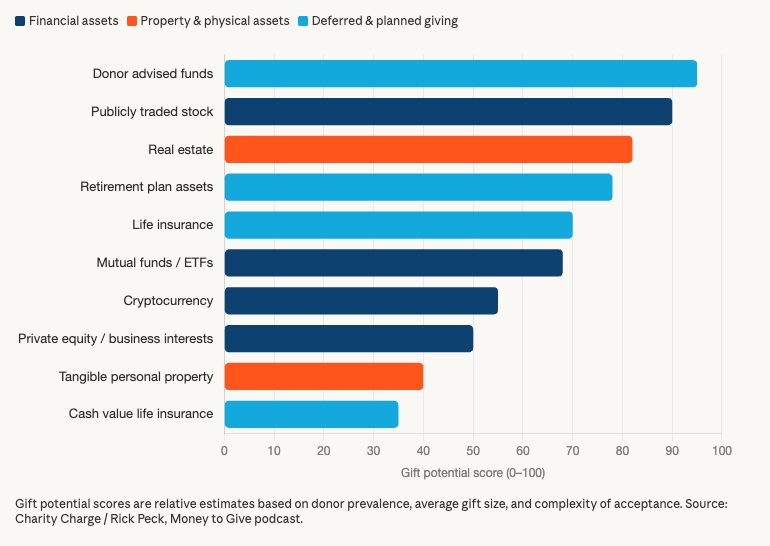
Roughly 95% of most donors’ total wealth is held in non-cash assets: real estate, stocks, mutual funds, retirement accounts, cryptocurrency, life insurance, and donor advised funds. Most nonprofits only ask for cash, which is the asset class donors have the least of.
Rick walks through the practical fix in three steps:
- Adopt a gift acceptance policy that explicitly addresses non-cash donations and gets board approval.
- Market it visibly — add information to the website, donation pages, and donor communications about how people can give non-cash assets.
- Partner with third-party processors that handle the logistics so the nonprofit doesn’t have to.
He highlights two vendors he trusts for real estate gifts: Realty Gift Fund (Santa Fe, NM) and Charitable Solutions (Jacksonville, FL). Both accept the property, sell it, and wire the net proceeds to the nonprofit after taking a fee.
“95% of most people’s assets are in a non-cash position. When we’re asking just for cash, we’re only asking for one of the asset classes that they have the least amount of money in.”
He shares a concrete example. A couple approached a nonprofit with a $1.1 million residential property to donate. That first nonprofit said they didn’t accept real estate. The couple went to a second nonprofit. Rick connected them with Realty Gift Fund. The gift was made in December, the property sold by February, and $1.1 million was wired to the nonprofit. The couple said it felt so easy they thought it was a scam.
That gift represented roughly a third of the nonprofit’s annual revenue, sourced from a donor type they had never formally tried to reach.
| Non-Cash Asset Type | Accepts for Nonprofits? | Suggested Vendor / Approach |
|---|---|---|
| Real estate | Yes, via third party | Realty Gift Fund, Charitable Solutions |
| Publicly traded stock / mutual funds | Yes | Direct brokerage transfer or Charitable Solutions |
| Cryptocurrency | Yes, via third party | Charitable Solutions, Engiven |
| Donor Advised Funds | Yes | DAF sponsoring organization distributes directly |
| Life insurance / retirement plans | Yes (via beneficiary designation) | Legal or planned giving counsel recommended |
| Tangible personal property (vehicles, art) | Case by case | Gift acceptance policy defines parameters |
What Effective Nonprofit Boards Actually Look Like
Board problems usually start with fuzzy expectations. Rick sees this constantly: board members join as a favor to a friend, assume it’s a light commitment, and no one ever defines what they’re actually supposed to do.
His framework for a functioning board comes down to four things:
- Written job descriptions for every board member and any subcommittees (especially a development or fundraising committee).
- Term limits to keep the board from going stale and to create room for new perspectives.
- Active recruitment beyond the founding network — posting board openings publicly, targeting young professionals, seeking geographic and skills diversity.
- Ongoing education so board members understand what’s working elsewhere and feel equipped to contribute meaningfully between meetings.
“If you have to put a job description out there for others to see on some sort of a posting board, do it — because otherwise you’re just going to capture friends and family and others that you know.”
He also advocates for a formal development subcommittee with its own job description. This group owns fundraising accountability, knows what success looks like, and isn’t leaving it all to staff.
The Executive Director and Board Dynamic: How to Navigate It Without Getting Fired
Executive directors occupy a difficult position: they’re responsible for organizational results while reporting to a board that can hire and fire them. Rick’s view is that this tension doesn’t need to be adversarial, but it does require clarity from both sides.
He uses a straightforward principle: “If you’re going to buy a racehorse, you better give it a track to run on.” Boards that hire strong EDs and then fail to give them resources, direction, or aligned expectations are setting everyone up to fail.
His recommendations for making it work:
- The ED articulates what they need to be successful and lays out a clear vision.
- The board shares their vision for the organization.
- Both parties land on a shared strategic plan that everyone is accountable to.
- Job descriptions are documented for the ED and board members alike.
- Annual self-evaluations happen for both sides, not just performance reviews of the ED.
He points to a 27-year-old executive director he works with as an example of this mindset done right. She’s already thinking about succession, not because she plans to leave soon, but because she wants to hand off a healthy organization to whoever comes next.
Nonprofit Financial Planning: Think Beyond the Annual Budget
Most nonprofits treat financial planning as an annual exercise: set a budget, raise money to cover it, spend it all, repeat. Rick argues that framing is too narrow, and it’s part of why so many organizations stay perpetually small.
The better framework is two-part: understand your financial health today (assets, liabilities, operating costs), and then plan explicitly for where the organization needs to go. That planning should drive fundraising strategy, not the reverse.
“If we’re going to go from $2 million to $10 million, first of all, why would we do that? Where does that mean we’re going? Are we going to make more impact? And if so, what does that more impact look like?”
He connects this back to the case for support: if you know where you’re going and why, it becomes much easier to make a compelling ask for the resources to get there. Reserves, innovation budgets, and long-term financial sustainability aren’t luxuries. They’re what allows the next generation of staff and leadership to inherit an organization worth leading.
Nonprofit financial management starts with the right tools.
Charity Charge gives nonprofits a corporate card and spend management platform built for how your organization actually operates, with controls, reporting, and accounting integrations your finance team will actually use.
About Rick Peck

Rick Peck is an independent philanthropy consultant based in Belmont, NC. He holds a CFP designation, a Chartered Financial Consultant designation, a Chartered Advisor in Philanthropy certification, and an Impact Philanthropy Advisor certification. He spent 20+ years in major gifts and planned giving roles at Dartmouth College and New Hampshire Charitable Foundation before launching his consulting practice in 2023. He hosts the Money to Give podcast and consults with nonprofits, individual donors, and professional advisors on philanthropic strategy.
Q: Rick, can you start by sharing your background and how you became involved in philanthropy?
Rick Peck:
I began my career in financial services back in 1998 as a financial advisor. I worked directly with individuals and families helping them with retirement planning, education planning, insurance strategies, and cash management.
After about seven years, my wife was working at Dartmouth College and encouraged me to explore a position there called Associate Director of Gift Planning. That role involved working with alumni and helping them think about charitable giving through things like bequests, charitable remainder trusts, charitable gift annuities, and complex asset donations.
That transition allowed me to combine financial planning knowledge with philanthropy. I ended up spending more than 20 years working in nonprofit fundraising and philanthropic advising.
Over time I moved into major gifts and principal gifts. I eventually became Director of Gift Planning for both the Dartmouth Medical School and Dartmouth-Hitchcock Medical Center, where I was responsible for planned giving, major gifts of $50,000 or more, and principal gifts of $1 million or more.
Later I joined the New Hampshire Charitable Foundation as Vice President for Development and Philanthropy Services. That role expanded my work across multiple issue areas including climate change, food insecurity, homelessness, and behavioral health.
In 2023 I launched my own practice as an independent philanthropy consultant. Today I work with nonprofits to strengthen fundraising programs, advise donors on giving strategies, and help professional advisors have philanthropic conversations with their clients.
Q: About 97% of nonprofits operate with less than $2 million in annual revenue. Why do many organizations hit a fundraising ceiling?
Rick Peck:
Many nonprofits start with passion and a strong mission. But eventually they reach the limits of their immediate network.
Founders typically begin fundraising by asking:
-
friends
-
family
-
early supporters
-
board members
That works at the beginning, but it doesn’t scale.
What happens is they keep doing the same things they’ve always done, expecting different results. Without evolving their strategy, fundraising stalls.
The organizations that break through that ceiling tend to professionalize their fundraising operations.
That means developing the right messaging, expanding their outreach, and using tools that help them identify and connect with new donors.
Q: What foundational elements should every nonprofit have in its fundraising program?
Rick Peck:
The first thing I recommend is having a strong case for support.
A case for support is a document that clearly explains:
-
your mission and vision
-
your organizational history
-
the problem you’re trying to solve
-
the solutions you’re offering
-
the funding needed to achieve those goals
It should also explain where the organization is today and where it wants to go in the future.
Without that clarity, donors often struggle to understand how their support will make a difference.
The case for support essentially becomes the core narrative you use in marketing, donor conversations, events, and campaigns.
Q: What role does marketing play in expanding a nonprofit’s donor base?
Rick Peck:
Once you have a strong case for support, the next step is sharing it widely.
That means using multiple communication channels such as:
-
social media
-
newsletters
-
blog posts
-
podcasts
-
in-person events
-
direct donor meetings
The goal is to consistently communicate the organization’s impact and opportunities for support.
Another powerful strategy is donor research. Tools like iWave or DonorSearch allow nonprofits to identify individuals who have the capacity and history of charitable giving.
This kind of research helps organizations focus their outreach on people who are more likely to become supporters.
Q: You spoke about the importance of accepting non-cash donations. Why is this such a major opportunity for nonprofits?
Rick Peck:
Most nonprofits only ask for cash donations.
You’ll typically see a donation page offering options like $25, $50, or $100.
But the reality is that most people’s wealth is not held in cash. It’s held in assets.
Those assets may include:
-
stocks
-
mutual funds
-
real estate
-
retirement accounts
-
life insurance policies
-
cryptocurrency
-
donor-advised funds
-
personal property such as vehicles
If nonprofits only ask for cash, they’re asking donors to give from the smallest portion of their wealth.
That’s why expanding donation options can dramatically increase fundraising potential.
Q: Many nonprofits worry about the complexity of accepting non-cash assets. How can they manage those types of gifts?
Rick Peck:
The key is understanding that nonprofits don’t have to process these gifts themselves.
There are specialized third-party organizations that handle the entire process.
For example, when it comes to real estate donations, there are groups like Realty Gift Fund and Charitable Solutions that specialize in accepting and liquidating real estate assets for charitable purposes.
Here’s how it works.
The donor transfers the property to the third-party organization. That organization manages the sale of the property and then sends the net proceeds to the nonprofit.
The nonprofit receives the funds without needing to manage the asset or navigate the sale themselves.
Q: Can you share an example of how a non-cash gift can impact a nonprofit?
Rick Peck:
Absolutely.
I worked with a nonprofit that was approached by a couple who wanted to donate a residential property valued at around $1.1 million.
The first nonprofit they approached declined the gift because they didn’t accept real estate donations.
When the couple approached another nonprofit, that organization worked with a real estate donation intermediary.
The timeline looked like this:
-
November: nonprofit was approached
-
December: property transferred to the intermediary
-
February: property sold and proceeds distributed
The nonprofit received about $1.1 million, which represented roughly a third of their annual revenue.
The entire process was handled by the intermediary organization.
This example shows how transformative non-cash gifts can be when nonprofits are prepared to accept them.
Q: Board governance is another major factor in nonprofit success. What are some common issues you see with nonprofit boards?
Rick Peck:
One of the biggest issues is lack of clarity.
Sometimes board members are recruited simply because they are friends of the founder or early supporters of the organization.
They may join without a clear understanding of:
-
their responsibilities
-
the expectations for engagement
-
how they can contribute their skills
Without clear expectations, board members often assume the role will be relatively light.
But effective boards require active participation.
That’s why I believe strongly in having clear job descriptions for board members.
Every board member should know why they were recruited and what role they play in helping the organization succeed.
Q: What are some best practices for building a stronger nonprofit board?
Rick Peck:
A few things can make a big difference.
First, establish clear expectations and job descriptions for board members.
Second, consider implementing term limits. This helps ensure boards continue to evolve as the organization grows.
Third, create subcommittees, such as development or fundraising committees, that focus on specific priorities.
Another important step is expanding recruitment beyond your personal network.
If nonprofits only recruit people they already know, they often miss out on talented individuals who would bring new ideas and energy to the organization.
Posting board opportunities publicly can help attract younger professionals and people with diverse expertise.
Q: How can executive directors navigate the tension between leading an organization and being accountable to the board?
Rick Peck:
This relationship works best when expectations are clearly defined.
The executive director and the board should work together to establish a shared vision and strategic plan for the organization.
That plan helps ensure everyone is aligned on:
-
priorities
-
performance expectations
-
organizational goals
Regular evaluations can also help strengthen the relationship.
Boards can evaluate their own performance, and executive directors can also conduct self-evaluations.
These reviews encourage accountability on both sides.
Q: Many nonprofit leaders are discussing whether nonprofits should operate more like businesses. What is your perspective on that?
Rick Peck:
I think the key idea is sustainability.
Nonprofits often operate on an annual cycle where they raise money, spend it during the year, and then start over again the following year.
But long-term impact requires long-term thinking.
That means considering questions like:
-
What impact do we want to achieve five or ten years from now?
-
What funding will be required to get there?
-
What systems and infrastructure will support that growth?
Organizations that invest in strategic planning and innovation are much more likely to build sustainable models.
Ultimately, nonprofits and for-profits both benefit from thoughtful planning, operational efficiency, and a willingness to try new ideas.
Frequently Asked Questions
Nonprofits grow beyond their founding network by developing a formal case for support, using prospect research tools like iWave or DonorSearch to identify new donors, and investing in multichannel marketing including social media, newsletters, and events. Without these systems, organizations tend to plateau once their personal connections are exhausted.
Non-cash asset donations include real estate, stocks, mutual funds, cryptocurrency, retirement accounts, life insurance, and donor advised funds. They matter because roughly 95% of most donors’ total wealth is held in these forms. Nonprofits that only accept cash are ignoring the majority of what donors actually have to give.
Nonprofits can partner with third-party gift processing organizations like Realty Gift Fund or Charitable Solutions. These vendors receive the property, handle the sale, and wire the net proceeds to the nonprofit after taking a fee. The nonprofit never needs to own or manage the property directly.