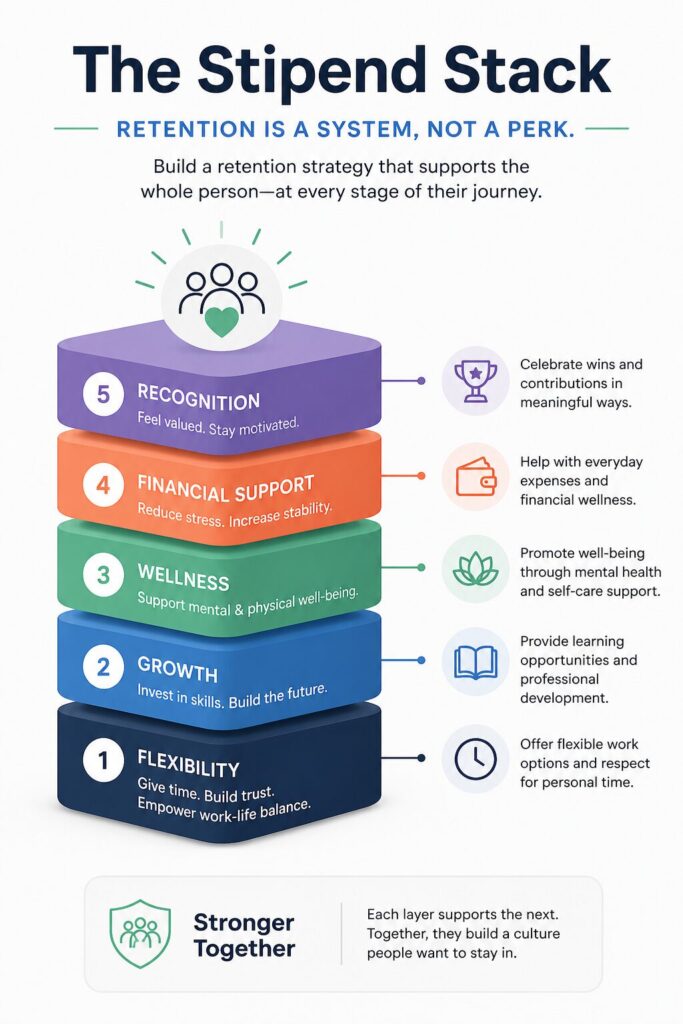
Most nonprofits can’t outbid the private sector on salary. They can still retain nonprofit staff who could earn more elsewhere. The trick is using soft benefits and targeted stipends to close the gap on what employees actually want: flexibility, growth, recognition, and breathing room.
The numbers behind nonprofit turnover are sobering. Annual turnover sits around 19 to 21% sector-wide, and nearly 7 in 10 nonprofit employees report they’re either job-hunting or planning to be within the year per the Social Impact Staff Retention Project. Smaller organizations with budgets under $2 million often run above 25%. Replacing a single employee can cost 30 to 50% of their salary at the low end, and the loss compounds: institutional knowledge walks out the door, remaining staff absorb more work, and the cycle accelerates.
Here’s the part that should reframe your retention budget. The top reasons nonprofit staff give for leaving aren’t primarily about base pay. They’re workload, lack of growth, and weak management. Salary lands fourth. That means the marginal dollar spent on the right soft benefit, structured well, often retains better than the same dollar added to a paycheck.
This guide covers specific tactics: which ones move the needle, what they typically cost, how the IRS treats them for tax purposes, and how to fund them without raiding restricted program dollars.
Quick Summary
- Nonprofit turnover sits around 19 to 21%, and replacing a staff member costs 30 to 200% of their annual salary.
- Salary isn’t the top driver of nonprofit departures. Workload, lack of growth, and weak management are.
- Most stipends are taxable to the employee, but they still cost the org less than a comparable raise after benefits load.
- Programs that compound: flexible work, professional development stipends, mental health support, and clear career paths.
- Funding source matters: use unrestricted funds or a board-designated reserve, and code stipends correctly for Form 990 functional expense reporting.
Why Nonprofit Retention Is a Budget Problem and a Culture Problem
Nonprofit turnover runs roughly 19 to 21% per year, compared to about 12 to 17% across other sectors. Replacement costs run 30% to 50% of an employee’s salary at the low end, and up to 200% for senior or specialized roles when you factor in lost productivity, recruiting, and onboarding.
The Social Impact Staff Retention (SISR) Project found that nearly 7 in 10 nonprofit employees were job-hunting or planned to be within a year. The top reasons they cited:
- Too much work and not enough support (59%)
- Limited growth opportunities (54%)
- Unsupportive management (52%)
- Inadequate pay and benefits (50%)
Three of the top four reasons aren’t about base salary. They’re about how the job feels day-to-day. That’s where soft benefits and stipends earn their keep.
1. Flexible and Hybrid Work Schedules
Flexible scheduling is the cheapest, highest-leverage retention tool a nonprofit can offer. It costs nothing on paper and consistently ranks at the top of what employees say they want.
Practical versions: a 4-day workweek (some orgs run 32-hour weeks at full pay), summer half-day Fridays, fully async core hours, or a hybrid schedule with two anchor days in office. Pick one, write it down, and apply it consistently. The worst version is “we’re flexible” with no documented policy, because it punishes the people who don’t ask.
2. Professional Development Stipend ($500 to $2,500 per Year)
A professional development stipend gives employees a defined annual budget for courses, certifications, conferences, or coaching. It directly addresses the #2 reason nonprofit staff leave: limited growth.
Common ranges: $500 to $1,000 per year for individual contributors, $1,500 to $2,500 for managers and directors. Under IRS Section 127, employers can provide up to $5,250 per employee per year tax-free for qualified educational assistance (tuition, books, supplies). Other professional development spend may qualify as a working condition fringe benefit if it maintains or improves skills required in the current job. Anything outside those rules is taxable to the employee.
3. Mental Health and Wellness Stipends
Mental health support is the most under-deployed benefit in the nonprofit sector relative to how badly staff need it. Compassion fatigue and secondary trauma are real, and 95% of nonprofit leaders report concern about staff burnout per the Center for Effective Philanthropy’s State of Nonprofits report.
Two practical structures:
- Wellness stipend: $50 to $100 per month for therapy copays, gym, meditation apps, fitness classes. Generally taxable to the employee per IRS guidance, but still a strong perceived benefit.
- EAP (Employee Assistance Program): Group plans run roughly $1 to $5 per employee per month and include free counseling sessions, often non-taxable when structured as a qualified plan.
An EAP plus a small wellness stipend covers more ground than either alone.
4. Extra PTO, Mental Health Days, and Sabbaticals
Time off is the benefit nonprofit employees consistently say they don’t take enough of. Adding capacity here costs the org very little in real dollars and signals that leadership actually means it when they say “take care of yourself.”
Tactics that work:
- 3 to 5 designated mental health days per year, separate from sick leave
- Office-wide closure between Christmas and New Year’s (no PTO charged)
- 1-month paid sabbatical at the 5-year and 10-year tenure marks
- “Recovery weeks” after major events (galas, year-end campaigns, audit close)
5. Remote Work Stipend ($25 to $100 per Month)
For hybrid or remote teams, a remote work stipend offsets internet, phone, and home office costs. Typical range is $25 to $100 per month. The IRS treats most remote work stipends as taxable wages unless paid through an accountable plan that requires receipts and documentation tied to actual business expenses.
If you go the accountable plan route, the reimbursement isn’t taxable to the employee and the org still gets the deduction. That’s the version your bookkeeper will thank you for.
6. Student Loan Repayment Assistance
Roughly half of nonprofit professionals carry student loan debt, and many entered the sector through programs requiring graduate degrees. A small monthly contribution toward loan principal, even $50 to $150, lands as more meaningful than a similar dollar amount as a generic raise.
Under IRS Section 127, employers can pay up to $5,250 per employee per year toward qualified student loan principal and interest tax-free through 2025.
7. Caregiver and Family Support Stipends
A caregiver stipend covers childcare, elder care, or backup dependent care. Common structures:
- Dependent Care FSA: Most employees can set aside up to $7,500 pre-tax annually for eligible childcare and dependent care expenses.
- Backup care benefit: A few days of subsidized backup care per year for when a regular arrangement falls through.
- Direct caregiver stipend: $100 to $300 per month, generally taxable but flexible enough to use however the employee needs.
For nonprofits with majority-female workforces (which is most of the sector), this is one of the most retentive benefits you can offer.
8. Recognition Programs That Aren’t Pizza
Public recognition costs nothing and routinely outperforms small cash bonuses on engagement surveys. The catch: it has to be specific, frequent, and not tied to fundraising metrics alone.
What works:
- Peer-nominated recognition with a small reward ($50 to $250 gift card or extra PTO day)
- Tenure milestones at 1, 3, 5, and 10 years with a meaningful gift, not a generic plaque
- Public acknowledgment at all-hands and board meetings of specific work, by name
- Written notes from the ED to staff after major projects, mailed home
Skip the pizza party as a recognition tool. It reads as a substitute for a real raise, because that’s what it is.
9. Clear Career Paths and Promotion Tracks
Lack of advancement is the #2 reason nonprofit staff leave. Most small and mid-size nonprofits don’t have written career ladders, which means promotions feel arbitrary and the only way up is out.
The fix is documentation, not budget:
- Write 2-tier or 3-tier role bands for each function (e.g., Development Coordinator → Development Manager → Director of Development)
- Define the skills, outcomes, and tenure required to move between bands
- Publish salary ranges for each band internally
- Run promotion conversations on a predictable cadence (annual or semi-annual)
This removes the biggest source of resentment in nonprofit retention: feeling like you’ll never know what it takes to move up.
10. Coworking, Internet, and Commuter Stipends
For 2026, employers can provide tax‑advantaged commuter benefits up to the IRS monthly limits for transit and vanpooling, and up to the separate IRS monthly limit for qualified parking. These amounts are excluded from employees’ taxable income when structured as qualified transportation fringe benefits. Coworking memberships and home internet reimbursements are generally treated as taxable compensation unless they qualify as business expenses reimbursed under an accountable plan.
For distributed teams, offering a $100 to $200 monthly coworking stipend can give employees access to a professional workspace without requiring the organization to lease permanent office space. This is especially helpful for staff who lack a dedicated home office or need an occasional change of environment to work effectively.
11. Stipend Spending Made Easy (the Ops Layer)
The biggest reason stipend programs fail at small nonprofits isn’t the budget. It’s the admin burden. Reimbursing twelve people for twelve different vendors every month, then coding all of it correctly for Form 990 functional expense reporting, eats more staff time than the program is worth.
This is where a nonprofit corporate card with built-in spend management changes the math. Issue per-employee cards with a monthly limit set to the stipend amount, tag transactions to the right program or category at the point of sale, and let receipts capture itself through the app. No reimbursement requests, no Excel reconciliation, no surprises at audit time.
Cost Comparison: Soft Benefits vs. a $5,000 Raise
This table shows the relative cost-to-impact ratio of common benefits versus a base salary increase. Numbers assume a $60,000 salaried employee.
| Benefit | Annual Cost to Org | Tax Treatment | Retention Signal |
|---|---|---|---|
| $5,000 raise | ~$5,500 (with payroll taxes) | Fully taxable wages | Moderate; fades after 6 months |
| Professional development stipend | $500 to $2,500 | Tax-free up to $5,250 under Section 127 if qualifying | High; tied to growth |
| Wellness stipend ($75/mo) | ~$900 | Generally taxable | High; daily reminder |
| 4-day workweek | $0 direct cost | N/A | Very high |
| Extra week PTO | ~$1,150 (lost productivity) | N/A | High |
| EAP | $100 to $300 per employee | Often non-taxable | Moderate; high in crisis |
| Sabbatical (1 month at 5 yrs) | ~$5,000 amortized | Wages during leave | Very high; reduces senior turnover |
How to Pay for Soft Benefits Without Touching Programmatic Funds
The funding question trips up most EDs and finance leaders. Here’s the standard playbook:
- Use unrestricted operating revenue. Soft benefits are management and general expenses on Form 990. They cannot be paid from restricted program grants unless the grant explicitly allows indirect cost allocation.
- Allocate via your indirect cost rate. If you have a federally negotiated indirect cost rate, employee benefits are typically included in the indirect pool. This means a portion of every program grant funds them automatically.
- Tap the operating reserve carefully. A board-designated reserve can fund a one-time program rollout, but ongoing benefits should come from recurring revenue.
- Make the case to funders. Some funders now explicitly fund staff retention and capacity-building. Frame benefit costs as part of organizational sustainability, not overhead.
Code each benefit correctly on Form 990 Part IX. Most soft benefits go in management and general (line 9) or program services (line 10) depending on which staff received them and how their time is allocated. This matters for your charity ratings and for restricted-grant compliance.
What Doesn’t Work (and Why)
A few benefits that sound good on paper but consistently underdeliver:
- One-off retention bonuses. They cost the same as a raise and signal panic. People who take them often leave anyway once the vesting clears.
- Generic “wellness weeks.” Lunchtime yoga doesn’t fix burnout caused by understaffing.
- “Unlimited PTO” with no usage minimum. Research consistently shows employees take less time off under unlimited policies than capped ones.
- Pizza, swag, and surprise treats as a primary recognition strategy. Useful as a supplement; insulting as a substitute.
Retention gets easier when the tools your staff use every day were built for nonprofits in the first place. That is the whole point of Charity Charge, and it is how we think about our own team too. If you want to work on that problem from the inside, see open roles at Charity Charge.