Yes, nonprofits can legally invest in stocks and other securities. Under IRS regulations, 501(c)(3) organizations are generally exempt from federal income tax on investment returns, including dividends and capital gains, as long as those activities comply with their tax-exempt status and do not primarily benefit private individuals.
Investing is not only permitted for nonprofits, for many organizations with reserve funds or endowments, it is considered a fiduciary responsibility. The National Council of Nonprofits identifies prudent investment of assets as part of sound financial stewardship for mission-driven organizations.
Overview
The Legal Framework: What the IRS Allows
The IRS permits 501(c)(3) organizations to hold and grow investment portfolios. Capital gains, dividends, and interest income from passive investments are generally exempt from federal income tax under IRC Section 501(c)(3). Nonprofits must report investment income on Form 990, it is publicly disclosed, but not taxed in most scenarios.
Three core legal requirements govern nonprofit investing:
No private inurement. Investment proceeds cannot benefit board members, executives, or any private individuals. A nonprofit cannot purchase stock in a company owned by a board member to prop up that person’s holdings. Violations can trigger IRS excise taxes or, in severe cases, revocation of tax-exempt status.
Fiduciary duty applies. Board members carry a legal obligation to act in the best interest of the organization. This “prudent investor standard” requires that investment decisions be documented, intentional, and consistent with an approved Investment Policy Statement (IPS). Going it alone without professional oversight is a governance risk.
State law matters. Many states have adopted versions of the Uniform Prudent Management of Institutional Funds Act (UPMIFA), which governs how nonprofits manage endowments and long-term funds. Requirements vary by state and may affect spending rules, asset allocation, and delegation of investment authority.
Understanding UBIT: When Investment Income Gets Taxed
Most passive investment income , stock dividends, bond interest, mutual fund gains, is exempt from Unrelated Business Income Tax (UBIT). However, there are situations where investment activity can trigger UBIT exposure.
Income from a partnership or LLC where the nonprofit is a passive investor may be classified as unrelated business income, particularly if the entity conducts commercial activities unrelated to the nonprofit’s mission. Debt-financed income, returns generated from assets purchased with borrowed money, is also subject to UBIT under IRC Section 514.
For most nonprofits holding publicly traded equities, bonds, index funds, or ETFs in a standard brokerage account, UBIT is not a concern. Organizations investing in alternative assets like real estate, private equity, or hedge funds should consult a nonprofit tax attorney before proceeding.
UBIT exposure is reported on IRS Form 990-T. Any unrelated business income over $1,000 in a year requires filing.
What Nonprofits Can Invest In
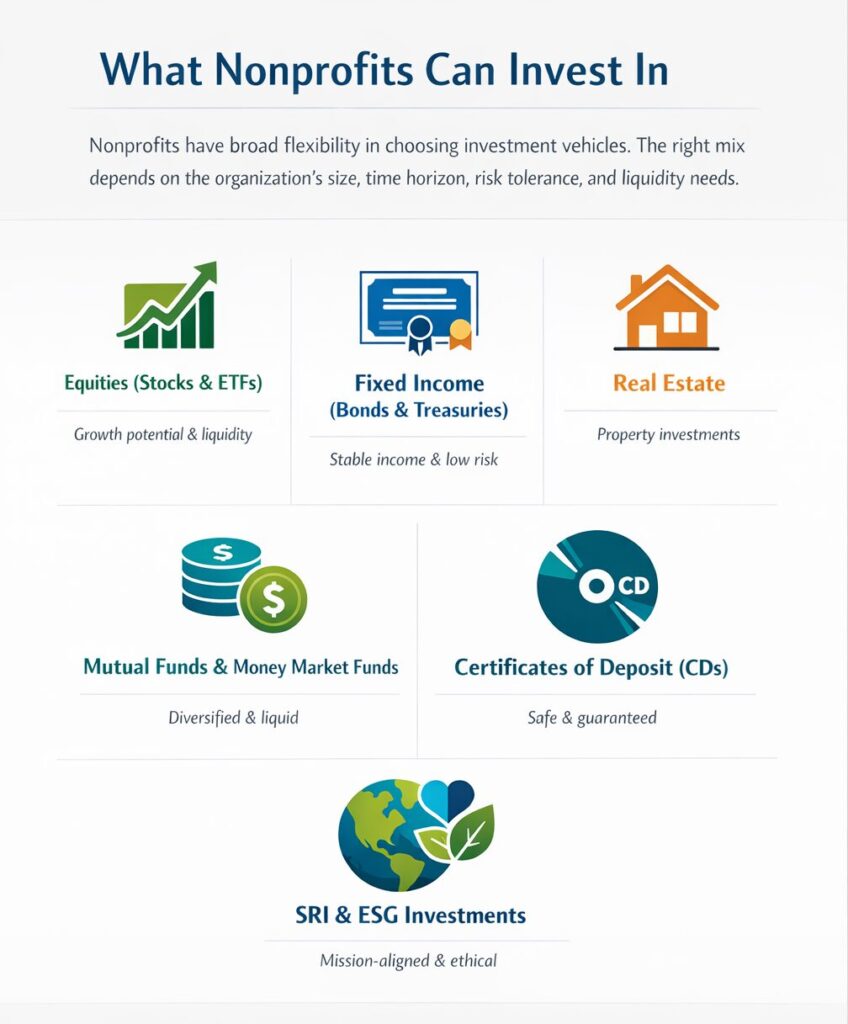
Nonprofits have broad flexibility in choosing investment vehicles. The right mix depends on the organization’s size, time horizon, risk tolerance, and liquidity needs.
Equities (Stocks and ETFs). Publicly traded stocks and exchange-traded funds offer growth potential and liquidity. Passive index funds with low expense ratios are widely used by nonprofits because they minimize costs, which matters when fiduciaries are accountable for fee management.
Fixed Income (Bonds and Treasuries). Bonds provide more predictable income with lower volatility. U.S. Treasury Bills and Treasury Bonds are among the lowest-risk instruments available and are commonly used for operating reserves and near-term capital needs.
Mutual Funds and Money Market Funds. Diversified mutual funds allow nonprofits to access broad market exposure without selecting individual securities. Money market funds are used for working capital that needs to stay liquid while earning more than a standard checking account.
Certificates of Deposit (CDs). FDIC-insured CDs are appropriate for reserves that will not be needed for a defined period. They carry virtually no credit risk.
Real Estate: Real estate can provide long-term income, appreciation potential, and portfolio diversification. Nonprofits may invest directly in property, such as office buildings or affordable housing, or indirectly through Real Estate Investment Trusts (REITs). Direct ownership can generate rental income and strategic program benefits, while REITs provide liquidity and professional management. Real estate is typically suited for organizations with longer time horizons and sufficient reserves to manage illiquidity and maintenance costs.
Why Nonprofits Should Invest Reserve Funds
Grant funding and donations are inherently unpredictable. Building investment assets creates a buffer against revenue shortfalls, leadership transitions, or economic downturns. Beyond stability, there are four concrete reasons to invest:
Tax efficiency. Because 501(c)(3) organizations are exempt from capital gains tax on most investment income, a nonprofit’s portfolio grows at a faster net rate than an equivalent taxable account. This built-in advantage is often underused by smaller organizations.
Endowment building. Endowments are designed to provide perpetual financial support for an organization’s mission. The investment returns — rather than the principal, fund operations, scholarships, or grants annually. Major universities and foundations rely on endowments worth billions; the model scales down to smaller nonprofits as well.
Donor confidence. Sophisticated major donors and foundations frequently review an organization’s financial health before making large gifts. A well-managed investment portfolio signals financial maturity and long-term planning. It can directly increase major gift conversions.
Inflation protection. Cash sitting in a low-interest account loses purchasing power each year. Reserve funds invested conservatively in diversified portfolios maintain or grow their real value over time, preserving the organization’s future capacity.
Building a Nonprofit Investment Policy Statement
Before making a single investment, the board should adopt a formal Investment Policy Statement (IPS). This is the governance foundation for all investment activity and protects the board from fiduciary liability.
A complete IPS should address the following:
Investment objectives. Define what the portfolio is meant to accomplish: capital preservation, long-term growth, income generation, or some combination.
Risk tolerance and asset allocation. Set a target allocation between equities, fixed income, and cash equivalents. A common starting framework for nonprofits with a moderate time horizon is 60% equities and 40% fixed income, though this varies based on spending needs and reserve targets.
Liquidity requirements. Specify what percentage of the portfolio must remain accessible within 30, 60, or 90 days to fund operations.
Spending policy. For endowments, define the annual draw rate (typically 4% to 5% of a rolling average of portfolio value). This prevents organizations from depleting principal during market downturns.
Socially responsible investment criteria. If ESG or SRI screens apply, define them explicitly so investment managers can implement them consistently.
Delegation and oversight. Identify who manages day-to-day investment activity (board committee, external investment manager, or OCIO) and how frequently performance is reviewed. Quarterly reporting to the board is standard practice.
Prohibited investments. Some organizations restrict speculative instruments, derivatives, or concentrated positions.
The National Council of Nonprofits provides a sample investment policy statement as a starting framework. Organizations should customize it with legal counsel familiar with their state’s version of UPMIFA.
Reporting Requirements: Form 990 and Transparency
All investment income must be reported on Form 990, which is publicly available. Line 10 captures dividends and interest; capital gains are reported in Part VIII. Investment assets are disclosed on Schedule D.
Because Form 990 is visible to donors, watchdog organizations like Candid (formerly GuideStar), and the media, accurate and clean reporting matters beyond mere compliance. A portfolio that is clearly governed — with an IPS on file, consistent reporting, and documented oversight — reflects well on organizational management. One that shows unexplained investment losses or concentrated holdings in related-party companies raises red flags.
Common Mistakes Nonprofits Make When Investing
No Investment Policy Statement. Investing without a written policy exposes the board to personal fiduciary liability and leaves investment decisions open to inconsistency or self-dealing.
Excessive concentration. Holding a large share of the portfolio in a single stock, particularly donated stock, creates unnecessary risk. A formal policy should specify maximum concentration limits and require timely diversification of gifted securities.
Ignoring fees. Investment management fees compound over time. A 1% annual fee on a $500,000 portfolio costs $50,000 over ten years in lost compounding. Fiduciaries are accountable for fee reasonableness; low-cost index funds are often the most defensible choice.
Mixing restricted and unrestricted funds. Board-designated reserves, endowment funds, and grant-restricted funds may have different spending and investment rules. Commingling them in a single account without proper tracking creates accounting and compliance problems.
Not seeking professional advice. Nonprofit investment management has specific nuances around UBIT, UPMIFA, and mission alignment. A financial advisor with nonprofit experience, or an Outsourced Chief Investment Officer (OCIO) for larger portfolios, provides both expertise and additional documentation for fiduciary protection.
How Charity Charge Supports Nonprofit Financial Operations
Investing is one component of a broader nonprofit financial management strategy. The operational side, tracking how investment income is categorized, allocated by fund, and reported against restricted vs. unrestricted purposes, requires the same discipline as the investment policy itself.
Charity Charge provides nonprofits with the spend management infrastructure to run cleaner operations. With nonprofit-specific corporate cards that support fund-level tracking, receipt capture, and integrations with accounting platforms like QuickBooks and Sage Intacct, your finance team can maintain the kind of clean general ledger that makes investment reporting straightforward rather than a quarterly scramble.
Explore how Charity Charge works for nonprofit finance teams.
FAQs
Yes. 501(c)(3) organizations are permitted to invest in publicly traded stocks, bonds, mutual funds, ETFs, and other securities. Investment returns are generally exempt from federal income tax, provided the activity does not constitute unrelated business income and does not benefit private insiders.
Most passive investment income, dividends, interest, capital gains from publicly traded securities, is exempt from Unrelated Business Income Tax. UBIT typically applies when a nonprofit invests in a partnership conducting unrelated commercial activities or when income is generated from debt-financed property.
Yes. The board is legally responsible for the organization’s financial assets. Before any investment activity begins, the board should adopt a written Investment Policy Statement (IPS) that defines objectives, risk tolerance, asset allocation, and oversight responsibilities.
Not if investments comply with IRS rules. Tax-exempt status is at risk if investment proceeds benefit insiders (private inurement), if unrelated business income grows disproportionately large, or if the investment activities effectively become the organization’s primary purpose rather than its charitable mission.
Nonprofits report investment income on Form 990, dividends and interest on Line 10, capital gains in Part VIII, and investment assets on Schedule D. Form 990 is publicly available. Organizations with more than $1,000 in unrelated business income must also file Form 990-T.