Starting a nonprofit board requires defining your mission, identifying the skills your organization needs, recruiting qualified members, and establishing governance policies before your first meeting. To successfully start a nonprofit board, done right, a strong board is the single most important structural asset your nonprofit has.
This guide walks through every step, from recruiting your first board member to setting up reporting practices that keep your organization accountable and mission-focused.
Each member has a role to play when you start a nonprofit board, contributing to the overall success.
This guide will help you understand how to effectively start a nonprofit board and walks through every step, from recruiting your first board member to setting up reporting practices that keep your organization accountable and mission-focused.
Knowing how to effectively start a nonprofit board can set the foundation for future success.
Every step you take to start a nonprofit board will help ensure compliance with regulations.
What Is a Nonprofit Board of Directors?
A nonprofit board of directors is the governing body legally responsible for the organization’s financial health, mission alignment, and regulatory compliance. The board sets strategic direction, oversees the executive director, and ensures the organization operates ethically and transparently.
Under IRS rules for 501(c)(3) organizations, a functioning board is not optional. It is a core requirement for maintaining tax-exempt status.
Core board responsibilities include:
As you set goals, consider how these will affect your ability to start a nonprofit board effectively.
- Keeping the organization aligned with its stated mission
- Approving annual budgets and reviewing financial reports
- Overseeing compliance with federal, state, and local regulations
- Hiring, evaluating, and supporting the executive director or CEO
- Setting and monitoring strategic goals
It’s important to evaluate your approach when you start a nonprofit board to ensure you attract the right people.
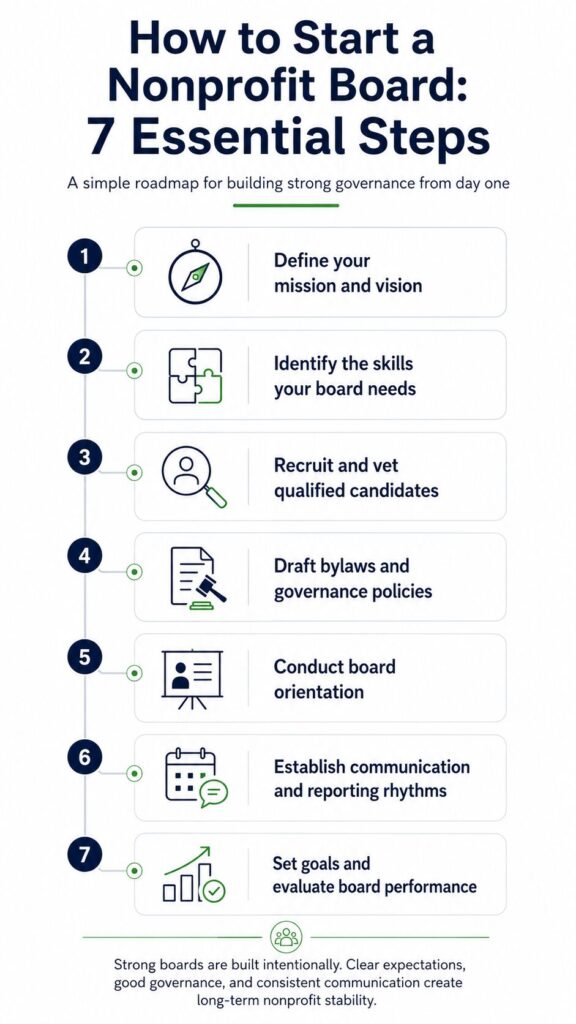
Step 1: Define Your Mission and Vision First
Each statement helps prospective members understand why they should want to start a nonprofit board with you.
Before recruiting a single board member, lock in your mission and vision statements. These two documents do more than communicate purpose. They are the filter through which you identify, recruit, and evaluate every board member.
The foundation to start a nonprofit board is built on clear expectations and responsibilities.
Mission statement: Defines who you serve, what you do, and why it matters.
Vision statement: Describes the long-term change you are working toward.
Prospective board members use these to decide if this is an organization worth their time. Weak or vague statements result in weak recruitment.
Step 2: Identify the Skills and Expertise Your Board Needs
Map out the specific expertise gaps your organization has before recruiting anyone. A well-structured nonprofit board balances skills across finance, legal, fundraising, marketing, and program management.
High-value skill sets for most nonprofit boards:
To effectively start a nonprofit board, consider diverse skills and experiences that prospective members bring.
| Expertise Area | Why It Matters |
|---|---|
| Finance / Accounting | Budget oversight, Form 990 accuracy, audit readiness |
| Legal | Compliance, contracts, employment law |
| Fundraising | Donor relationships, grant strategy, major gifts |
| Marketing / Communications | Brand visibility, donor acquisition, public relations |
| Program / Subject Matter | Mission credibility, program evaluation |
When you start a nonprofit board, always be transparent about the expectations for involvement.
As you draft bylaws, remember that clarity can help you start a nonprofit board with strong governance.
Beyond credentials, prioritize candidates who show genuine commitment to the mission, a track record of follow-through, and the capacity to attend meetings consistently.
Step 3: Recruit and Vet Board Members Strategically
Effective board recruitment is not passive. Start with your existing professional network, then expand to community leaders, local professional associations, and nonprofit governance platforms like BoardSource.
Recruitment process best practices:
- Write a formal board member job description that specifies time commitment, expected meeting frequency, and any giving or fundraising expectations
- Conduct a structured interview to assess alignment with your mission and willingness to engage actively
- Check references, especially for candidates taking on financial oversight roles
- Be explicit about what you expect. Ambiguity is what leads to disengaged board members
The job description matters more than most nonprofits realize. Candidates who understand the commitment upfront are dramatically more likely to fulfill it.
Step 4: Draft Bylaws and Governance Policies
Bylaws are the legal rulebook for your board. They define how the organization makes decisions, who holds authority, and what happens when something goes wrong. Every 501(c)(3) is required to have them.
What your bylaws must address:
- Board positions and titles (Chair, Vice-Chair, Treasurer, Secretary)
- Term lengths and term limits
- Meeting frequency and quorum requirements
- Voting procedures and decision-making authority
- Conflict of interest policy
- Process for removing or replacing board members
Work with a nonprofit attorney when drafting bylaws. The cost of a legal review upfront is far lower than the cost of a governance dispute later.
Step 5: Run a Structured Board Orientation
Onboarding new board members with a formal orientation reduces confusion, accelerates engagement, and sets clear expectations from day one. Do not assume members will figure things out on their own.
A strong board orientation covers:
Having a structured orientation can give new members the confidence they need to start a nonprofit board.
- Overview of current programs and strategic priorities
- Walkthrough of the budget, financial statements, and any active audits
- Review of bylaws, governance policies, and the conflict of interest policy
- Explanation of individual board member roles and committee assignments
- Introduction to the leadership team and key staff
Pair the orientation with a board member handbook that members can reference throughout their term.
Step 6: Establish Communication and Reporting Rhythms
The board and organizational leadership must stay aligned between meetings, not just during them. Inconsistent communication is one of the leading causes of board disengagement.
Practices that keep boards functional:
- Meet at minimum quarterly. Monthly or bi-monthly is better for early-stage nonprofits.
- Distribute meeting agendas and relevant reports at least 72 hours in advance
- Use a board portal or shared drive to centralize documents, financials, and meeting minutes
- Send brief monthly updates between meetings covering financials, program milestones, and any emerging issues
- Create space for candid conversation. Boards that only hear good news become rubber stamps.
Step 7: Set Goals and Evaluate Board Performance
Regular meetings help maintain momentum as you start a nonprofit board and keep members engaged.
A board without measurable goals is unaccountable. Establish specific, time-bound goals at the start of each fiscal year and build in a formal annual evaluation process.
What to measure:
- Meeting attendance rates
- Individual board member fundraising or giving performance (if applicable)
- Progress on strategic plan milestones
- Financial health indicators: liquidity, reserve levels, expense ratios
- Program impact metrics tied to mission outcomes
An annual board self-assessment is a standard governance best practice. BoardSource publishes evaluation tools specifically designed for nonprofit boards.
Frequently Asked Questions
Most states require a minimum of three board members for a 501(c)(3), but requirements vary by state. A board of five to nine members is more common for early-stage nonprofits because it provides enough diversity without making decision-making unwieldy.
Board members typically serve as volunteers, and paying them can create conflicts of interest that trigger IRS scrutiny. Some nonprofits reimburse reasonable expenses or compensate members for specific contracted services, but compensation for board service itself is uncommon and should be reviewed by legal counsel.
Most nonprofit boards meet quarterly at minimum. Early-stage or rapidly growing organizations often benefit from monthly meetings. The right frequency depends on the complexity of your organization’s operations and the strategic demands of the moment.
A conflict of interest policy requires board members to disclose any personal, financial, or professional interests that could influence their decisions on behalf of the organization. The IRS Form 990 asks whether your organization has a written conflict of interest policy, making it a compliance consideration, not just a governance best practice.