Around 1.3 million kids are less active in youth sports than they were just a few years ago.
The reasons pile up fast: registration fees, equipment costs, language barriers, gender barriers, and neighborhoods without a safe place to play. Volo Kids Foundation’s answer is to make youth sports completely free, and to fund “free” with a model most nonprofits have never tried.
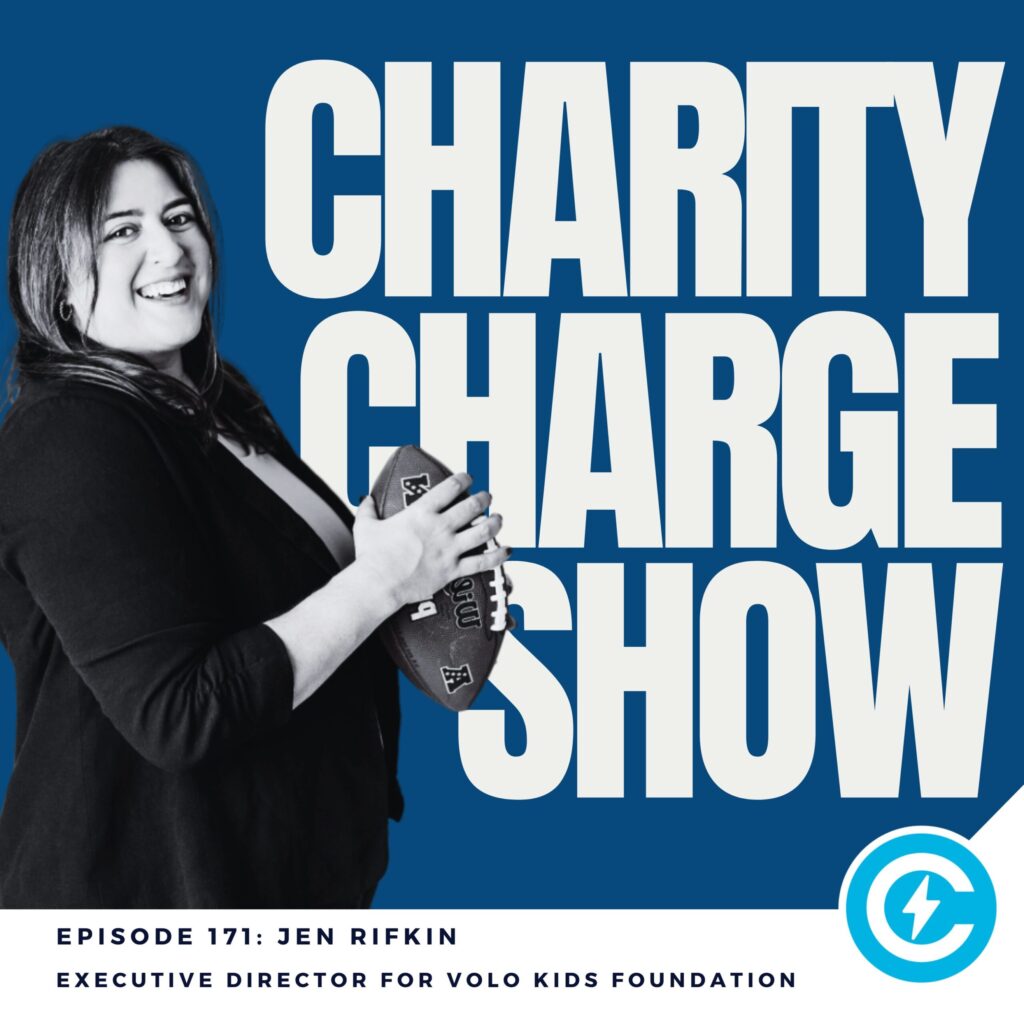
In this episode of the Charity Charge Show, host Grayson Harris talks with Jen Rifkin, Executive Director of Volo Kids Foundation, about how a single free flag football program in East Baltimore grew into a national operation, why a for-profit sister company covers the foundation’s core costs, and what is actually working in one of the hardest fundraising markets in years.
Key Takeaways
- Volo Kids funds free programming in part through Volo Sports, a for-profit adult sports company with the same founder. Every adult player’s shirt reads “We play so the kids play free,” and a portion of their registration revenue supports the foundation.
- Because that partnership offsets core costs, money the foundation raises goes directly into kids’ programming. That is a clean, credible pitch to funders.
- The expansion playbook is a repeatable six-week program structure plus one dedicated full-time leader per market, powered by local volunteers. Trust comes first: community meetings, schools, and local government before a single game is scheduled.
- Grants keep getting more competitive, so personal relationships are doing the heavy lifting. Every coach, volunteer, and adult player who talks about the kids opens the door to a new funding relationship.
A Free Flag Football League Born in East Baltimore
Volo Kids started in Baltimore in 2015, at a moment when the city was working through serious racial tension. Founder Giovanni Marcantoni worked with Brandon Scott, then in local government and now Baltimore’s mayor, on an idea meant to be a bright spot: free youth sports, starting with a flag football program in East Baltimore.
The premise was never just exercise. “Sports is a great opportunity to make friends and practice social skills,” Rifkin says. “Sports helps you learn how to lead, how to win. It helps you learn how to lose too.”
Rifkin’s own path into the organization started on the field. She was teaching in Baltimore and volunteering as a coach when something clicked: “I quickly found that the impact that I could have through volunteering with this organization was at times more than the impact that I could have in my classroom.” She joined full time in 2018, helped grow the Baltimore operation, and moved to the national team during COVID to lead expansion.
Cookie Cutters with Sprinkles: How the Model Scales
Today the foundation runs programs across the country, and the Baltimore lineup alone covers soccer, basketball, dance, volleyball, dodgeball, flag football, tennis, and kickball for kids ages 5 to 13. Holding all of that together is a deliberately simple structure: each market has one dedicated full-time leader who owns operations and community impact, supported by what Rifkin calls a little army of volunteers.
The programming itself is built to replicate. Rifkin describes a proven six-week format the team can place in any market, then adapt: “We have this really good foundation of a program… we can take that and kind of place it anywhere and add sprinkles on top.”
What does not get templated is the community work. “What we don’t want to do is show up in a community and say, we know exactly what you need, we’re here to fix everything,” Rifkin says. Before launching in a new city, the team attends community meetings, talks to schools and local government, and finds like-minded organizations to partner with. No two city launches have followed the same blueprint, and Rifkin considers that a feature.
The model also plans for what happens when kids age out. Players who hit the top of the age range can return as junior volunteers, keeping the relationships, and the mentorship, intact.
We Play So the Kids Play Free
The most distinctive piece of the Volo Kids story is how the free programming gets paid for. Volo Sports, a for-profit adult sports league company founded by Marcantoni, sends a portion of its registration revenue to the foundation. The message is printed on every adult player’s jersey: we play so the kids play free.
“I always say they’re kind of like the foundation of the foundation, but it allows us to scale really sustainably.”
– Jen Rifkin, Volo Kids Foundation
For nonprofit leaders, the mechanics matter. The Volo Sports revenue helps cover core operating costs, which means the foundation can tell donors that what they give goes directly to programming for kids. Adult players often go a step further and volunteer as coaches, and the kids treat them like celebrities. “They must be professional soccer players, look at them,” Rifkin laughs. Volunteers who coach also get to play in Volo Sports leagues for free, which keeps the whole loop turning.
Earned revenue will not replace fundraising for most organizations, but the principle travels: a reliable revenue stream that covers overhead changes every conversation you have with funders.
Fundraising When There Is Less to Go Around
Rifkin is candid about the current climate. “You’ve got more of a need, more demand, less supply, and less funding to support the supply,” she says. Grants keep getting more competitive while demand for nonprofit services climbs.
What is working is personal. “The more people that we have that are supporting what Volo Kids is doing and spreading the word about what Volo Kids is doing, the more opportunities we have to open the door to a new relationship,” Rifkin says. Those doors do not always open to cash. Sometimes it is sponsorship, donated services, or materials that offset a cost so the foundation can serve more kids. The practical takeaway: treat every coach, volunteer, and supporter as a development officer, and stay flexible enough to accept value in whatever form it arrives.
About Jen Rifkin
Jen Rifkin is the Executive Director of Volo Kids Foundation. A former Baltimore teacher, she joined the foundation as a volunteer coach, came on full time in 2018, and led national expansion before stepping into the executive director role, where she is now approaching three years. Volo Kids Foundation provides free youth sports programming for kids ages 5 to 13 in communities across the United States.
Listen to the Full Episode
Hear the whole conversation, including the story Rifkin tells about the foundation’s first post-pandemic soccer practice, on the Charity Charge Show. Find it on Apple Podcasts, Spotify, or browse all episodes.
Want to get involved with Volo Kids? Coach, volunteer, join a fundraising board, or just spread the word at volokids.org. If you run a youth sports program yourself, our guide to youth sports league finances and the treasurer handoff covers the bank account, cards, and controls that keep a volunteer-run league on solid ground.