
Deborah Wondercheck didn’t start the Arts and Learning Conservatory(ALC) because she thought it was a good idea. She started it because she’d lived the alternative, and she knew exactly what kids lose when the arts get cut.
Today, ALC serves roughly 3,700 students annually across nearly 50 schools in Southern California. Since 2004, more than 35,000 kids have encountered the arts through the organization for the first time. It started with 21 kids, a string ensemble, and a few cast members doubling as nuns.
In this episode of the Charity Charge Show, Deborah walks through the personal story that led to Arts and Learning Conservatory, how the organization has grown from a garage operation to a facility with a 200-seat theater, and what advice she has for nonprofit leaders still figuring out the early stages.
Quick Summary
- Deborah founded ALC in 2004 after a career teaching in public schools, motivated by the steady elimination of arts programs.
- Her personal story, including fleeing domestic violence as a child and finding refuge through a performing arts magnet school, directly shaped ALC’s mission.
- ALC started with a 21-kid summer camp and grew organically, now operating in close to 50 schools across Orange County, LA, and the Inland Empire.
- The organization recently completed a facility remodel that added a 200-seat theater, which it uses for productions and rents out as a revenue stream.
- Deborah’s top advice for early-stage nonprofit leaders: find a mentor, connect with peers, and don’t operate in isolation.
Show Notes
- Guest: Deborah Wondercheck, Founder & CEO, Arts and Learning Conservatory
- Organization: artsandlearning.org
- Founded: 2004, Costa Mesa, California
- Programs: Orchestra, band, musical theater, African drumming, Latin percussion, K-pop dance (ages 4-18)
- Scale: ~50 schools, ~60 teaching artists, ~3,700 students annually
Why Deborah Wondercheck Started ALC
Deborah’s origin story is one of the more remarkable ones we’ve featured on this show. She’s the youngest of seven kids, all string players, raised by a mother who had been denied access to music as a child because her family was the only Black family in an affluent, predominantly white Chicago suburb. That rejection became fuel: her mother made sure all seven kids learned instruments, played in churches, senior homes, and community centers, and used music as something altruistic, not just personal.
Five of the seven siblings eventually earned college scholarships on the back of their instruments. But Deborah’s childhood also involved domestic violence, and the arts were part of how the family survived it. When her mother finally made the decision to leave, it happened in a single night: cello on Deborah’s back, suitcase in hand, moving from Chicago to Denver to San Diego, spending time in women’s shelters along the way.
It was at a performing arts magnet school across from one of those shelters where Deborah found her footing. Teachers loved her. Other kids thought her playing was amazing. She describes it plainly: it brought her back to life.
That experience is the foundation of ALC. Not a trend or a market gap. A lived reality.
Interview: Deborah Wondercheck on Building ALC
Q: Tell us about the work and mission of the Arts and Learning Conservatory.
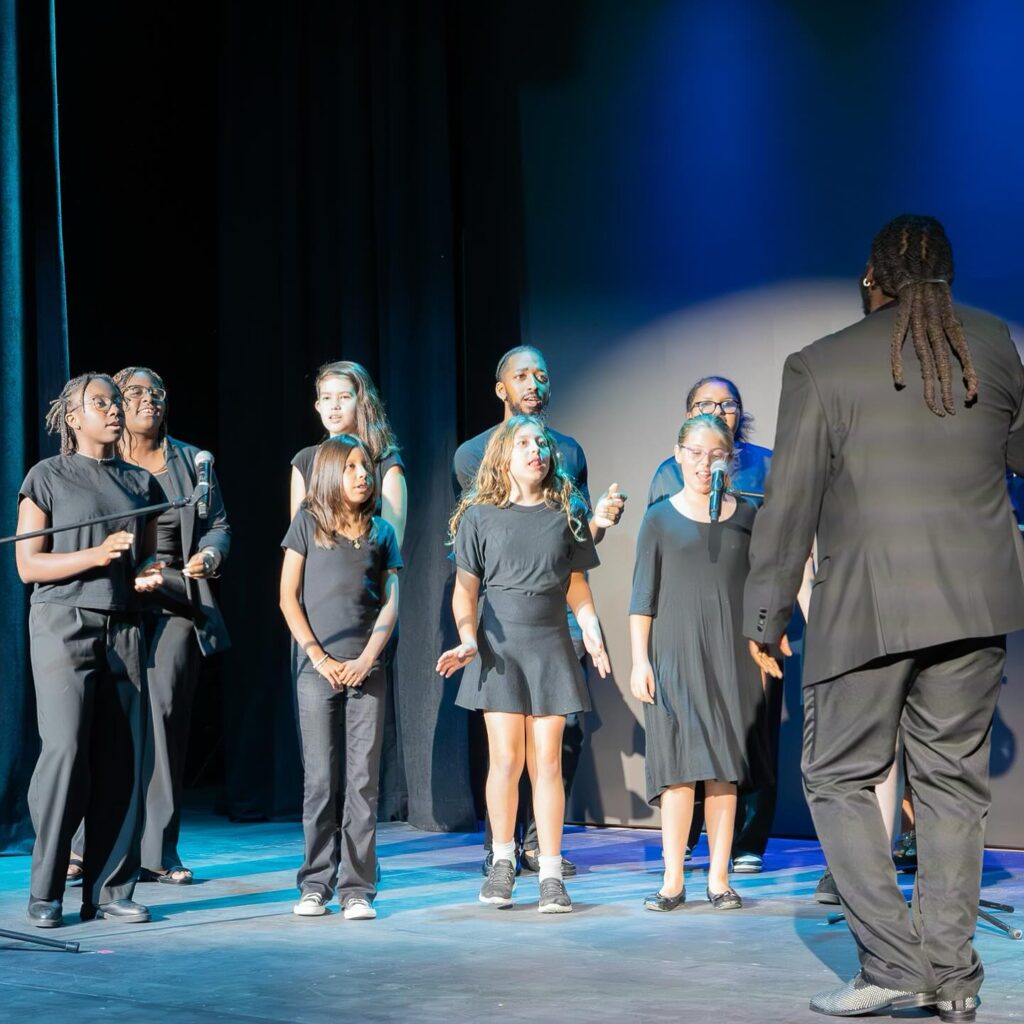
ALC is about setting children up for success. We provide performing arts classes to kids ages four to 18 on school campuses throughout Southern California, as well as at our conservatory location in Costa Mesa. At the conservatory, we have a 200-seat theater and classes in acting, singing, dancing, and instrumental music. Right now we’re in the middle of production season. We’ve got Wizard of Oz happening at several locations, plus Annie and Matilda. Six productions in three weeks.
Q: What was the personal experience that led you to start this organization?
The arts weren’t just something I chose to build a career around. They’re something I lived. I’m the youngest of seven kids. We all played stringed instruments because my mother was denied the chance to play as a child, and she turned that into a mission to make sure we all had access. Five of the seven of us went to four-year universities with scholarships because of our instruments.
But we also grew up with domestic violence in the home. When my mother finally decided to leave, she did it overnight. We escaped from Chicago and ended up in women’s shelters in Denver and then San Diego. As a 10-year-old, I was afraid of everyone. I had what I’d call major anxiety today. But across the street from one of those shelters was a performing arts magnet school. The teachers loved me. The kids thought I was incredible. That school brought me back to life. That’s why ALC exists.
Q: What did the organization look like when you first started?
I had been teaching in public schools for 10 years, conducting orchestras, the whole thing. But I kept watching music programs get cut. So I started with a summer camp. That first camp had 21 kids. We did a musical excerpt from The Sound of Music with a 13-piece string ensemble. We had so few kids for the acting portion that some of my string players had to double as nuns. They’d finish their part, run up on stage, play a townsperson, come back. It was pretty funny. The next summer we had 145 kids. Then a school called us. Then three schools. Then the county. It just kept growing from there.
Q: How is the organization structured now in terms of staff and delivery?
We have about five people on our admin team and roughly 60 teaching artists who go into schools. Early on we used volunteers and college students, but we wanted consistency, so we pay all 60 instructors. They’re degreed. If someone comes in fresh out of college, we put them through an apprenticeship before they go into classrooms.
We also run a formal apprenticeship program with the Orange County Department of Education that pays high school students to train under our staff. And we have university students doing internships with us as well. The structure is much more solid now than it was, and the results show it.
Q: You recently completed a major facility remodel. What was that moment like?
That ribbon-cutting was a long time coming. The facility itself was actually gifted to us about 10 years ago by a couple in the community who believed in the work. But we didn’t have the resources to do much with it for a while. Early on we were operating out of my garage, storing costumes and sets there. My husband wasn’t thrilled, but that’s where everything lived.
When we finally remodeled the facility three years ago and added a 200-seat theater, it changed everything. We don’t have to rent theater space anymore. We can do all our productions in-house. And because we’re a nonprofit, we see this as a real social enterprise opportunity: we rent the facility out, and that funding goes right back into the programs. Especially with grant funding slowing down the way it is now, that revenue stream matters.
Q: What would you tell a nonprofit leader who’s still in those early “operating out of your garage” days?
Get a mentor. I didn’t have one at the very beginning, and it cost me time. We all have the heart to serve, but there’s a whole other side to running a nonprofit: HR, legal, compliance, your annual filings, your 990. If you don’t have someone helping you navigate that, you’ll figure it out eventually, but it’ll take longer than it needs to.
Here in Orange County there’s a program called Executive Coaches of Orange County (EC of OC). They match you with retired executives for free. I’d also say don’t operate in a silo. Connect with other nonprofits doing similar work. Partner where it makes sense. Once I started doing both of those things consistently, the organization moved a lot faster.
Q: What does growth look like for ALC going forward?
We want to expand further into South Orange County and into San Diego. Right now we’re in Orange County, LA, and the Inland Empire. Eventually we’d like to scale across the state. But it has to be done with the same quality. That means growing our admin team alongside the program growth, which we’re actively working on. We have a wait list of schools and communities that want our programs. That’s the right problem to have, and we’re focused on building the infrastructure to meet it.
Q: How can people in your community get involved?
A few ways. Visit artsandlearning.org and click “Get Involved.” We need volunteers for our costume shop, our theater, and in schools. We’re always open to donations and sponsors. We also have a major benefit concert coming up called Gospel Voices of Orange County at the Barclay Theater in Irvine on June 27 [verify before publishing]. It’s a two-hour celebration of Black music and artistry timed to Juneteenth and Black Music Month, and we’re actively looking for sponsors. If you have kids ages four to 18, we have classes and camps at the conservatory as well. There’s something for everyone.
Three Things Nonprofit Leaders Can Take from This Episode
1. Personal experience is your strongest credibility signal. Deborah didn’t position ALC around a market opportunity. She built it around something she actually lived. Donors, schools, and community partners responded to that authenticity in ways that generic mission statements rarely produce.
2. Organic growth is a feature, not a gap in strategy. ALC didn’t grow through a formal expansion plan. Schools called. The county came to them. That kind of pull-based growth happens when the program consistently delivers value. Getting the program right matters more than getting the pitch right, at least early on.
3. Real estate and earned revenue change the sustainability equation. ALC’s 200-seat theater is more than a nice facility. It’s a revenue engine that reduces dependency on grants and individual donations. For nonprofits watching government and foundation funding tighten, building owned assets and earned income streams is worth taking seriously.