Food insecurity is rising even as household budgets stretch thinner, and food banks have become core infrastructure for hundreds of thousands of families. On this episode of the Charity Charge Show, Tom Nardacci, CEO of the Regional Food Bank of Northeastern New York, breaks down how his organization feeds roughly 350,000 people each month across 23 counties, and what nonprofit executives can learn from how he runs it. The conversation covers local food sourcing, leadership lessons from the for-profit world, and how to build funding resilience when federal support is unpredictable.
Quick Summary
- The Regional Food Bank of Northeastern New York distributes about 50 million pounds of food annually through nearly 1,000 partner agencies across 23 counties.
- Its Agricultural Hub initiative connects local farms directly to food pantries, with a goal of growing farm and produce distribution to 30 million pounds per year.
- Nardacci applies for-profit team-building and accountability practices to nonprofit operations, treating the food bank like a logistics company.
- Funding volatility, especially around SNAP, makes diversified revenue and strong funder relationships essential for any nonprofit.
About the Guest: Tom Nardacci
Tom Nardacci has served as CEO of the Regional Food Bank of Northeastern New York since August 2023. Before moving into nonprofit leadership, he founded and ran Gramercy Communications, a public relations firm he led for more than 15 years, and launched the Troy Innovation Garage, a business incubator in the Capital Region.
His connection to food access runs deep. His grandparents operated Nardacci’s Broadway Food Mart in Rensselaer, New York for 50 years, and he grew up watching them quietly feed neighbors who could not always pay. Today he leads one of the oldest food banks in the country, an organization that operates like a major grocery wholesaler with a fleet of trucks, warehouse operations, and thousands of volunteers.
The Current State of Food Insecurity
Food insecurity is at historically high levels, driven by the simple fact that a dollar no longer covers what it used to at the grocery store. Families who managed their budgets comfortably a few years ago are now visiting food pantries regularly, and many are relying on them more frequently than before.
Nardacci describes a fundamental shift in who needs help. The demand is no longer concentrated among the chronically unemployed. Working families, seniors on fixed incomes, and college students all show up in the data, which is why the Food Bank now partners with SUNY campuses to address student hunger directly.
Destigmatizing Food Assistance
Reducing stigma is one of the most effective ways to increase food access, because shame keeps eligible families from seeking help. Nardacci notes that food pantries were once tucked into church basements, intentionally out of sight. Over the past five years, the charitable food system has worked to bring these services into the open.
That visibility matters beyond food. When families feel comfortable walking into a pantry, they are more likely to connect with adjacent services like mental health support and health screenings. For nonprofit executives in any sector, the lesson is the same: how you present a service shapes whether people actually use it.
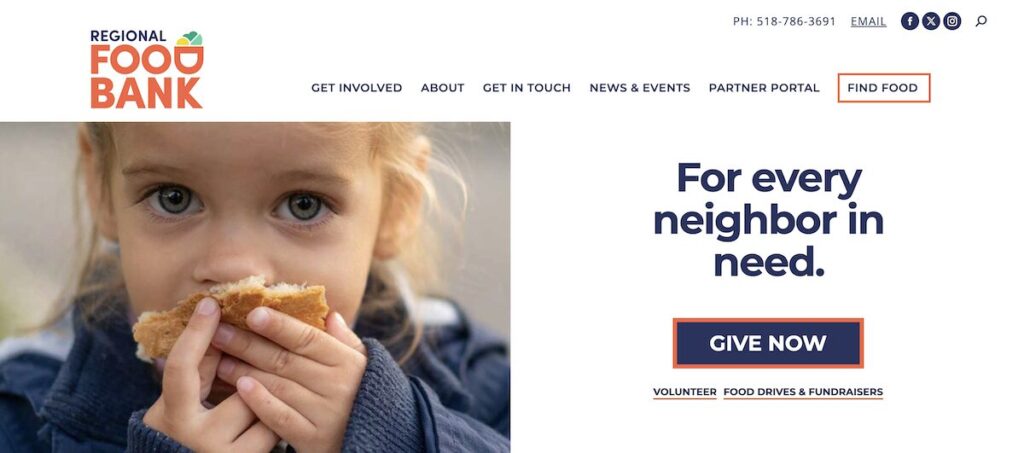
The Agricultural Hub: Connecting Local Farms to Food Banks
The Agricultural Hub is the Food Bank’s initiative to source food directly from New York farms and move it into local pantries at scale. New York is a major agricultural state, yet much of what its farms produce leaves the region. The Hub keeps that food local, with a goal of growing the Food Bank’s produce and farm product distribution to 30 million pounds per year.
The initiative builds on the Food Bank’s Patroon Land Farm, which recently marked 20 years of operation, and was kicked off with a $1 million federal grant secured by Senators Chuck Schumer and Kirsten Gillibrand. It also extends the Food Bank’s Micro Purchasing Program, which buys fresh produce from small family farms for distribution to area pantries.
Why the Agricultural Hub Model Works
Best for: Food banks and regional nonprofits building local supply chains
The Hub solves three problems at once, which is why other regions are watching it closely.
- Fresh, nutritious food: Families receive local produce and dairy instead of relying solely on shelf-stable donations.
- Support for local farmers: Family-owned farms gain a reliable buyer, keeping agricultural dollars in the regional economy.
- Logistical efficiency: The Food Bank uses its existing trucking and warehouse network to move millions of pounds of food without building new infrastructure from scratch.
Leadership Lessons: Running a Nonprofit Like a Logistics Company
Nardacci’s core leadership principle is putting the right people in the right seats, a discipline he carried over from two decades of building companies. Since taking the CEO role, he has visited food banks across the country to study best practices, introduced data analytics to manage product flow, and restructured teams around talent rather than tenure.
He pairs that operational rigor with intentional workplace culture. Employees who feel valued and connected to the mission perform better, but positivity without accountability drifts. Nardacci’s approach holds both: a supportive environment where goals are clear and results are measured.
For nonprofit executives, the takeaway is that mission and management are not in tension.
The Food Bank moves 50 million pounds of food a year precisely because it runs its logistics like FedEx, not despite it.
Navigating Funding Volatility and the SNAP Disruption
Diversified funding is the single best protection against federal uncertainty. Nardacci experienced this firsthand when the November 2025 government shutdown halted SNAP benefit issuance, an interruption he has said removed the equivalent of roughly 30 million pounds of food per month from the system. Food banks across the country scrambled to fill the gap.
His playbook for sustainability applies to any nonprofit dependent on government revenue:
- Build funder relationships before you need them. Strong ties with private and public funders create a safety net when one source disappears.
- Stay agile. Strategies should adapt to the funding landscape rather than assume last year’s budget repeats.
- Engage the community. A broad base of individual donors and local businesses cushions shocks that no single grant can absorb.
Three Takeaways for Nonprofit Executives
| Takeaway | Why It Matters |
|---|---|
| Local partnerships scale impact | Sourcing from nearby farms delivers fresher food, supports the regional economy, and uses logistics you already have. |
| Operational discipline is mission work | Data analytics, talent placement, and accountability are what turn donated dollars into delivered outcomes. |
| Never depend on one funding source | The SNAP disruption showed how fast federal support can vanish. Diversified revenue is a survival strategy, not a nice-to-have. |
Financial Tools Built for Nonprofits Like Yours
The Charity Charge Nonprofit Business Card is designed exclusively for 501(c)(3) organizations, with no annual fee, built-in spend controls, and expense management that keeps your team audit-ready. See How Charity Charge Works for Your Nonprofit
Frequently Asked Questions
The Regional Food Bank of Northeastern New York distributes about 50 million pounds of food annually to people in need across 23 counties. It supplies nearly 1,000 partner agencies, including food pantries, soup kitchens, and shelters, serving roughly 350,000 people each month.
The Agricultural Hub is a Regional Food Bank initiative that sources food directly from New York farms for distribution to local pantries. It aims to grow the Food Bank’s produce and farm product distribution to 30 million pounds per year while supporting family-owned farms.
Destigmatizing food assistance increases access because shame prevents many eligible families from seeking help. Making pantries visible and welcoming encourages more people to use them and connects families to related services like mental health and healthcare support.