Quick summary
The main comment deadline for OMB’s proposed federal financial-assistance rule passed July 13, 2026. OMB says late comments will be considered only to the extent practicable. The rule isn’t final, and October 1 isn’t guaranteed. Nonprofits shouldn’t rewrite policies based on a proposal, but they can use the weeks between now and October 1 to fix records, test cash timing, and clarify approvals.
Use the proposal to test the systems you already need
The Office of Management and Budget published a proposed government-wide revision to federal financial-assistance rules on May 29, 2026. Comments were due July 13, although OMB says it will consider late comments only to the extent practicable. OMB proposes to issue a final rule effective by October 1, 2026.
That puts nonprofit finance teams in an annoying spot. You can’t treat the proposal like current law. You also don’t want to wait for the final text and then discover your award records live in six folders, two inboxes, and one person’s memory.
The practical move is simple: don’t predict the final rule. Use the deadline to pressure-test the systems you already need.
This article isn’t legal, accounting, tax, or grant advice. It’s a finance and operations checklist to help your team find gaps and ask better questions of funders and qualified advisers.
Start with what the proposal actually says
The proposal would revise the federal financial-assistance rules commonly known as the 2 CFR 200 Uniform Guidance. Its final wording, timing, and agency guidance may change.
The National Council of Nonprofits also says the proposal doesn’t change the indirect-cost rate or the Single Audit requirement. That matters because a readiness plan built around changes that aren’t in the proposal wastes everyone’s time.
Focus on the boring operational questions instead. Can you identify every active award? Can you support every reported cost? What happens if a payment arrives 30 days late? Who can pause spending?
Those questions matter under almost any final outcome.
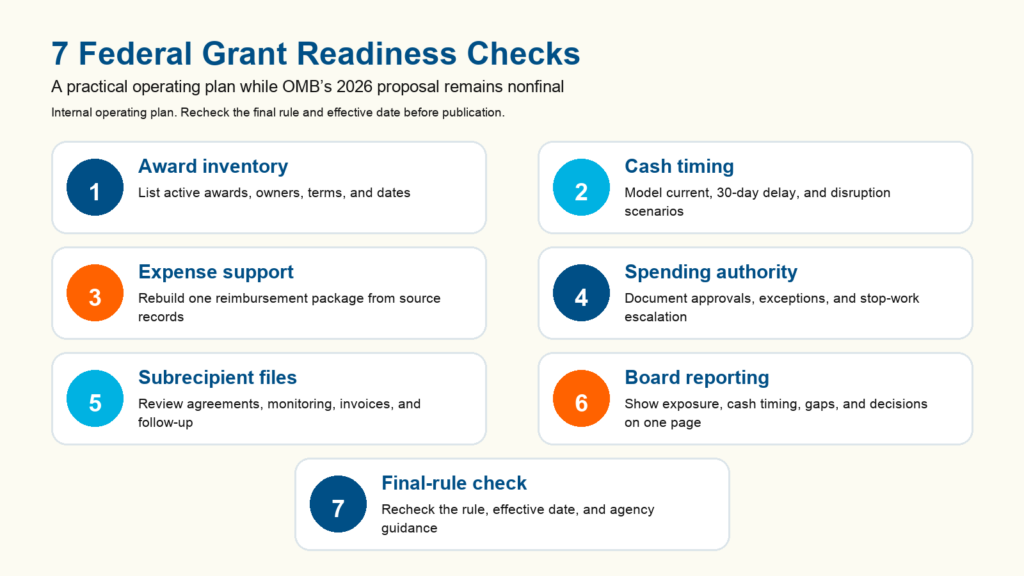
1. Put every federal award in one place
Start with a complete inventory of active federal awards and subawards. For each one, record the funding agency, pass-through entity, award number, program owner, period of performance, payment method, reporting schedule, remaining balance, subrecipients, and renewal or closeout dates.
If those awards are mixed into broad operating categories, use a clear fund accounting structure so each material grant can be traced without rebuilding the ledger every reporting period.
This isn’t a new requirement created by the proposal. Current 2 CFR 200.302 already requires financial systems to identify federal awards, support required reports, and track expenditures.
Add two fields that spreadsheets have a habit of ignoring:
- Name the person who owns the funder or pass-through relationship.
- Name the person who can pause spending if terms, timing, or funding status changes.
You don’t need to build the world’s greatest grant database in 76 days. You need a reliable map that shows where a change could cause an operating problem.
2. Model when cash arrives, not just how much was awarded
Take a simple example. A $500,000 award can look comforting on a budget, but it won’t cover Friday’s payroll if the next payment is delayed and your unrestricted cash is already committed.
Build three timing scenarios for each material award:
- Payments arrive on the current schedule.
- The next payment arrives 30 days late.
- The award is modified, paused, or ends earlier than planned.
Then answer the questions that usually get skipped. Which obligations continue? Which costs can you pause? How much unrestricted cash is available? Who approves a program or staffing change?
Don’t copy a reserve target from another nonprofit and call the work done. Your answer depends on the award terms, liquidity, program commitments, and the risks your board is willing to accept.
3. Rebuild one reimbursement package from scratch
Pick a recent reporting period and pretend the original preparer is unavailable. Can someone else move from the reimbursement request to the general ledger, then find the invoice, receipt, payroll record, approval, allocation method, and proof of payment?
Look for the breaks that create the worst cleanup work:
- Receipts or invoices are missing.
- Costs were coded to the wrong grant, fund, program, or function.
- Shared costs don’t have a documented allocation method.
- Payroll charges lack support.
- A purchase exceeded delegated authority.
- Contractor files are missing agreements or proof of completed work.
- Corrections were made without an explanation.
One test package will tell you more than another hour spent debating what OMB might do. Fix the evidence chain now and reporting, monitoring, reimbursement, and audit work all get easier.
4. Make spending authority obvious
Grant problems turn into operating problems when nobody knows who can commit funds, approve an exception, or stop spending.
Document who can approve purchases, contracts, budget revisions, payroll allocations, and subrecipient payments. Charity Charge’s guide to setting nonprofit spending limits can help turn those approval levels into a written authorization matrix. Then set an escalation path for a changed award term, questioned cost, delayed payment, or stop-work instruction.
Current 2 CFR 200.303 requires recipients and subrecipients to maintain internal control over federal awards, monitor compliance, and act promptly when they identify noncompliance.
Your policy can’t anticipate every possible event. It should answer the first four questions without a meeting: who gets notified, what spending pauses, which records get preserved, and who contacts the funder?
5. Check subrecipient files while there’s still time
If your organization passes federal funds to another entity, review every active subrecipient file. Confirm that the agreement, scope, budget, reporting expectations, monitoring notes, invoices, approvals, and follow-up actions are together and current. This review belongs inside the broader post-award grant lifecycle, not in a separate folder that only gets opened before an audit.
Current 2 CFR 200.332 sets requirements for pass-through entities, including subaward information, risk assessment, monitoring, and follow-up.
A clean prime-recipient file won’t fix missing support held by a subrecipient. Ask your grants or accounting adviser which monitoring and documentation requirements apply to each relationship because the answer can vary by arrangement and award terms.
6. Give the board one page, not 108
Board members don’t need a line-by-line analysis of the proposal. They need enough information to understand the financial exposure and the decisions management may need from them.
A one-page grant exposure summary should include:
- Active federal awards and remaining balances.
- Programs that depend most heavily on those awards.
- Near-term cash timing and major obligations.
- Documentation or subaward gaps under review.
- Decisions that would require board involvement.
- The next external milestone or funder communication.
Separate confirmed facts from planning scenarios. If an award hasn’t changed, say so. A board update should reduce confusion, not create it.
7. Use the 76 days like an operating plan
A checklist without owners and dates is a list of good intentions. Assign the work now.
This is a suggested internal work plan, not a regulatory timetable. Recalculate it if the publication date changes.
Days 1 to 15: complete the award inventory, assign owners, and find missing agreements or award terms.
Days 16 to 35: run the cash scenarios and rebuild one evidence package for each major award type.
Days 36 to 55: correct documentation gaps, review subrecipient files, and test escalation procedures.
Days 56 to 70: prepare leadership and board reporting. Send unresolved questions to funders or qualified advisers.
Days 71 to 76: check for a final rule, revised timing, or agency guidance. Update the plan from the final text instead of assumptions made during the proposal period.
What should be true by October 1
Your team may not know exactly what the final rule will say by October 1. You can still know which awards are exposed, how long programs can operate through a payment delay, where the supporting records live, who can stop spending, and what the board needs to decide.
That’s the practical goal. Better records and clearer authority help under the current rules, the proposed rules, or another round of revisions from OMB.
Charity Charge helps nonprofit teams reduce financial and administrative work so leaders can stay focused on their mission. You can find more funding and grant resources in our nonprofit grant resources guide.
Sources
- Federal Register: Regulation for Federal Financial Assistance, proposed rule, May 29, 2026
- National Council of Nonprofits: OMB Uniform Guidance
- eCFR: 2 CFR 200.302, Financial management
- eCFR: 2 CFR 200.303, Internal controls
- eCFR: 2 CFR 200.332, Requirements for pass-through entities
Frequently asked questions
No. OMB published a proposed rule on May 29, 2026. Comments were due July 13, but OMB says late comments will be considered only to the extent practicable. Check the current status before acting on any specific provision.
No source reviewed for this article supports that claim. Check each award’s current terms and any final guidance from the relevant agency or pass-through entity.
The National Council of Nonprofits says the 2026 proposal doesn’t change the Single Audit requirement or indirect-cost rate.
Start with the award inventory, payment timing, expense support, spending authority, and subrecipient records. Those areas will show you where missing information can turn into an operating problem.
Don’t treat proposal language as final. You can still correct missing records, clarify approvals, test cash scenarios, and prepare questions for funders and qualified advisers.