Spending limits at nonprofits aren’t about distrust. They’re about protecting staff from making judgment calls with organizational money, and protecting the organization from the liability that comes when those calls go wrong.
At most nonprofits, spending decisions happen dozens of times a week. Think small purchases, vendor payments, travel expenses, and team meals. Individually, none of these feel risky. But collectively, they shape how money flows through the organization, and how defensible that flow is to auditors, funders, and the public.
Without clear limits, those decisions default to human judgment. A staff member guesses what is “reasonable.” A manager gives a quick verbal approval. Finance cleans it up later. It works until it doesn’t.
That’s where problems start to compound. Inconsistent approvals. Missing documentation. Expenses that technically violate policy, even if they were made in good faith. By the time it shows up in your books or on your Form 990, it’s already messy.
Well-structured spending limits fix this upstream. They remove ambiguity at the point of purchase. They give staff confidence in what they can spend, and just as importantly, what they shouldn’t. They also create a clean, repeatable system that holds up under audit scrutiny.
For teams managing federal awards, this federal grant readiness plan shows how approval limits fit with award records, cash timing, expense support, and stop-work escalation.
Done right, spending limits don’t slow your team down. They do the opposite. They eliminate back-and-forth approvals, reduce reimbursement friction, and let finance teams close the books faster with fewer surprises.
Quick Summary
- Spending limits should be set by role and transaction type, not as a single organization-wide cap
- IRS accountable plan rules require documentation within 60 days and return of excess funds within 120 days
- Board members should follow the same expense documentation standards as staff
- Corporate card programs with per-card controls are the most efficient way to enforce limits
- Authorization levels should be written into your financial policies manual and reviewed annually
Why Spending Limits Matter More Than Most Nonprofits Realize
Most small and mid-size nonprofits either don’t have a formal spending policy or rely on something outdated and unenforceable.
The result is predictable. Staff make informal decisions. Executive directors approve things verbally. Finance teams reconstruct everything at month-end.
That creates three real risks.
1. Staff Are Forced Into Governance Decisions
A program coordinator shouldn’t be deciding whether a $200 dinner is acceptable. That’s a policy decision, not an operational one.
Clear limits remove that ambiguity.
2. Audit Exposure Increases
Form 990 is public. Donors, watchdogs, and regulators can see how expenses are categorized.
If documentation is weak or approvals are inconsistent, it raises flags quickly.
3. Private Inurement Risk
Under IRS rules for 501(c)(3) organizations, insiders can’t benefit from organizational funds.
That includes executive directors, board members, and key staff.
Unclear spending authority is one of the easiest ways to cross that line accidentally.
How to Structure Spending Authority by Role
The most defensible approach is a tiered authorization matrix. Different roles have different limits, with clear escalation points.
Example Spending Authority Framework
| Role | Per-Transaction Limit (No Pre-Approval) | Monthly Limit | Requires Second Approval Above |
|---|---|---|---|
| Program Staff | $75 | $250 | $76 |
| Program Manager | $250 | $1,000 | $251 |
| Department Director | $500 | $2,500 | $501 |
| Executive Director | $2,500 | Budgeted amount | $2,501 |
| Board Chair / Executive Committee | Per board resolution | Per board resolution | Varies |
These numbers aren’t universal.
A nonprofit with field staff traveling regularly will need higher limits than a policy-focused organization with minimal expenses.
The principle is simple:
Limits should be high enough to avoid constant approvals, but low enough to control risk.
What Board Members Can and Can’t Spend
Board members sit in a tricky position. They’re volunteers, but also fiduciaries.
Most nonprofits get this wrong in one of two ways:
- No expense policy for board members at all
- Looser rules because board members are seen as donors
Both create problems.
What Board Members Can Expense
- Travel to board meetings
- Conference registration (when representing the organization)
- Meals tied to official board activities
What They Must Do
Board members must follow the same documentation standards as staff:
- Submit receipts
- Provide a business purpose
- Include dates, locations, and attendees (for meals)
- Submit within 60 days
Common Risk
Board members using personal cards and submitting large reimbursements with little documentation.
That’s a pattern auditors notice immediately.
The IRS Accountable Plan: The Baseline Requirement
Every nonprofit reimbursement policy must meet IRS accountable plan rules.
If it doesn’t, reimbursements become taxable income.
The Three Requirements
1. Business Connection
The expense must directly relate to organizational work.
2. Adequate Accounting
Must include:
- Amount
- Date
- Location
- Business purpose
- Names of participants (for meals)
- Receipts (commonly required above $75)
3. Return of Excess Funds
Overpayments must be returned within 120 days.
If any of these fail, the reimbursement becomes wages and triggers payroll tax obligations.
Using Card Programs to Enforce Spending Limits
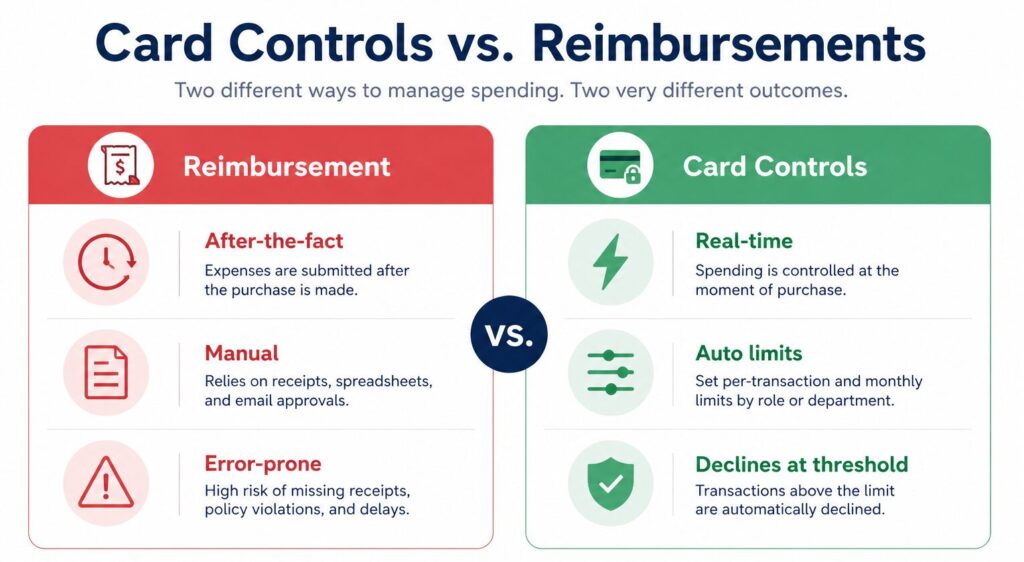
Reimbursement systems rely on after-the-fact control.
Card programs enforce limits in real time.
That’s the difference.
Key Controls You Can Set
- Per-card monthly limits tied to roles (the foundation of a nonprofit P-card program)
- Per-transaction caps to control single purchases
- Merchant category restrictions (e.g., block airlines or entertainment)
- Virtual cards for one-time vendor payments
Example:
A staff card with a $500 monthly limit simply declines at $501. No judgment call, no policy debate.
This removes friction for staff and reduces cleanup work for finance teams.
How to Write a Spending Policy That Holds Up
A policy that actually works needs six components.
1. Scope
Define who the policy applies to:
- Employees
- Contractors
- Board members
- Authorized volunteers
2. Authorization Matrix
Include a clear table or structured thresholds by role.
3. Documentation Requirements
Define:
- Receipt thresholds
- Required details
- Submission timelines
4. Approval Chain
Clarify who approves whose expenses.
Important:
The executive director should not approve their own expenses.
5. Out-of-Policy Handling
Define what happens when:
- Limits are exceeded
- Purchases fall outside approved categories
Include escalation steps, not just restrictions.
6. Annual Review
Tie policy updates to your budgeting cycle.
Common Mistakes to Avoid
One Limit for Everyone
Creates unnecessary friction and constant exceptions.
Executive Director Self-Approval
A governance red flag. Often flagged in audits.
Undefined Pre-Approval
“Pre-approval required” isn’t enough. Define:
- Who approves
- How (email, system, etc.)
- What must be documented
Ignoring Board Expenses
Board members often submit late or incomplete reports.
That’s an avoidable audit risk.
Set Up Spending Controls That Actually Work
Spending policies only work if they’re enforced consistently.
That’s where infrastructure matters.
Charity Charge Corporate Cards are built specifically for nonprofit expense management, allowing organizations to:
- Issue cards with role-based limits
- Restrict spending categories
- Track expenses in real time
- Sync directly with accounting systems like QuickBooks, Sage Intacct, and NetSuite
See how Charity Charge handles nonprofit spending controls and card management.