2 CFR 200, the Uniform Guidance, is the federal government’s master rulebook for all federal grant awards. It covers how funds must be managed, how costs are classified, what audits are required, and how subrecipients must be monitored.
The 2024 revision, effective for awards issued on or after October 1, 2024, introduced the most significant changes to the Uniform Guidance in a decade. If your organization receives federal funding, these changes affect you now.
OMB also proposed a broader government-wide revision in May 2026. Our 2026 federal grant readiness checklist explains what nonprofit finance teams can pressure-test while that proposal remains nonfinal.
Quick Summary
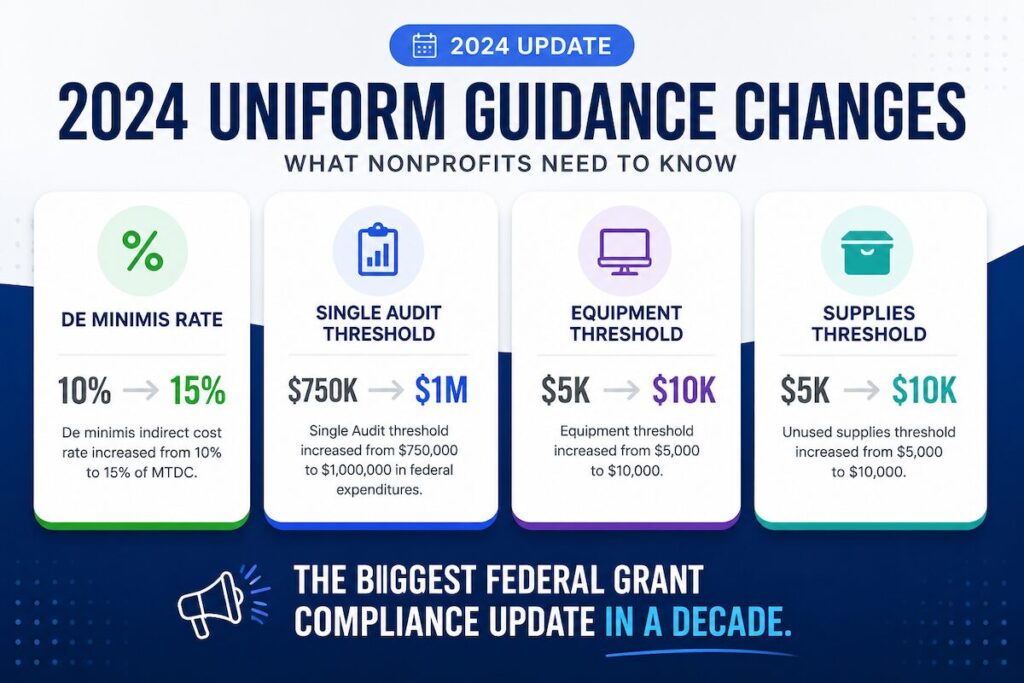
- The 2024 revision raised the de minimis indirect cost rate from 10% to 15% of modified total direct costs (MTDC).
- The single audit threshold increased from $750,000 to $1,000,000 in federal expenditures per fiscal year.
- Equipment and unused supplies thresholds both increased from $5,000 to $10,000.
- Internal controls under Section 200.303 are not optional and are the most frequently cited weakness in federal audits.
- Subrecipient monitoring and procurement documentation remain the top sources of audit findings for nonprofits.
What Is 2 CFR Part 200?
2 CFR Part 200 is the government-wide framework that governs how federal grant funds are administered. OMB first consolidated these rules in 2014, replacing the old A-122, A-110, and A-133 circulars with a single unified document.
It applies to all non-federal entities receiving federal awards, including nonprofits, state agencies, universities, and tribal governments. If your organization receives any federal funding, directly or as a pass-through subrecipient, 2 CFR 200 governs how you spend it.
The regulation is organized into six subparts:
| Subpart | Topic |
|---|---|
| A | Acronyms and Definitions |
| B | General Provisions |
| C | Pre-Federal Award Requirements |
| D | Post-Federal Award Requirements |
| E | Cost Principles |
| F | Audit Requirements (Single Audit) |
What Changed in the 2024 Revision
OMB finalized the 2024 revision in April 2024. Most provisions took effect for new federal awards issued on or after October 1, 2024. The Subpart F audit changes apply to fiscal years beginning on or after October 1, 2024.
Indirect Cost Rate: 10% to 15%. Organizations without a negotiated indirect cost rate agreement (NICRA) may now elect a de minimis rate of up to 15% of MTDC. This is up from 10%. Indirect costs, things like rent, utilities, and shared administrative salaries, are often underfunded in federal grants. The higher de minimis rate lets organizations recover more overhead without negotiating a formal rate agreement. Federal agencies cannot require an organization to use a rate lower than what they’re eligible for under the de minimis provision.
Equipment and Supplies Thresholds. The equipment threshold increased from $5,000 to $10,000. The same $10,000 threshold now applies to unused supplies. Purchases below $10,000 can be expensed directly without triggering the formal property disposition requirements under Section 200.313.
Single Audit Threshold. Organizations expending $1,000,000 or more in federal funds in a fiscal year must now undergo a Single Audit (previously $750,000). This is a meaningful change for mid-size nonprofits that were previously subject to Single Audit requirements but now fall below the new threshold. Falling below the $1,000,000 threshold does not eliminate compliance obligations. All Uniform Guidance rules still apply.
Plain Language Rewrites. OMB rewrote significant sections in plain language to reduce ambiguity. Several terms that generated conflicting interpretations, including the distinction between “contractor” and “subrecipient,” received clarified definitions.
The Seven Requirements That Generate the Most Audit Findings
Federal auditors consistently identify the same problem areas across nonprofit single audits. These aren’t obscure requirements. They’re the core of what 2 CFR 200 demands.
1. Internal Controls (Section 200.303)
Organizations must establish, document, and maintain effective internal controls over every federal award. The standard is “reasonable assurance” that the organization is managing funds in compliance with federal statutes, regulations, and award terms.
OMB points organizations to two frameworks: the GAO’s Green Book and the COSO Internal Control-Integrated Framework. Auditors cite internal control deficiencies more often than any other finding. The most common gaps are lack of written policies, missing segregation of duties, and no documented review process for grant expenditures.
2. Subrecipient Monitoring (Sections 200.331-200.333)
If your organization passes federal funds to another entity, you’re a pass-through entity (PTE) and must monitor that subrecipient. This includes evaluating the subrecipient’s risk of noncompliance before making the subaward, providing all required award information, reviewing financial and performance reports, and conducting site visits or desk reviews proportionate to risk.
Misclassifying a subrecipient as a vendor is one of the most common single audit findings. A vendor provides a commercial service uniformly available to the public. A subrecipient carries out a portion of the federal program. The distinction matters because vendor relationships don’t require the same monitoring obligations.
3. Procurement (Sections 200.318-200.327)
All non-federal entities must have written procurement policies. Competitive bidding is required above specific dollar thresholds, and sole-source justifications must be documented when competition is bypassed.
| Purchase Amount | Requirement |
|---|---|
| Below $10,000 | Micro-purchase; no competition required (organization policy may set lower threshold) |
| $10,000 to $250,000 | Price or rate quotations from a reasonable number of qualified sources |
| Above $250,000 | Full formal procurement process required |
Auditors regularly flag contracts awarded above policy thresholds without documented competitive bidding. This finding is avoidable with a written procurement checklist applied consistently.
4. Allowable Costs (Subpart E)
Costs charged to a federal award must be necessary and reasonable for the performance of the award, allocable (the award benefits from the cost in proportion to what is charged), consistently treated across both federal and non-federal activities, and adequately documented. The most common allowable cost issues involve personnel charges.
5. Time and Effort Documentation
Personnel costs are typically the largest line item in a nonprofit grant budget. The Uniform Guidance requires that payroll records accurately reflect the work performed and are supported by documentation that can withstand audit scrutiny. A signed timesheet is the minimum. For employees splitting time across multiple awards or between a federal award and general operations, allocation documentation is required.
6. Schedule of Expenditures of Federal Awards (SEFA)
The SEFA is a schedule in a nonprofit’s financial statements that lists all federal awards expended during the year. Common errors include omitting federal funds passed through a state agency (state pass-through awards still count as federal expenditures), misclassifying award types, and missing CFDA numbers. Excluding state pass-through grants from the SEFA is a material weakness.
7. Reporting Deadlines
Federal awards include performance and financial reporting requirements with specific deadlines. Missing those deadlines is a compliance finding. Most federal agencies require quarterly or semi-annual performance reports and a final report within 90 days of the award end date. Build reporting deadlines into your calendar system at the time of award setup, not at the end of the period.
Internal Controls Nonprofits Should Have in Place
Most audit findings trace back to a failure of internal controls, not a failure of intent. The controls below address the most common gaps.
- Expense Authorization: Every expense charged to a federal award should require approval by someone other than the person initiating the transaction. This segregation of duties is the baseline requirement under Section 200.303.
- Grant Coding: Expenses must be coded to the correct fund and program at the time of entry, not retroactively. A chart of accounts structured around your grant portfolio makes this easier. Fund accounting software (QuickBooks Nonprofit, Sage Intacct, NetSuite) supports this natively.
- Monthly Budget-to-Actual Review: Finance staff should reconcile actual grant expenditures against the approved budget every month. Variances should be investigated and documented. This is how you catch allocation errors before the auditor does.
- Procurement Checklist: Every purchase above your organization’s micro-purchase threshold should go through a written checklist confirming compliance with your procurement policy before the purchase order is issued.
- Subrecipient Risk Assessment: Before issuing a subaward, document your assessment of the subrecipient’s risk. A one-page assessment covering prior experience, Single Audit history, and staff capacity is defensible.
- Documentation Retention: The Uniform Guidance requires records to be retained for three years after the final expenditure report, or longer if required by award terms or ongoing litigation. Set a retention schedule and apply it consistently.
How the 2024 Changes Affect Your Grant Budget
The de minimis indirect cost rate increase is the most financially significant change for nonprofits without a negotiated rate.
If your organization previously used a 10% de minimis rate and has $500,000 in MTDC on a federal award, you were recovering $50,000 in indirect costs. At 15%, that becomes $75,000. A $25,000 increase per award compounds across a multi-funder portfolio. Organizations that haven’t updated their indirect cost methodology since October 2024 may be leaving money on the table. Review your rate elections on any new awards.
The equipment threshold increase also has a practical effect on grant budgets. Purchases below $10,000 that previously required tracking as capital assets can now be expensed directly. This simplifies equipment management for organizations without a dedicated asset tracking system.
Frequently Asked Questions
2 CFR Part 200, known as the Uniform Guidance, is OMB’s set of administrative, cost, and audit requirements for all entities receiving federal financial assistance. It applies to nonprofits, state and local governments, universities, and tribal organizations that receive federal grants, contracts, cooperative agreements, or pass-through subawards.
Organizations that expend $1,000,000 or more in federal funds in a fiscal year must undergo a Single Audit under 2 CFR 200 Subpart F. This threshold increased from $750,000 and applies to fiscal years beginning on or after October 1, 2024. Organizations below the threshold are still subject to all other Uniform Guidance requirements.
Organizations without a negotiated indirect cost rate agreement may elect a de minimis rate of up to 15% of modified total direct costs (MTDC). This increased from 10% under the 2024 revision, effective for awards issued on or after October 1, 2024. Organizations may elect a lower rate, but federal agencies cannot require one below the eligible de minimis amount.
The most common findings involve subrecipient monitoring failures (especially misclassification of subrecipients as vendors), procurement without documented competitive bidding, internal control deficiencies, incomplete or inaccurate SEFA reporting, and time and effort documentation gaps.
Violations can result in audit findings classified as material weaknesses or significant deficiencies, repayment demands for disallowed costs, suspension of award payments, and in serious cases, debarment from future federal funding. The consequences scale with the severity and whether the organization took corrective action.