Nonprofit board member compensation is any financial or in-kind benefit paid to individuals serving on a nonprofit’s board of directors. The IRS permits it for 501(c)(3) organizations, provided the amount is reasonable, properly approved, and disclosed on Form 990. Most small nonprofits rely on unpaid volunteer boards, but mid-size and large organizations increasingly use compensation to recruit experienced governance leaders.
This guide covers IRS requirements, typical pay ranges, legal risks, and the disclosure obligations that come with compensating board members.
Overview
Is Nonprofit Board Member Compensation Legal?
Nonprofit board member compensation is legal under federal tax law. Section 4958 of the Internal Revenue Code allows 501(c)(3) organizations to pay board members, as long as the compensation meets the IRS “reasonable compensation” standard. Amounts that exceed what a similarly situated organization would pay for similar services are classified as excess benefit transactions, triggering intermediate sanctions penalties against both the organization and the individual.
The IRS does not set a specific dollar cap. Instead, it evaluates reasonableness using comparability data — what peer organizations pay board members for comparable governance responsibilities.
How Much Is Nonprofit Board Member Compensation?
Compensation ranges vary significantly based on organizational size, revenue, and governance complexity:
| Organization Type | Annual Revenue | Typical Compensation Range |
|---|---|---|
| Small nonprofits | Under $1M | $0 — volunteer or expense reimbursement only |
| Mid-size nonprofits | $1M — $10M | $5,000 — $15,000 |
| Large nonprofits | $10M+ | $15,000 — $50,000 |
| Major foundations | $50M+ | $50,000 — $100,000+ |
| International NGOs | Varies | $25,000 — $75,000 |
These figures represent total compensation inclusive of stipends, per diem, and allowances.
Most nonprofits in the $5M — $10M revenue range offer modest stipends or per diem payments rather than formal salaries. Expense reimbursement for travel, meals, and lodging is the most common form of compensation at all budget levels.
What Forms Does Nonprofit Board Member Compensation Take?
Nonprofits can structure board compensation several ways, each with distinct tax treatment:
- Stipends – Fixed periodic payments; treated as ordinary taxable income. Requires W-2 or 1099 issuance.
- Per diem allowances – Daily payments for meeting attendance; taxable above IRS per diem rates.
- Expense reimbursements – Non-taxable when paid under an IRS-compliant accountable plan with receipts and business purpose documentation.
- Honorariums – One-time payments for specific advisory contributions; taxable income reported on 1099.
- In-kind benefits – Event access, professional development, travel perks; may be taxable depending on value and structure.
The most legally defensible approach is reimbursement under an accountable plan, since it avoids payroll complexity and tax withholding obligations.
Guide: How to Start a Nonprofit Board: A Step-by-Step Guide
IRS Rules for Nonprofit Board Member Compensation
Three IRS requirements govern nonprofit board member compensation:
1. Reasonable compensation standard. Compensation must be comparable to what similarly situated organizations pay for similar services. The IRS uses a rebuttable presumption of reasonableness when an independent body approves compensation using documented comparability data.
2. Conflict of interest controls. Board members who are being compensated must not participate in the vote to approve their own compensation. Many nonprofits establish a dedicated compensation committee of non-compensated members for this purpose.
3. Form 990 disclosure. All compensation paid to officers, directors, and key employees must be reported publicly on Form 990, Part VII. Individuals receiving more than $150,000 in total compensation require additional disclosure on Schedule J.
Failure to follow these requirements can trigger IRS intermediate sanctions, result in excise taxes, and — in extreme cases — jeopardize the organization’s 501(c)(3) status.
State Law Considerations
State nonprofit statutes vary significantly. Some states, including California, impose additional restrictions on board compensation and require heightened conflict of interest disclosures beyond IRS minimums. Other states have no specific limits but require compensation to be authorized in the organization’s bylaws. Before implementing or modifying a board compensation policy, nonprofits should review their state’s nonprofit corporation act and consult legal counsel familiar with that jurisdiction.
Pros and Cons of Nonprofit Board Member Compensation
Reasons to compensate:
- Attracts professionals with finance, legal, or industry expertise who otherwise prioritize paid opportunities
- Acknowledges the time burden on boards overseeing complex organizations
- Can reduce board turnover and improve governance continuity
- May increase accountability — compensated members often take fiduciary duties more seriously
Risks and tradeoffs:
- Creates public scrutiny, especially for donor-funded organizations where optics matter
- Adds administrative overhead: payroll, tax filings, W-2/1099 issuance
- Strains budgets at smaller organizations where program funding competes for the same dollars
- Increases IRS audit risk if compensation is not documented using proper comparability data
The decision is ultimately a governance call. Organizations should weigh the talent acquisition benefit against both the financial cost and the reputational considerations specific to their donor base and community.
Best Practices for Nonprofit Board Member Compensation
1. Benchmark using public Form 990 data. IRS 990 filings are publicly searchable on the ProPublica Nonprofit Explorer. Pull compensation data from three to five comparable organizations to establish a defensible range.
2. Get independent committee approval. The IRS’s rebuttable presumption of reasonableness requires that a board body with no financial interest in the outcome approve compensation decisions. Document the meeting, the comparables reviewed, and the rationale.
3. Build a written policy. A formal board compensation policy should define eligibility criteria, payment structure, approval process, and disclosure procedures. The policy itself should be approved by the full board and reviewed periodically.
4. Use an accountable plan for reimbursements. If the goal is covering expenses rather than paying stipends, implement an IRS accountable plan. This eliminates payroll complexity and keeps reimbursements non-taxable for the board member.
5. Disclose proactively. Don’t wait for a Form 990 to tell the story. Include board compensation disclosures in your annual report and on your website if compensation is a meaningful number. Donors who find it themselves are far less concerned than donors who feel it was hidden.
Frequently Asked Questions
In most nonprofits, board service is unpaid. Compensation is more common in large organizations, foundations, or international NGOs where governance demands are significant and time commitments are high.
Yes, it is legal if compensation is reasonable, documented, and approved under proper governance procedures. It must comply with IRS rules, state laws, and the organization’s bylaws.
The biggest risks are public backlash, conflicts of interest, and IRS scrutiny. Poorly structured compensation can damage trust or trigger penalties for excess benefit transactions.
Decisions should be made by independent, non-compensated board members. Compensation should be benchmarked, documented, and supported by a written conflict of interest policy.
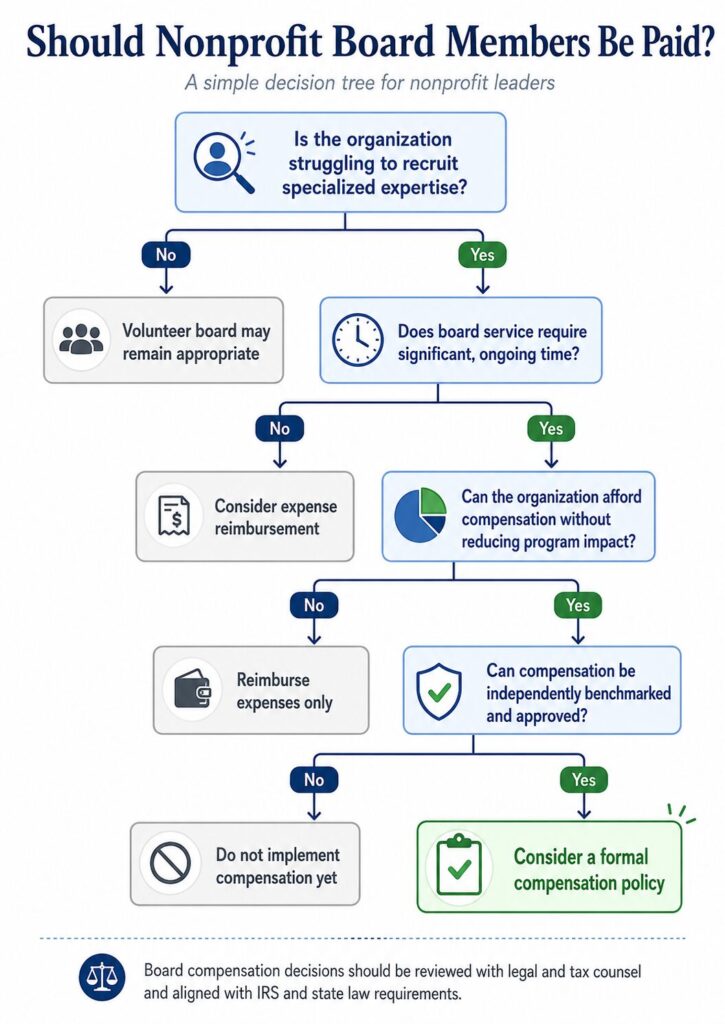
Compensation may make sense when the organization requires specialized expertise, significant time commitments, or operates at a scale where volunteer governance is no longer realistic.