Claude is an AI assistant built by Anthropic that nonprofit organizations can use to reduce administrative burden, improve donor communications, strengthen grant applications, and streamline financial operations. Recently, Anthropic launched Claude for Nonprofits, a formal program offering eligible organizations up to 75% off Team and Enterprise plans, new integrations with nonprofit software, and a free AI training course.
This guide covers both the program itself and the most practical use cases for nonprofits putting Claude to work.
What you will find in this guide:
What Is Claude for Nonprofits?
Claude for Nonprofits is Anthropic’s program to help mission-driven organizations use AI more effectively. It launched in partnership with GivingTuesday and includes three components: discounted access to Claude, new connectors to nonprofit software platforms, and a free educational course.
The program was shaped by nonprofits already using Claude before the formal launch. Organizations like the Epilepsy Foundation, the International Rescue Committee, and IDinsight provided direct feedback on what works and what does not, which Anthropic used to design the program around real operational needs.
The Discount: Up to 75% Off Team and Enterprise Plans
Eligible nonprofits can receive up to 75% off Claude’s Team and Enterprise plans. This is the most significant element of the program for most organizations.
| Plan | Best For | Key Features |
|---|---|---|
| Team | Smaller nonprofits collaborating across departments | Shared projects, organizational knowledge, collaboration tools |
| Enterprise | Larger nonprofits with security and compliance requirements | Advanced security, administrative controls, priority support |
Both discounted plans include access to Claude Opus 4.6, Claude Sonnet 4.5, and Claude Haiku 4.5. Opus 4.6 handles the most complex tasks. Sonnet 4.5 is Anthropic’s recommendation for grant writing and program analysis. Haiku 4.5 offers fast performance for high-volume, lighter tasks.
Real Nonprofits Already Using Claude: What the Data Shows
Before the formal program launched, several organizations were already using Claude and shared concrete results with Anthropic.
- Epilepsy Foundation: Deployed Claude to provide 24/7 support to 3.4 million Americans living with epilepsy
- International Rescue Committee: Uses Claude to communicate with local partners and analyze field data faster in time-sensitive humanitarian settings
- IDinsight: Reports working up to 16x faster on research and analysis tasks
- SkillUp and Robin Hood: Use Claude for coding and administrative work that would otherwise require significantly more resources
Anthropic also piloted Claude with more than 60 grantee organizations through the Constellation Fund, Robin Hood, and Tipping Point Community, focusing on grant proposals, program impact analysis, donor stewardship, and board documentation.
New Connectors: Blackbaud, Candid, and Benevity
Claude for Nonprofits added three open-source connectors to platforms nonprofit teams already use, allowing Claude to pull data directly from these systems rather than requiring staff to manually copy and paste information.
| Platform | What It Does | How Nonprofits Use It with Claude |
|---|---|---|
| Blackbaud | CRM and fundraising platform | Donor management, campaign tracking, giving optimization |
| Candid | Nonprofit and funder data | Discovering organizations, grants, and philanthropic opportunities |
| Benevity | 2.4+ million validated nonprofits | Volunteering and donation searches directly within Claude |
Claude already supports connectors for Microsoft 365, Google Workspace, Asana, Slack, and Box. Anthropic is also working with The Bridgespan Group, Idealist Consulting, Vera Solutions, and Slalom to help nonprofits with strategy, impact measurement, and organization-wide implementation.
AI Fluency for Nonprofits: Free Training Course
In partnership with GivingTuesday, Anthropic developed AI Fluency for Nonprofits, a free course available through Anthropic Academy. It requires no technical background and is designed for staff new to AI.
The curriculum covers grant writing, program evaluation, donor engagement, and organizational efficiency. Anthropic supplements the course with step-by-step prompt guides for key nonprofit workflows including grant writing and impact reporting.
How Nonprofits Can Use Claude: Top Use Cases
Below are the workflows where Claude delivers the most measurable time savings for nonprofit teams.
Grant Writing and Funder Communications
Grant writing is one of the highest-leverage use cases. The average grant proposal takes 20 to 40 hours to write. Claude compresses research, drafting, and revision cycles significantly when given clear inputs.
- Draft narrative sections based on your program data and funder guidelines
- Rewrite existing grant language to match a new funder’s tone and priorities
- Summarize long RFPs and identify required sections
- Generate budget justification narratives from line-item data
- Review drafts for alignment with funder criteria and flag gaps
Sample prompt: “You are an expert grant writer. I am applying to [Funder Name] for a $75,000 grant to support our workforce development program serving formerly incarcerated adults in [City]. Here is our program description: [paste]. Here are the funder’s priorities from their RFP: [paste]. Write a 750-word project narrative that directly addresses the funder’s goals and includes our outcomes data.”
Donor Communications and Stewardship
Personalized, timely communication directly influences donor retention. Claude helps produce higher volumes of quality communication without proportionally increasing staff time.
- Drafting acknowledgment letters segmented by donor level and gift type
- Writing appeal email sequences for annual fund, year-end, and matching gift campaigns
- Creating impact reports tailored to major donors vs. general supporters
- Generating board member thank-you scripts for phone outreach
- Personalizing lapsed donor re-engagement messages
Sample prompt: “Write a warm, professional acknowledgment letter for a $500 first-time donor to our food bank. Mention that their gift provides 1,500 meals. Avoid generic language. Tone: personal and specific. Length: 200 words.”
Financial Operations and Expense Management
Nonprofit finance teams deal with fund accounting, restricted grant tracking, board-level reporting, and compliance documentation, often with lean staff. Claude accelerates several of these workflows.
| Task | How Claude Helps | Time Saved (Est.) |
|---|---|---|
| Policy drafting | Write or update expense policies, card use policies, travel reimbursement guidelines | 3-6 hours |
| Board report narratives | Turn financial statements into plain-English summaries for non-finance board members | 2-4 hours |
| Budget narratives | Draft program budget justifications for restricted grants or board approval | 2-5 hours |
| Vendor communication | Write payment dispute letters, vendor onboarding checklists, AP procedure docs | 1-3 hours |
| Audit prep | Summarize audit findings, draft management response letters, organize documentation checklists | 4-8 hours |
Program Reporting and Impact Documentation
Funders, boards, and major donors all require program reports. Claude converts raw data and outcome numbers into narrative form so program staff can stay focused on service delivery.
- Drafts mid-year and final grant reports from your data and notes
- Writes logic model summaries and theory of change documents
- Creates plain-language summaries of evaluation findings
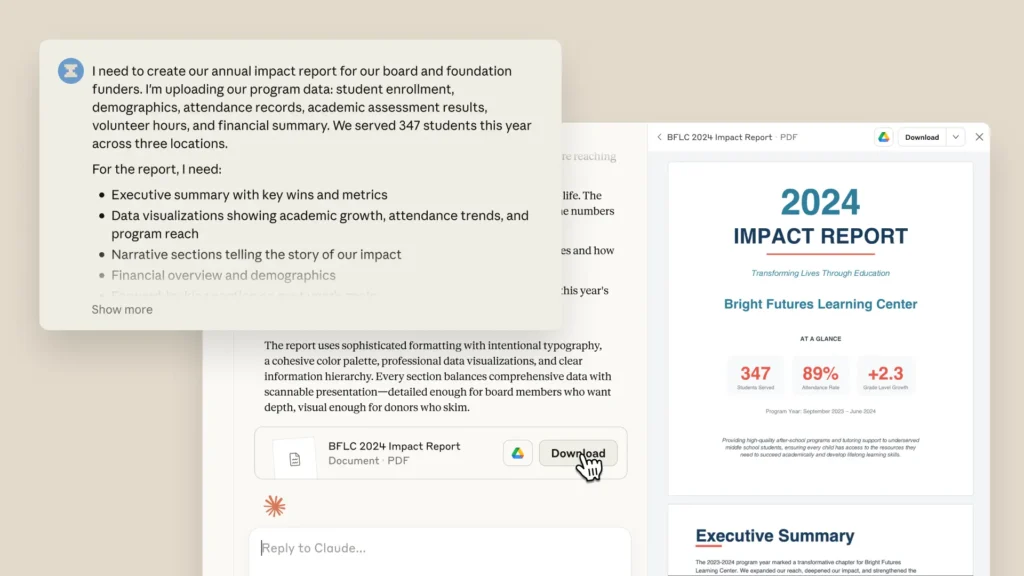
- Generates annual report content: mission impact, program highlights, financials overview
Sample prompt: “Write a 500-word mid-year report narrative for the [Funder Name] grant supporting our after-school tutoring program. Outcomes so far: 142 students served, 78% improved reading scores by at least one grade level, 3 new school partnerships. Grant goals: 150 students, 70% reading improvement, 2 school partnerships. Acknowledge the positive variance on two metrics and explain the enrollment shortfall.”
Board Communications and Governance
Claude helps nonprofit staff produce cleaner board materials without adding hours to their workload.
- Board meeting agendas with supporting context for each item
- Plain-English summaries of complex legal or regulatory updates
- New board member orientation documents and policy summaries
- Committee charters and terms of reference
Human Resources and Staff Management
Nonprofit HR teams are often one-person operations supporting organizations of 20 to 200 staff. Claude handles documentation and drafting tasks that consume disproportionate time.
- Job description drafting and updating
- Employee handbook sections and policy updates
- Performance review frameworks and evaluation templates
- Onboarding checklists and new hire documentation
How to Write Effective Prompts for Nonprofit Tasks
Claude performs significantly better with structured, specific prompts. These five elements, included in every prompt, will improve output quality across nearly every nonprofit use case.
| Element | What to Include | Example |
|---|---|---|
| Role | Tell Claude who it is | “You are an experienced nonprofit grant writer.” |
| Context | Describe your org and situation | “We are a 501(c)(3) workforce development nonprofit in Chicago.” |
| Task | State the specific deliverable | “Write a 750-word project narrative.” |
| Data / Inputs | Paste in relevant info | “Here is our program description: [paste]” |
| Format constraints | Length, tone, structure | “Use formal language. Include three subheadings.” |
Common prompting mistakes to avoid:
- Too vague: “Write a grant proposal” produces generic output. Always specify funder, program, data, and word count.
- No context: Claude does not know your organization. Paste in your mission statement, program descriptions, and outcomes data.
- Single turn: Use follow-up prompts to refine length, tone, or specificity.
- Ignoring hallucination risk: Claude may generate plausible-sounding statistics that are incorrect. Verify all specific claims before use in official documents.
Limitations and Risks Nonprofits Should Know
Claude is a powerful tool with real limitations that nonprofit leaders need to understand before relying on it for important outputs.
- No real-time information: Claude’s training data has a knowledge cutoff. It cannot pull current funder priorities or IRS updates without a web search tool enabled.
- Hallucination risk: Claude can produce confident-sounding text that is factually wrong. This is especially risky in grant writing where incorrect data could damage funder relationships.
- No organizational memory: Claude does not remember previous conversations by default. Re-provide your organizational context at the start of each new session.
- Not a legal or financial advisor: For questions about UBIT, Form 990 compliance, restricted fund accounting, or employment law, always consult a qualified professional.
- Style drift: Outputs can feel generic without strong prompting. Build an organizational context document you can paste into prompts consistently.
Recommended risk mitigation:
- Create a one-page organizational context document and include it in every Claude session
- Always have a staff member review AI-generated content before external use
- Never submit grant applications without verifying all statistics Claude produced
- Build a prompt library and save high-performing prompts for reuse across your team
How to Access Claude for Nonprofits
To apply for the nonprofit discount and access the AI Fluency for Nonprofits course, visit Clause for Nonprofits. Eligibility requirements and the application process are outlined on Anthropic’s program page.
Organizations looking for hands-on implementation support can connect with Anthropic’s service partners including The Bridgespan Group and Idealist Consulting, which specialize in nonprofit technology adoption.
FAQs
Eligible nonprofits can receive up to 75% off Claude’s Team and Enterprise plans. The program launched in December 2025 in partnership with GivingTuesday. Both plans include access to Claude Opus 4.6, Sonnet 4.5, and Haiku 4.5.
Nonprofits use Claude for grant writing, donor communications, financial reporting, board materials, HR documentation, and program impact reports. The highest-value use cases are tasks that require professional writing, document summarization, or converting data into narrative form.
Claude now connects to Blackbaud for donor management, Candid for nonprofit and funder discovery, and Benevity for access to more than 2.4 million validated nonprofits. Claude also supports Microsoft 365, Google Workspace, Asana, Slack, and Box.
Yes. Anthropic and GivingTuesday developed AI Fluency for Nonprofits, a free course available through Anthropic Academy. It covers grant writing, program evaluation, donor engagement, and organizational efficiency. No technical background is required.
Claude can help draft narrative sections of the Form 990 and explain requirements in plain language for board members. It is not a substitute for a CPA. Never file 990 responses generated by Claude without review by a qualified accountant.
Claude’s Team and Enterprise plans include data privacy provisions and conversations are not used to train Claude models on paid plans. Nonprofits should avoid inputting personally identifiable information about clients or beneficiaries without a signed data processing agreement in place.
The Team plan is the right starting point for most smaller nonprofits. At up to 75% off through the Claude for Nonprofits program, it provides shared projects, organizational knowledge tools, and collaborative access for one to ten staff members using AI regularly.