Ethical storytelling for nonprofits means telling the truth about your work while protecting the people at the center of it, even when that means sharing less. The Exodus Road, a global anti-trafficking nonprofit, has turned that restraint into one of its strongest donor trust assets. Charity Charge works with nonprofit leaders every day on the money side of trust, and this conversation shows the same principle applies to communications: donors trust what is consistent, documented, and verifiable.
On the Charity Charge Show, host Grayson Harris talked with Preston Goff, VP of Global Communications at The Exodus Road, about how his team writes policy around consent, proves impact without exposing case details, and sometimes waits years before telling a story.
Quick Summary
- The Exodus Road has written policies on imagery and consent, including a rule never to seek consent from a minor involved in a case.
- Goff frames many storytelling limits as “not yet” decisions rather than “never,” returning to survivors once they are adults and further along in healing.
- Stories are paired with tracked KPIs, such as people freed, cases submitted to law enforcement, and people trained, so donors see proof even when details stay private.
- Long-running stories stay on track through relationships with survivors and field teams, not project management software.
- Small communications teams can find their best material by talking regularly with frontline staff.
What is ethical storytelling for nonprofits?
Ethical storytelling is the practice of sharing real stories truthfully without exploiting, sensationalizing, or retraumatizing the people involved. For a nonprofit like The Exodus Road, whose work spans prevention, intervention alongside law enforcement, and survivor aftercare, the stakes are higher than in most sectors.
Preston Goff came to the organization about seven years ago as creative director, after a career telling global stories in church ministry. He had conducted sensitive interviews before. Human trafficking was different, he said, because the risk of trauma and secondary trauma changes how every interview, photo, and edit decision gets made.
The standard his team works toward is a story that is truthful but not salacious. That protection extends beyond survivors to the advocates, investigators, and professionals working the cases.
Why written consent policies matter more than good intentions
A written consent policy turns ethical storytelling from a personal value into an organizational standard. The Exodus Road has formal, executed policies on what imagery it will and will not share and how it seeks consent.
The clearest example: the organization never seeks consent from a minor involved in one of its cases, even when the story is redemptive and compelling. Goff explained that the goal is to give that young person time to process and heal, and to make the decision as an adult.
Goff also described setting boundaries with an outside news crew filming in Thailand. Because he had spent time at Freedom Home, the aftercare home the organization runs there, he knew a full film crew inside the residence would change the environment for the girls who live there. He kept cameras out of the home, offered to supply the footage the crew needed, and moved the interview outside.
His reflection on that shift is worth noting for any communications leader. Early in his career, he said, he would have looked for the best shot. Now he looks for the most protective way to tell the story.
How do you build donor trust when you can’t share the details?
Nonprofits build donor trust under privacy limits by explaining why the limits exist and then delivering proof over time. Goff described educating The Exodus Road’s community directly about why case details are withheld, and making the case that donors should value that protection in the organizations they support.
He acknowledged the tension. Causes like disaster response or clean water produce visible, photographable results. Anti-trafficking work often does not, at least not at the moment of intervention.
His answer is a long arc. The organization may tell the story of a rescue without a photo. One or two years later, after counseling, trauma care, and job or education support, the survivor is an adult and in a different place. At that point the team may ask for consent, and come back to donors with the follow-up, sometimes still blurring identity or changing a name.
As Goff put it, sometimes it is not a “never” but a “not yet.” That patience is what lets the organization open the door wider over time without breaking its own rules.
Relationships, not software, keep multi-year stories on track
Long-form survivor stories at The Exodus Road are tracked relationally rather than administratively. Goff pointed to a survivor named Valentina, who gave permission for her name and story to be shared.
The team had been in conversation with Valentina for two years before her story was produced. A team member sent her flowers when she was repatriated home. Months later the team called just to listen and take notes, then met her on one trip and filmed with her on another.
Notably, Valentina wanted to share her story sooner than the team was comfortable with. They asked her to wait, explained why, and made clear the decision was hers without pressure from them. That is consent treated as a process, not a signature.
The organization also builds story discovery into its rhythm. Every month, communications staff ask country directors and aftercare workers which stories are giving them hope right now.
Pair stories with metrics donors can verify
Stories create connection, but structured metrics create accountability. Goff was clear that impact data at The Exodus Road is a different system entirely: KPIs, post-intervention reporting forms, and aftercare forms synthesized into a central database.
The organization reports on people freed, traffickers arrested, survivors receiving aftercare, and people trained. It also reports the number of cases submitted to law enforcement, because that is the input the team controls most directly. Some cases stall, and sometimes a suspected victim is moved before police can act, so outcome numbers alone would understate the work.
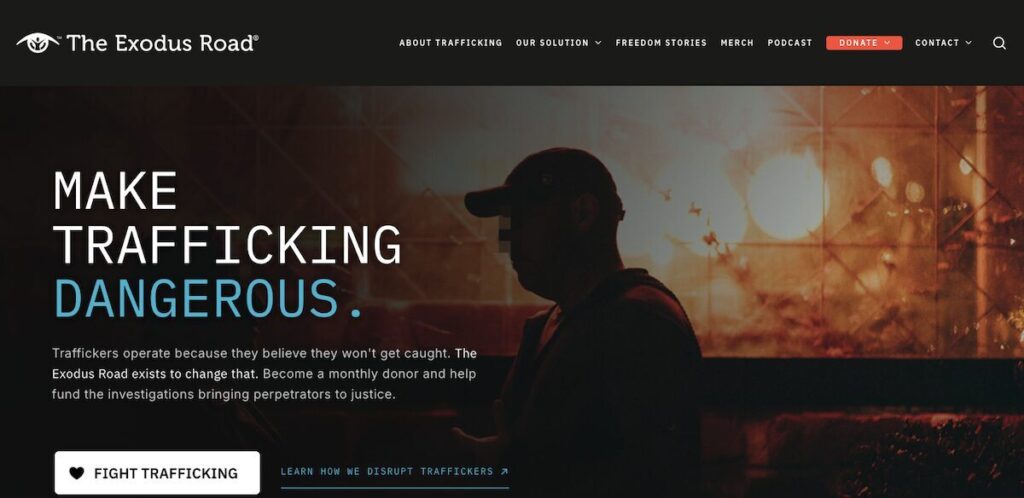
As of October 2026, The Exodus Road’s website reports more than 6,400 children, women, and men freed, more than 2,100 traffickers and perpetrators arrested, more than 3,200 survivors supported with aftercare, and more than 68,000 officers and citizens trained.
For nonprofit leaders, the lesson is the split itself. Narrative and numbers do different jobs, and donors need both to trust either one.
Long-form storytelling still has an audience
Long-form formats give sensitive stories room to breathe. The Exodus Road partnered on Stolen Lives, a documentary on human trafficking in the United States, covering commercial sex trafficking, labor trafficking, and online exploitation. The organization served as subject-matter experts and helped bring other voices into the film.
Goff also hosts Until All Are Free, the organization’s podcast, which launched in April 2020 and returned this year after a hiatus. He aims for roughly an even split between investigative, immersive storytelling and interviews with people working on human rights more broadly. His view is that audiences living in short-form video still want long-form depth.
Where small nonprofit communications teams find their best ideas
The best story ideas often come from people who do not work in communications. Goff’s advice to one-person and small comms teams is to protect regular time for creative conversation with staff who are close to the mission but think nothing like a marketer.
Those people often represent the audience you are trying to reach: donors, volunteers, and advocates. A frontline worker describing the moment a survivor reminded them why they do the work will frequently say it better than a polished statement from the comms team.
Limited headcount is real. But Goff’s point is that the raw material for strong storytelling is usually already inside the organization.
Why this matters beyond the communications team
Donor trust is built the same way in storytelling and in finance: clear policies, consistent reporting, and proof over time. The Exodus Road earns trust by explaining what it will not share and backing that with tracked numbers.
The same expectation applies to how a nonprofit manages spending. Boards and major donors want to see controls, documentation, and clean reporting, not just good intentions. Charity Charge gives nonprofit finance teams cards, approval workflows, and receipt capture built for that kind of accountability.
Three Takeaways
- Write it down. Consent and imagery policies protect survivors and staff better than case-by-case judgment, and they give your team something to point to when outside partners push for more access.
- Treat limits as “not yet.” Telling the right part of a story now and the fuller version later builds more trust than oversharing once.
- Separate stories from metrics. Track the inputs you control, like cases submitted or people trained, alongside outcomes, and report both consistently.
Podcast Transcript Q&A
Grayson Harris: Let’s start with the baseline. What is the mission of The Exodus Road, and what impact is your team making every day?
Preston Goff: We’re a global anti-trafficking nonprofit, about 15 years old, operating through regional hubs around the world. We do three primary things. We work on prevention of exploitation and human trafficking. We’re involved in intervention, which means walking alongside law enforcement to support investigations that bring freedom for trafficked people and justice for perpetrators. And we’re deeply involved in aftercare. I’ve been part of this work for about seven years. I came to it as a creative and a storyteller, and I’ve fallen in love with the mission. It’s been transformative for me.
Grayson Harris: Have you been in this role the whole seven years, or has your position changed?
Preston Goff: I came from a career in church ministry, telling global stories within and alongside the church. I was confronted with the issue of human trafficking, and I’d followed The Exodus Road since its early days. I said if an opportunity ever came to lend my skills, with a camera in hand, graphic design, web design, all the things you’d expect from a marketing professional, I’d want to do it. I started as creative director, grew more involved with our global teams, and worked to grow my voice as a leader. Today I run global communications.
Grayson Harris: There’s a delicate balance in ethical storytelling, especially when working with survivors. How do you handle that when communicating a story to donors?
Preston Goff: Human trafficking stories are some of the most challenging from a creative standpoint. I’d done sensitive interviews before, but in this space there’s a heightened concern for trauma and secondary trauma. What does a trauma-informed interview look like? How do you tell a story that’s truthful but not salacious, not exploitative, and won’t cause secondary trauma? We have to protect the survivors we serve and the advocates, investigators, and professionals in this field. As a result, we’ve built policies and practices I’m proud of. We have fully executed written policies on what imagery we will or won’t share and how we seek consent. For instance, we never seek consent from a minor involved in one of our cases, even if it’s the most redemptive, beautiful story. We want to give that young person the chance to process their journey and step into healing first, and we want them to be an adult when they make that decision.
Preston Goff: It’s also been a gift to step boldly into that and educate our community about why we don’t share every case detail. You should actually value that in the nonprofit you support, because you understand why we make that decision. There are unique challenges, and unique opportunities too.
Grayson Harris: You started as the person behind the camera. How has that on-the-ground experience helped as you’ve developed these policies across a larger team?
Preston Goff: On-the-ground experience is everything. As someone who leads creatives and communications professionals, I prioritize giving them time with our global teams and everyday connection to the people doing the work and the survivors we serve. Thankfully that’s possible virtually now. But I’ve learned lessons in the field I never would have learned otherwise. In the last year I was in Thailand filming a story with a young survivor, working with an outside film crew documenting it for news coverage. Because I’d spent time at Freedom Home, an aftercare home we run, I knew certain limits had to be set before the crew arrived.
Preston Goff: I told them, I know you want to bring a whole crew, but I won’t allow a camera inside the home where these girls live. We’ll provide the footage you need, and you can do your interview outside, because a film crew inside creates a whole new dynamic. It’s not easy. You have to navigate it relationally with media. But it’s the right way to do it. When I started this work, I might have just looked for the best shot. Now I look for the most protective way to tell the story.
Grayson Harris: You mentioned you can’t share every detail of a case. How do you build trust with donors when those limits are in place?
Preston Goff: You want to give as many details as possible to prove you’re doing the work. That’s easier when the service is visible, like disaster response or clean water. But we’ve found ways to work within our boundaries and still give donors clear glimpses that what we say is happening is happening. We might tell the story of a survivor’s intervention, her escape from trafficking through our teams and our partnership with law enforcement, without sharing a photo. Then after one or two years in our care, she’s an adult. She’s been through trauma healing, counseling, job skills training, maybe education. She’s in a different place, and we may seek her consent to tell the story. Then we can go back to donors and say, remember that intervention story without a photo? Here is that young woman now.
Preston Goff: We may still blur identity or change a name, but we open the door a little wider and let donors hear from her directly. As you grow in your voice, sometimes it’s not a never, it’s a not-yet decision. That’s what allows you to prove and build trust with your base.
Grayson Harris: How do you stay organized across multi-year stories like that?
Preston Goff: Honestly, it’s less administrative and more relational. I’m thinking of a specific young woman, Valentina, who gave us permission to use her name and produced her story with us. We knew to follow up because we’d been in conversation with her for two years. We celebrated when she was repatriated home. A member of our team sent her flowers. A few months later we got on a call just to hear her story and take notes. I met her on one trip, and on another we filmed with her. It wasn’t about a project management tool. It was about the relationship and checking in to see if it was the right time.
Preston Goff: In her case, she actually came to us sooner than we were comfortable with. We said, we think you should wait a little longer. Do you trust us? We’ve done this a lot, and we want you protected and safe and far enough into healing. We want to give you agency in this decision without any pressure from us. So let’s wait a little longer.
Grayson Harris: It sounds like an organic process because of the natural touch points with everyone involved.
Preston Goff: Certainly. Every month, part of our conversation with country directors and aftercare workers is, what stories are giving you hope right now? Hearing that from the front lines surfaces what we as storytellers should carry forward.
Grayson Harris: Donors often ask for metrics, the impact by the numbers. How do you arrive at the numbers you share?
Preston Goff: Those are highly tracked. That side is administrative: KPIs, post-intervention reporting forms, aftercare forms, all synthesized into a database with the KPIs that best represent our work. We report how many individuals were freed from trafficking and exploitation as a result of our team’s efforts. We also report how many cases we submitted to law enforcement, because that’s what we can control most. Sometimes cases don’t move forward, or a suspected victim is moved before law enforcement can act, and that work has to be redone. On our homepage you’ll see arrests resulting from our work, how many people we’ve trained worldwide, and how many survivors are receiving aftercare.
Grayson Harris: That’s over 68,000 officers and citizens trained and over 6,400 children, women, and men freed, just to name a couple. You were also part of a new documentary this year, Stolen Lives. What’s the story behind it?
Preston Goff: Stolen Lives came from a relationship with someone who first came to us as a supporter. He’s a director and producer who has worked with several major networks, and he saw an opportunity to tell the story of what human trafficking looks like specifically in the US. He pitched it, it got picked up, and he came back and asked what we wanted to say. He and I worked closely to plan the beats of the documentary. The Exodus Road was one of the chief storylines, and we played host to other voices to show what commercial sex trafficking, labor trafficking, and online exploitation look like in the US right now. We were proud to be part of it.
Grayson Harris: You also host a podcast. How does it fit into your storytelling?
Preston Goff: We’ve learned there’s a real appetite for long-form storytelling, even in a time when everything is short-form video. We started Until All Are Free in April 2020, when I was creative director, and ran it for about 25 to 27 episodes. I took a hiatus to focus on other priorities and brought it back this year. We aim for a 50-50 split between investigative, immersive storytelling and compelling interviews. It’s not just Exodus Road voices. It’s anyone working for human rights. This morning an episode came out with someone involved in mental health care during crisis response. It’s not about trafficking directly, but it’s in the midst of crises that people become vulnerable to trafficking. It’s been creatively satisfying, and I’m grateful The Exodus Road makes space for it.
Grayson Harris: Where can our audience find it?
Preston Goff: Until All Are Free is anywhere podcasts are. It’s also video-based, so Spotify and YouTube are your place for that. The main web address is uaafpod.com.
Grayson Harris: For a nonprofit communications team, or an executive director wearing many hats, what lesson would you share for building a communications strategy with donors?
Preston Goff: Sometimes the best ideas come from the most unexpected places. You may be a small creative team or a single person running all communications. Find and protect space for creative conversation with people who don’t think like you but are close to the work and the mission. Often those people represent the exact audience you need to attract to raise funds, gain volunteers, and grow your community. Some of our best ideas have come from sitting with someone who doesn’t think in communications lanes but knows what tugs at their heartstrings and keeps them in the work. Resources may be slim, and more staff does make a difference. But don’t be afraid to involve the people around you.
Grayson Harris: And you apply that yourself, by sitting down with your case teams.
Preston Goff: Absolutely. Sometimes the most moving thing isn’t a nicely wordsmithed statement from a comms team. It’s the rawness of someone who wakes up every day wondering if they’re making a difference, then meets a survivor who shows them what hope looks like. The way they put that into words is perfect on its own.
Grayson Harris: How can our audience get involved with The Exodus Road?
Preston Goff: Visit theexodusroad.com. We’re The Exodus Road on all major social platforms. The biggest thing we’re looking for partnership in is educating everyday people about human trafficking. We have a wealth of stories and well-researched educational articles on our site. We also have Influenced, a digital exploitation prevention program for young people, with formats for teens and for the adults teens turn to. You can find it at influenced.org. It’s trauma-informed and survivor-informed. If you have kids in your life and don’t know how to navigate the digital space, it’s a great resource.
Grayson Harris: Thank you, Preston. For our audience, find The Exodus Road on all their platforms, and if you’re a parent, check out the resources at influenced.org.
Preston Goff: Thanks so much for having us.
FAQs for this episode
Ethical storytelling is sharing real stories truthfully without exploiting, sensationalizing, or retraumatizing the people involved. It typically includes informed consent, protective imagery choices, and respect for a person’s right to decide when and how their story is told.
Trauma-informed storytelling means designing interviews, imagery, and editing decisions to avoid causing new harm to survivors. It considers the risk of secondary trauma, gives the storyteller control over what is shared, and avoids salacious detail used only for emotional impact.
Only with informed consent and a clear policy. Many anti-trafficking organizations, including The Exodus Road, never seek consent from minors involved in cases. Blurring faces, changing names, and waiting until a person is further along in recovery are common protective practices.
Explain why certain details are withheld, then back stories with consistent, verifiable metrics. Returning to a story later, once the person consents to share more, shows donors the long-term results of their support without compromising anyone’s safety.
Useful metrics include people freed, traffickers arrested, survivors receiving aftercare, people trained, and cases submitted to law enforcement. Reporting inputs the organization controls, like cases submitted, alongside outcomes gives donors a more accurate picture of the work.
Talk regularly with frontline staff. Program and field workers often see the most meaningful moments and describe them in raw, compelling language. Setting a recurring check-in, such as asking monthly which stories are giving staff hope, creates a steady pipeline.