Nonprofit accounts receivable is the money a nonprofit has earned or been promised but has not yet collected, and it deserves the same attention as fundraising. Money raised is not money in the bank until it is collected. That is the core lesson from Janeen Uzzell, CEO of the National Society of Black Engineers (NSBE), on the Charity Charge Show, where host Stephen Garten talks with nonprofit leaders about the financial operations that keep a mission funded.
Quick Summary
- NSBE named Janeen Uzzell its first CEO in July 2021, a newly created role, after she served as COO of the Wikimedia Foundation and spent nearly two decades at GE.
- One of her first priorities was collections: she treated unpaid sponsor commitments as a business risk, not an awkward conversation to avoid.
- NSBE brought in a dedicated collections specialist so account managers could focus on renewals, and the CEO personally worked the overdue list.
- Most overdue sponsors were not refusing to pay. Post-pandemic turnover meant new contacts did not know the commitment existed.
- Collections is now reviewed weekly next to fund development, with a standard accounts receivable process.
Why accounts receivable deserves the same attention as fundraising
Pledged and invoiced revenue only funds programs once it is collected. A nonprofit that tracks dollars raised but not dollars received can report a strong year while running short on cash.
Uzzell put it plainly to her team. “It’s not just money raised,” she said. Revenue that is booked but never collected “could be detrimental to us.”
For finance leaders, this is the gap between the development report and the bank statement. Sponsorships, event commitments, and corporate partnership invoices sit in receivables. If no one owns follow-up, those balances age quietly until they become write-offs.
What NSBE did to recover unpaid sponsorships
NSBE recovered overdue sponsor balances by assigning ownership, separating collections from relationship management, and communicating directly. Uzzell described a five-part approach:
- Trust and partner with the CFO. Uzzell worked side by side with Stanton Hill, NSBE’s Chief Financial and Operating Officer, who has been with the organization since 2015. Hard decisions on spending, saving, and who owed money were made together.
- Reset the team’s mindset. “If we don’t think that we’re worth it, we can’t expect other people to,” Uzzell said. Asking for payment owed is part of stewarding the mission.
- Hire a dedicated collections specialist. NSBE brought on a third-party consultant whose full job was follow-up calls. Account managers were no longer asked to chase invoices while negotiating renewals with the same contacts.
- Put the CEO on the list. Uzzell reviewed the overdue list herself and reached out where she had relationships.
- Make an honest, specific ask. NSBE explained the work completed together, the impact unpaid balances had on the organization, and options like payment plans.
The separation in step three matters. Asking the same person to deepen a relationship and press for payment creates tension that usually ends with neither getting done well.
Why most overdue sponsor invoices are not refusals
Most overdue sponsor invoices stem from turnover and lost context, not unwillingness to pay. Uzzell said NSBE did not reach a single sponsor that intentionally refused its bill.
After the pandemic, many partner contacts had left their companies. Their replacements did not recognize the commitment or the organization. The fix was not pressure. It was re-establishing who NSBE is, what the two organizations did together, and what the invoice covered.
This is a practical point for any nonprofit with corporate partners. When a sponsor contact changes, the receivable is at risk. A short handoff note to the new contact, with the agreement and invoice attached, can prevent months of aging.
What running a nonprofit like a business actually means
Running a nonprofit like a business means stewarding funds with the discipline a public company owes its shareholders: knowing how money comes in, how it goes out, and accounting for it with integrity. Uzzell said she did not arrive with a nonprofit mindset. She arrived knowing how to run a business.
She draws a direct parallel. In the corporate world, business development brings in revenue. In a nonprofit, fundraising does. Both require accurate accounting, controlled spending, and accountability for every dollar.
She also pushed back on what she called “tin cupping,” the habit of starting from zero each year. Her goal is a predictable run rate across NSBE’s revenue engines: the annual convention and career fair, corporate partnerships, and programs.
How NSBE is funding sustainability, not just programs
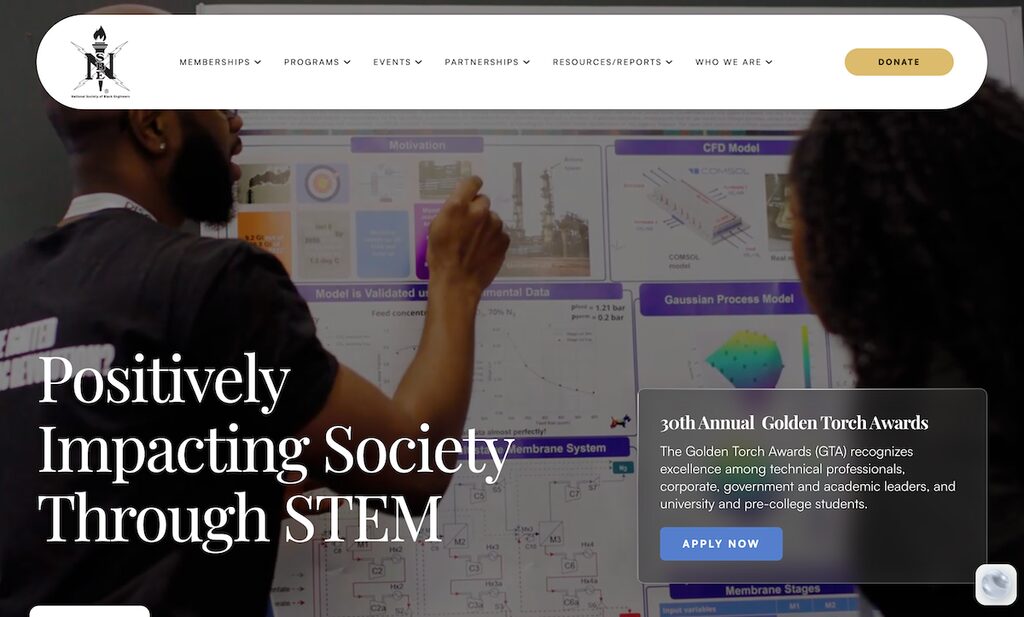
NSBE is shifting from funding individual program years to funding the systems that let programs last. The clearest example is the Summer Engineering Experience for Kids (NSBE SEEK), a free, three-week summer STEM camp for rising fourth through sixth graders.
At NSBE’s 2026 Annual Convention, Bechtel, a longtime NSBE partner, announced a $300,000 investment in the sustainability of NSBE SEEK. Uzzell said it was the first grant NSBE had received specifically to build the program’s long-term future rather than to fund a single summer of camp.
The plan is to package SEEK so community partners can run it. NSBE is building relationships with school superintendents, Boys and Girls Clubs, and local churches, with the goal of putting the model “in a box,” training partners, and letting them operate camps locally. NSBE hires hundreds of seasonal staff each summer to run SEEK today, which does not scale with a small headquarters team.
Uzzell also noted a shift in giving: individual gifts rose, named scholarships increased, and donors came forward to fund student scholarships directly. She credited part of that to transparency work, including a platinum-level transparency rating. [SOURCE NEEDED: confirm NSBE holds a Candid Platinum Seal of Transparency]
How a lean team runs a large membership organization
A lean staff can serve a large membership when policies, processes, and governance are clear. NSBE operates with about 40 headquarters staff, according to Uzzell, supporting more than 25,000 members and more than 700 chapters in the U.S. and abroad, per NSBE.
NSBE is also unusual in governance. It has remained student-led for 51 years, with matriculating students on its national board making decisions alongside advisors and the professional staff. Uzzell said turning 50 convinced her the student model still works.
Her turnaround priority was internal as well as external. She put policies and processes in place so NSBE’s own staff “had the same experience that they work every day to give to our members.”
Where AI fits for engineers and mission-driven teams
Uzzell’s view is that AI will advance faster and better with engineers in the room, because engineers add the human judgment AI lacks. Her shorthand: “AI has no soul.”
She uses AI tools daily and is not skeptical of them. Her concern is the training data. If the content feeding these systems does not reflect the full population, bias spreads at scale. She saw a similar problem at Wikipedia, where coverage reflected a limited set of contributors.
Her advice to new graduates was practical: define what “AI ready” means for your own field. NSBE plans to announce a partnership that will give members self-selected AI skills training. [Partner and timing not disclosed on air]
What 51 years teach about durable organizations
Durable nonprofits hold their mission steady and adjust their operating model. NSBE has kept its name and mission, which is to increase the number of culturally responsible Black engineers who excel academically, succeed professionally, and positively impact the community, while opening membership to anyone who wants to join.
Uzzell said NSBE has kept impactful corporate sponsors and lost some as corporate priorities shifted, and she believes those sponsors will return. Internally, the team adopted a simple rallying idea: “We all we got.” The answer was to lean on alumni, individual donors, and existing partners, and to stay ready for larger opportunities.
She frames positioning as preparation. An organization that is financially clean, transparent, and well run is the one that lands on the radar of funders looking to do good.
Three Takeaways
- Collected revenue is the only revenue that funds programs. Review receivables on the same weekly cadence as fundraising, not once a quarter.
- Separate collections from relationship management. A dedicated person or partner for follow-up protects renewals and gets invoices paid.
- Turnover is the hidden collections risk. When a sponsor contact leaves, send the new contact the agreement, the invoice, and a one-paragraph summary of the partnership.
Podcast Transcript Q&A
Stephen Garten: Welcome to the Charity Charge Show. Today I’m joined by Janeen Uzzell, CEO of NSBE, the National Society of Black Engineers. Our platform supports more than 3,000 nonprofits, and I believe nonprofit leaders sharing what they’ve learned lifts the whole sector. Let’s start with NSBE: the mission, some history, and why you’re passionate about leading it.
Janeen Uzzell: If there’s one thing I can talk about, it’s NSBE. I’m a lifetime member. I joined in college at North Carolina A&T State University, and I’m a product of this organization. The conversations started around 1971 at Purdue, when two students, Edward Barnette and Fred Cooper, went to the dean of engineering and said Black engineering students needed a community. In the 1970s you could walk Purdue’s campus and barely see another Black student, and engineering is a hard curriculum. They wanted to help those students graduate and get jobs.
In 1974, six students from Chicago’s South Side, now known as the Chicago Six, formed the first chapter of what was then the Society of Black Engineers: Edward Coleman, Anthony Harris, Brian Harris, Stanley Kirtley, John Logan, and George Smith. Stanley Kirtley and John Logan have passed; four founders are still living. They wrote to all 288 accredited engineering schools at the time, and in April 1975 they held the first meeting of the National Society of Black Engineers at Purdue.
Our mission has always been to increase the number of culturally responsible Black engineers who excel academically, succeed professionally, and positively impact the community. We’re 51 years old now, with pre-collegiate, collegiate, and professional members and chapters across the U.S. and internationally. And anyone who wants to be a member can join. We were formed to serve Black engineering students, but our membership looks very different depending on where you go to school and where you find your community.
Stephen Garten: As I understand it, you’re NSBE’s first CEO. Is that right?
Janeen Uzzell: That’s correct. NSBE had executive directors before. I came in 2021, five years ago now, as the first CEO, and the board was very intentional about that.
Stephen Garten: I’ve seen a lot of successful nonprofits recruit leaders who built careers in the for-profit world. You were COO at the Wikimedia Foundation. Why did the board create the CEO role, and what did you bring from the corporate side?
Janeen Uzzell: For anyone thinking about nonprofit sustainability: NSBE is in its 51st year and remains student-led. Our board and leadership are matriculating students. We teach engineering students leadership beyond technology, from planning our convention to deciding how we serve members.
Alongside its advisors, the board decided in 2021 to move from an executive director model. That came out of the pandemic and a lot happening in the country. I wasn’t there for the decision, but I understand the goal was to guide NSBE into its 50th year and beyond with a business leader who could change how NSBE runs operationally and financially. They looked at my nearly 20 years at GE, my operational background, my capacity to lead a large organization, and the network I could bring.
I won’t claim to be the academic force on our executive team. Dr. Tiffini Andorful, our chief programs and membership officer, is an academic by training and represents us well in that space. Our chief financial and operating officer, Stanton Hill, has deep nonprofit experience and has been with NSBE for about 10 years. He has been a bright light in guiding me through the business of nonprofits.
Stephen Garten: Many nonprofit leaders tell me nonprofit status is just a tax designation, and they run with the same fiscal responsibility as a for-profit business. What’s been different coming from corporate, and what’s been similar?
Janeen Uzzell: I agree with that. When I joined, I said: I know what a nonprofit is, but what I know how to do is run a business. That means being strong stewards, the way you would for shareholders: managing expenses and operating costs, how you raise money, how you spend it, and how you account for it with integrity. I see a strong parallel.
So I didn’t approach this with a nonprofit mindset. I said, let’s run the business. One thing I wanted to dispel was tin cupping. I know we reset each year, but I wanted our arms around what a continuous run rate of funding could look like across our engines: convention and career fair, corporate partnerships, and programming. And we took a strong, dare I say aggressive, stance on collections. It was one of the first things I looked at: not just how we brought money in, but how we collected it and held people accountable for it.
Stephen Garten: Let’s dig into that. Many nonprofit leaders have been conditioned not to ask for what they deserve, and you don’t get what you don’t ask for. Collections can feel like walking on eggshells with sponsors and donors. How did you approach it in a way that kept the partnerships healthy?
Janeen Uzzell: First, if you’re going to trust your CFO, then trust your CFO. Stanton and I have worked shoulder to shoulder for five years, and NSBE is on solid footing. Getting there meant hard decisions about saving, spending, who owed us money, and how we would build a collections process. Collecting money is hard even in the private sector. It takes a certain personality and knack.
But I had to reset our mindset: if we don’t think we’re worth it, we can’t expect other people to. We’re doing good work. We’re serving the future workforce in a critical field, technology. No one else will believe that if we don’t.
We also brought on a third-party consultant whose full job was follow-up calls. They had a background in it and could be a little grittier. It was hard for our account managers to work renewals while collecting from the same partners, so we gave them room to do that.
And I got my hands dirty. For the first few years I was an all-in CEO: let me see the list, let’s go through it, let me reach out to people I know. Our message was: we held these events, you participated, and it’s possible people have changed roles. This was post-pandemic. I don’t think there was a single sponsor we called who intentionally didn’t want to pay. People had left companies. New people in those roles said, “I don’t know what this is or who you are.”
So we explained who we are, the work we did together, and the impact that debt has on an organization like NSBE. It could cut us at the knees and keep us from serving the mission. It was an empathetic plea. We offered payment plans and got creative. We were honest about where we were financially.
It wasn’t easy, and we still have collections issues. But we now have a standard accounts receivable process, with clear expectations on days outstanding. Collections is part of our weekly rigor, just like fund development and incoming revenue. As I told the team, it’s not just money raised. Money raised could be detrimental to us if we don’t actually collect it.
Stephen Garten: Now that you have the resources, tell us about the programs. Bechtel committed support to NSBE SEEK. How does the mission look day to day?
Janeen Uzzell: NSBE has three key levels: pre-collegiate, which is NSBE Jr. for K through 12; collegiate; and professionals. We also have international and lifetime members. We’ve had record membership and chapters in the U.S., Africa, the Caribbean, and Canada. We run events all year: our National Leadership Institute, regional conferences, our national convention, and chapter and zone events.
SEEK, our Summer Engineering Experience for Kids, is for rising fourth, fifth, and sixth graders, so you need to have completed third-grade math. It’s a three-week program funded by partners and individuals. Some donors ask what it costs per student and sponsor a camper. Campers get breakfast and lunch and spend the day coding, working with AI, and flying drones, with projects that change with the curriculum each year. Many of our paid teachers and mentors are NSBE alumni, graduate students, and teachers.
Bechtel has partnered with NSBE in many ways since our founding. This grant was special: it was the first we’ve received to build SEEK’s sustainability, not to fund camp itself. Dr. Andorful and her team are building out what the future of SEEK looks like. A primary focus is community relationships with superintendents, Boys and Girls Clubs, and local churches. We hire hundreds of people every summer to run camp, and as a small team we can’t scale that alone. The goal is to put it in a box, teach partners to run it, and reach as many young people as possible to keep the STEM pipeline fluid.
Stephen Garten: They say nail it before you scale it. Looking ahead 10 years, how will the engineer’s role shift with AI, and how is NSBE adapting?
Janeen Uzzell: It’s changing every day. I’ve been writing about it on LinkedIn. As a mechanical engineer with a background in human-centered design, this matters to me. Engineers will be part of the solution. AI will only advance and get better when engineers are in the room, adding humanity to its reasoning. My platform is: AI has no soul. It can help us think faster, generate strategy and content, and troubleshoot how technology is built and used. It cannot add the voice and heartbeat of humanity.
My view is engineers and AI will work side by side, and one won’t outpace the other. We are seeing challenges in early hiring: companies are hiring fewer new graduates in software engineering and other areas. A year from now, we could be having a very different conversation.
No one has defined what it means to be AI ready. So I told our graduates at commencement: you get to define it for your field, beyond general tools. As an organization, we’re building a partnership we’ll announce soon that brings AI training to members so they can build their own portfolio of AI skills.
Stephen Garten: I was 14 during Y2K, and some of today’s fear feels similar. But I’m seeing the benefits firsthand. What we’ve done at Charity Charge with AI is incredible, and we’ve moved well beyond a simple chatbot into agents and our own infrastructure.
Janeen Uzzell: I use it every day too, across many tools. The challenge is when humanity is missed and the content going into these tools isn’t an accurate reflection of the world. That floods technology with bias that harms certain people. I felt the same at Wikipedia, where stories reflected a limited group of contributors. That’s why I’m committed to getting our community trained. The more we use these tools, the more they will understand people who weren’t part of the core content.
Stephen Garten: NSBE has grown from Purdue to hundreds of chapters, and your 2026 convention in Baltimore drew more than 13,000 participants. What did the 50th anniversary teach you? And your founders have said today feels a lot like 1975. How do you bring that full circle?
Janeen Uzzell: Turning 50 encouraged me that the student model still works. I had wondered if young people today were different enough that it wouldn’t. Seeing what we accomplished encouraged me about our governance. And it energized me for the next 50 years, because I learned that with focus and a business mindset, you can change the entire shape of an organization in a short period. Four years. My position was: we’re not turning 50 like this.
We repositioned and rebranded our thought leadership so our voice was the key voice in tech for our community. We put our arms around our brand, our finances, and our staff at World Headquarters. We’re a small team of about 40, and we put policies and processes in place so the people running NSBE had the same experience they work to give our members.
When founder Tony Harris said today feels like 1975, he meant they faced the same challenges then. A different movement, the same challenges. We’re larger now. We have more sponsors and more alumni who can give back. We can do now what they did then, and do it better. Internally we started saying, “We all we got.” Individual giving went up. Named scholarships went up. People brought funding directly for student scholarships. Donors saw we had earned platinum transparency status. We were preparing without knowing what we were preparing for. Position your organization well, whatever its size, so you’re on the radar of those who want to help. I still believe the big phone call is coming, and I want to be ready.
Stephen Garten: My view is you’re getting to that big call naturally by compounding the right things day in and day out.
Janeen Uzzell: Thank you. In the toughest of times, NSBE chose to hold on to its mission. We remain the National Society of Black Engineers. Our board, staff, and executive leadership decided bravery would be our strategy, and we would continue serving anyone who chose to be part of our community. We’ve kept impactful corporate sponsors and lost some, but none left because they wanted to, and we believe they’ll come back. We’ll meet people where they are, adjust our models, and stay true to our mission. To learn more or get involved, visit nsbe.org.
Stephen Garten: For listeners with family or friends at companies, the corporate partnership model you’ve built is powerful, and the SEEK work with Bechtel is a great example. Thank you for being open about the challenges you worked through.
Janeen Uzzell: Thank you for having me. I hope this was helpful and encouraging to others doing this work. We’re in this together, so don’t feel like you have to go it alone. Connect with me on LinkedIn or through our website.
FAQs From This Episode
Nonprofits collect unpaid sponsorships by assigning clear ownership, contacting sponsors with context, and offering payment plans. NSBE used a dedicated collections specialist, had its CEO contact sponsors directly, and explained what the partnership delivered and how unpaid balances affected the mission.
A nonprofit with significant sponsor or event receivables should consider a dedicated collections resource. NSBE hired a third-party consultant for follow-up calls so account managers could focus on renewals without pressing the same contacts for overdue payments.
A good nonprofit accounts receivable process sets standard payment terms, tracks days outstanding, and reviews aging balances on a regular schedule. NSBE reviews collections weekly alongside fund development, so booked revenue and collected revenue are managed together.
Corporate sponsors most often miss payments because of staff turnover, not refusal. NSBE CEO Janeen Uzzell said new sponsor contacts often did not recognize the commitment. Re-introducing the partnership, the agreement, and the invoice usually resolves it.
Janeen Uzzell is the CEO of the National Society of Black Engineers (NSBE). She became NSBE’s first CEO in July 2021, after serving as COO of the Wikimedia Foundation and spending nearly two decades at GE.
NSBE SEEK, the Summer Engineering Experience for Kids, is a free, three-week summer STEM program for rising fourth through sixth graders. Campers work on hands-on engineering projects such as coding and drones, guided by mentors who are often NSBE members and alumni.