A donor-advised fund (DAF) is a charitable giving account that allows donors to make a tax-deductible contribution, invest those assets for potential growth, and recommend grants to eligible nonprofits over time. For nonprofit finance leaders, DAFs represent one of the most significant and fastest-growing sources of charitable revenue available today.
Quick Summary
- A DAF is a giving account held by a sponsoring organization (like Fidelity Charitable or a community foundation). Donors contribute assets, get an immediate tax deduction, and direct grants to nonprofits on their own schedule.
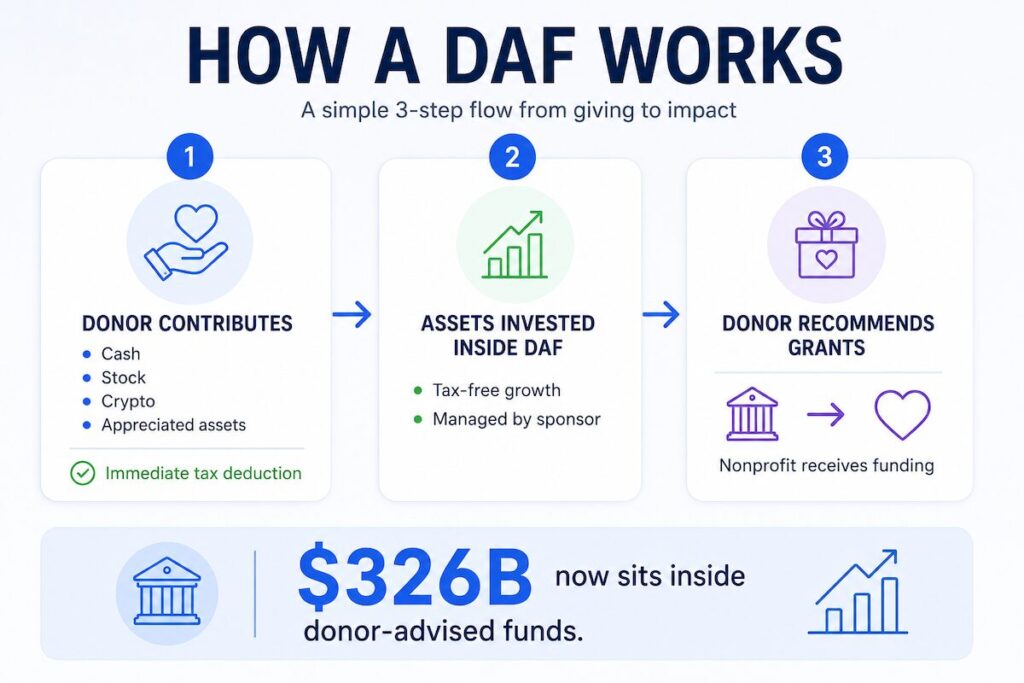
- DAF assets reached $326 billion in fiscal year 2024, with $65 billion granted to nonprofits, a 19% increase over the prior year.
- DAF grants are typically unrestricted general operating support, which makes them especially valuable for nonprofit operations and cash flow.
- Nonprofits cannot solicit grants directly from a DAF. The donor makes the recommendation; the sponsoring organization issues the check.
- Understanding how DAFs work helps your organization accept them correctly, steward DAF donors effectively, and plan for DAF-related cash flow.
How a donor-advised fund works
A donor-advised fund works in three stages: contribution, investment, and grant recommendation. First, the donor transfers cash, stock, or other assets into a DAF account held by a sponsoring 501(c)(3) organization. The donor receives a tax deduction in the year of the contribution, not the year a grant is made. The assets are then invested and can grow tax-free. When the donor is ready to support a cause, they recommend a grant to any IRS-qualified public charity.
The sponsoring organization handles all administrative functions, including vetting charities, processing grants, and issuing checks. The donor retains advisory privileges, meaning they can recommend where funds go, but the sponsoring organization retains legal control of the assets.
Common DAF sponsors include national charitable organizations like Fidelity Charitable, Schwab Charitable, and National Philanthropic Trust, as well as community foundations and single-issue charities. As of fiscal year 2024, there were 3.56 million DAF accounts across 1,485 sponsors in the United States.
Why DAFs matter to your nonprofit
DAF giving has become a major funding channel for nonprofits, not a niche one. In fiscal year 2024, donors recommended $64.89 billion in grants from DAFs, a 19% increase over the previous year. Total DAF assets nearly doubled between 2020 and 2024, reaching $326 billion.
For nonprofits, the practical implications are significant. DAF grants are predominantly unrestricted: general operating grants make up 59% of all DAF grants, according to the National Study on Donor Advised Funds. That ratio matters because unrestricted dollars are the hardest to fundraise and the most flexible for operations, payroll, and overhead.
DAF donors also tend to give more over time. Research from the Donor-Advised Fund Research Collaborative shows that DAF donors demonstrate higher retention rates and larger lifetime giving compared to donors who give through other channels. A donor who has placed assets into a DAF has already committed those dollars to charity. The question is which organizations receive them.
DAF vs. private foundation: what’s the difference
A DAF and a private foundation are both tools for structured, tax-advantaged charitable giving, but they operate very differently and have different implications for nonprofits that receive grants from each.
| Feature | Donor-Advised Fund (DAF) | Private Foundation |
|---|---|---|
| Legal structure | Account inside a sponsoring 501(c)(3) | Independent 501(c)(3) entity |
| Setup complexity | Low — open online in minutes | High — requires legal incorporation and IRS approval |
| Minimum distribution | None required | 5% of assets annually |
| Tax deduction (cash) | Up to 60% of AGI | Up to 30% of AGI |
| Tax deduction (appreciated assets) | Up to 30% of AGI | Up to 20% of AGI |
| Payout rate (FY 2024) | 25.3% | ~8.1% |
| Administrative overhead | Minimal — sponsor handles it | Significant — staff, filings, compliance |
| Grant anonymity | Possible | Rare |
From a nonprofit’s perspective, grants from private foundations typically come with more formal application requirements and may carry restrictions. DAF grants are often simpler to receive but may arrive without prior notification, since the donor, not the foundation, initiates the recommendation.
How nonprofits receive DAF grants
Your organization does not apply for DAF grants the same way you apply for foundation grants. The donor initiates the grant recommendation through their DAF sponsor’s portal. Once the sponsor approves the recommendation and vets your organization’s IRS status, a check or ACH payment is sent directly to your nonprofit.
To receive DAF grants, your organization must be recognized by the IRS as a 501(c)(3) public charity. Most DAF sponsors use databases like Candid (formerly GuideStar) to verify eligibility. Keeping your IRS determination letter, EIN, and GuideStar profile current is the most practical operational step your finance team can take to ensure DAF grants arrive without delays.
Grant amounts vary widely. The most common grant range from active DAF accounts is $10,000 to $50,000 annually, with 36% of active accounts in that range. Grantmaking is also distributed fairly evenly throughout the year, with only 32% occurring in Q4. This is a meaningful difference from individual giving, where 57% of donations arrive in Q4.
What nonprofits should know about DAF donor stewardship
DAF grants may arrive without a donor name attached. Many sponsors process grants with the organization’s name listed as sender rather than the individual donor. This creates a stewardship challenge: your development team may not know who sent a $25,000 check, making it difficult to acknowledge the gift or cultivate the relationship.
That said, donor anonymity in DAFs is less common than often assumed. Research shows that the majority of DAF donors are identifiable, meaning the individual donor’s name does appear on grant notifications in many cases. Building a process to match incoming DAF grants to known donors in your CRM is worth the investment.
When a DAF donor is identifiable, they should be stewarded like any major donor. They have already set aside assets specifically for charitable giving. Your role is to demonstrate that your organization uses funds well, reports outcomes clearly, and is worthy of repeat recommendations. Strong financial management and transparent reporting are your most effective stewardship tools.
DAFs and your nonprofit’s financial operations
From a financial operations standpoint, DAF grants have a few characteristics worth building into your processes.
First, DAF grants are unrestricted in most cases, meaning they can be allocated to operating expenses, payroll, or general program costs. Document how your organization classifies incoming DAF grants in your fund accounting system. If a DAF grant does arrive with donor-specified restrictions, it must be tracked as a restricted contribution under FASB ASC 958 just like any other restricted gift.
Second, DAF grants arrive on the donor’s timeline, not yours. There is no mandatory payout schedule. A donor who contributed to a DAF in 2020 may recommend a grant to your organization in 2026. Planning for DAF revenue means recognizing it when the commitment is clear and legally binding, which typically means when you receive the check or ACH transfer, not when a donor tells you they intend to give.
Third, your nonprofit’s financial health signals matter to DAF donors. A clean Form 990, audited financials, and a low overhead ratio all serve as credibility markers for donors reviewing potential grant recipients. This is where strong expense management and accurate reporting pay dividends well beyond compliance.
Built for nonprofits that manage real money
Charity Charge gives nonprofit finance teams the corporate card, expense tracking, and accounting integrations they need to keep operations clean and audits simple. See how Charity Charge works for nonprofits
Frequently Asked Questions
A donor-advised fund is a charitable giving account that lets donors make a tax-deductible contribution, invest those assets, and recommend grants to nonprofits over time. The account is held by a sponsoring organization, not the donor directly. The donor gets the tax deduction upfront and directs grants when ready.
No. Donor-advised funds are set up by individual donors, families, or organizations through a sponsoring 501(c)(3) organization. Nonprofits receive grants from DAFs but do not establish or administer them. If your organization wants to offer a DAF program, you would need to become an IRS-qualified DAF sponsor, which requires significant compliance infrastructure.
No. DAF grants received by a 501(c)(3) nonprofit are treated the same as any other charitable contribution. They are not taxable income. If your organization generates unrelated business income (UBIT), that is a separate matter governed by IRS rules and is unrelated to how you receive DAF grants.
Processing time varies by DAF sponsor. Most sponsors complete grant transfers within 5 to 10 business days after the donor submits a recommendation. Community foundations may take longer. Your organization’s EIN and current IRS status must be verifiable in public databases like Candid for the grant to process without delays.
You can inform donors that you accept DAF grants and provide your EIN to make the process easy, but you cannot solicit grants from the DAF account itself. Only the account holder can initiate a grant recommendation. Messaging on your donation page and in donor communications that highlights DAF giving options is appropriate and encouraged.
As of fiscal year 2024, DAF accounts in the United States held $326 billion in charitable assets across 3.56 million accounts. Donors recommended $64.89 billion in grants that year, a 19% increase over the prior year. DAF assets have nearly doubled since fiscal year 2020, making DAFs one of the most significant funding channels in U.S. philanthropy.